Aigle
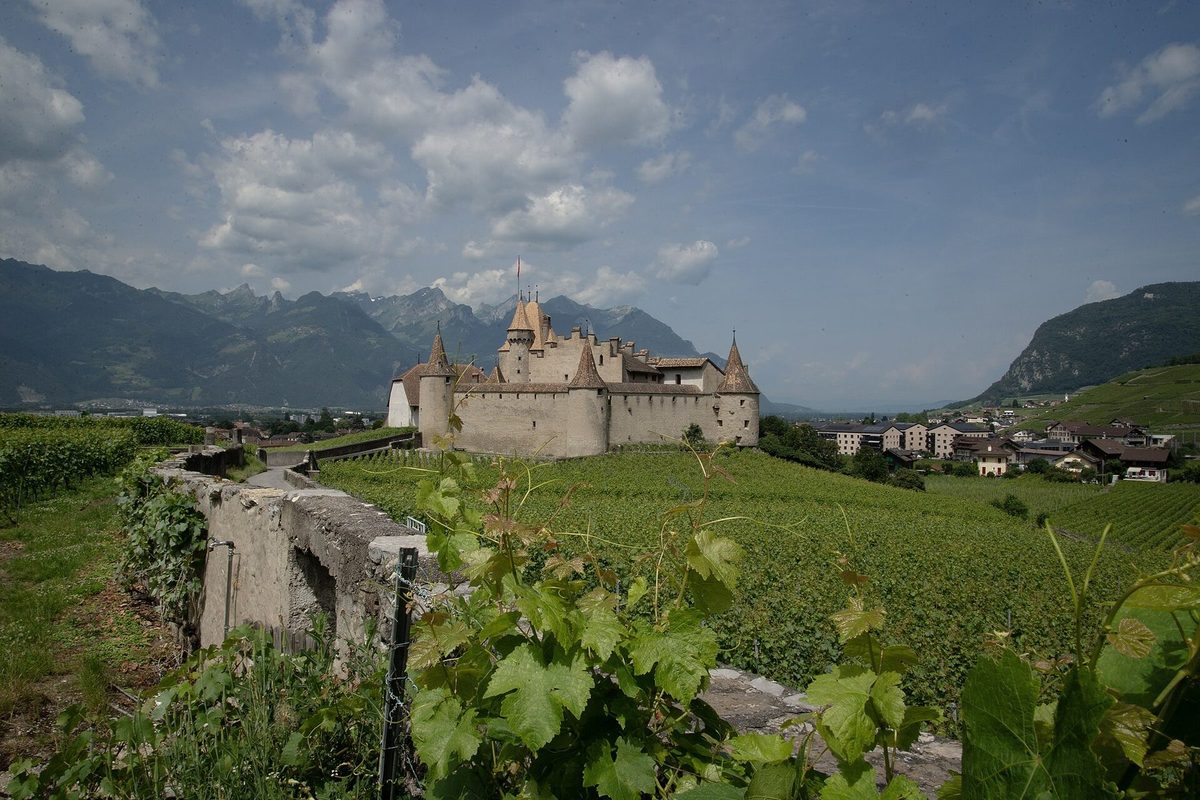
The first French-speaking territory conquered by Bern, in 1475, this Chablais market town turned its castle, once home to the Bernese governors, into the Museum of Vine and Wine.
Entry based on 19 sources · Our method · Reusable text (CC BY-SA)
Origin of the name Aigle
The place is mentioned around 1150-1154 as "Alium" and in 1153 as "de Aleo". The old German name is "Aelen". The name has nothing to do with the eagle (aigle). It reportedly comes from a Germanic personal name, Agil, Aigel or Eigel, which the Romance-speaking population would have adopted from the 5th century. It would thus have formed in the 6th-7th centuries, though this is not certain.[1]
Coat of arms of Aigle
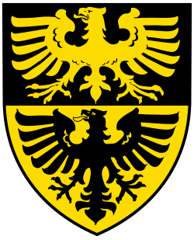
Per fess sable and Or, two eagles counterchanged. The shield is divided horizontally, black above and yellow below. A yellow eagle stands out on the black part, a black eagle on the yellow part. The arms reportedly go back to the 15th century, but the oldest known seal bearing them dates from the early 16th century. A link with the arms of the 13th-century vidames or with the eagle of Count Thomas of Savoy, in 1231, remains highly hypothetical.[8][9]
Founding of Aigle
The site has been inhabited since the Bronze Age. A Roman villa and early medieval burials have been found here. Aigle then grew around three cores: a 12th-century priory dependent on Saint-Maurice, a chapel of Saint-Pierre and the parish church of Saint-Jacques. The d'Aigle family held a fortified house here from the 11th or 12th century. Count Thomas I of Savoy raised the church district to the status of a bourg, after which the de Saillon family built a castle. The liberties granted to the bourg were modelled on those of Villeneuve.[1]
History of Aigle
Bronze Age. Bronze Age pottery.[1]
Roman period. Remains of a Roman villa.[1]
early Middle Ages. Burials.[1]
11th-12th century. The d'Aigle family builds a fortified house.[1]
around 1150-1154. First mention, in the form "Alium".[1]
12th century. A priory dependent on Saint-Maurice is attested.
1231. Count Thomas I of Savoy raises the church district to a bourg. The de Saillon family then builds a second castle.[1]
1314. A charter grants the bourg liberties modelled on those of Villeneuve.[1]
1475. Bern conquers Aigle, which becomes the seat of a Bernese government.
from 1489. Bern rebuilds the castle as its governor's residence.[1]
1526. Guillaume Farel settles in Aigle as schoolmaster.[1]
1528. Reformed worship prevails after a period of resistance.[1]
1554. Salt deposits are discovered, leading to the construction of a brine pipeline from Panex to Aigle.[1]
1764. The bourg has 1'431 inhabitants, 180 of them German-speaking.[1]
1850. The commune has 2'296 inhabitants.[1]
1901. Opening of the Aigle-Leysin railway.[1]
1907. Opening of the Aigle-Ollon-Monthey line.[1]
1976. The Museum of Vine and Wine opens in the castle.[1][3]
2000. The commune has 7'955 inhabitants.[1]
Population of Aigle
Sources and references: [1][5]
| 1764 | 1'431 |
| 1850 | 2'296 |
| 1900 | 3'897 |
| 1950 | 4'271 |
| 1960 | 4'381 |
| 2000 | 7'955 |
| 2025 | 12'081 |
Families of Aigle
d'Aigle. Ministeriales of the bishops of Sion, the d'Aigle appear around 1138/1150 with Guillaume. In 1179 Borcard, a vassal of Savoy, and Manfred, a witness for the bishop, each founded a branch. The first held the vidomnat of Aigle in the service of Savoy, and its last known member in the region was Hugonnet (1354). The other held the seneschalship of the bishop of Sion from 1227 and, from 1303, the vidomnats of Sion, Sierre, Raron, Visp and Naters, which passed to the Chevron-Villette in 1343.[11]
de Loës. A branch of this family settled in Aigle in the mid-14th century. As notaries, castellans and commissioners, its members held offices of the bailiwick: Jean-François was captain of Aigle in 1657, Isaac lieutenant of the gouvernement in 1724, Abraham major of the four mandements. They married within the burgher families of the gouvernement of Aigle. In the 19th century Jean-Louis was lieutenant of the Petit Conseil from 1803 to 1822 and Aloys (1830-1904) syndic from 1870 to 1895.[12]
Burgher families before 1800. The Register lists 44 families. Twenty-four appear with no precise date, among them the de Loës. The other twenty were received between 1558 and 1787, thirteen of them from other Vaud communes, often from nearby mountain communes such as Leysin, Corbeyrier or Ormont-Dessous. The last, registered in 1787, came from France.[10][12]
Show more families (2)
In the 19th century. The Aulet from Gryon VD, the Bornex and the Zehender are registered with no precise date. They were followed by the Capré, from Savoy (1817), the Roussy (1825) and the Veillon from Bex VD (1833). Later in the century foreign families arrived: Roder (1841), Reiss (1881), Körner (1885) and Gissler (1897) from Germany, Hallada from Austria (1887), Merle from France (1896), Cantova from Italy (1897 and 1899). Another Gissler line was registered in 1900 and 1902.[10][13]
From 1901 to 1962. With 86 entries, this period has almost twice as many as the earlier ones combined. Thirty-four families came from the canton of Bern, seventeen from Italy and seven from Valais. There is also a family from Yugoslavia in 1956 and one from Poland in 1961. The last entries, in 1962, were five families from Lucerne, Bern, Basel-Landschaft, St. Gallen and France.[10]
Notable people of Aigle
Pierre Guigoz (died in Aigle around 1547/1550). A mason and architect mentioned at Bagnes in 1503, he settled in Aigle. He built a chapel at Ollon in 1512 and from 1519 worked on the church of Le Châble, building its nave on the model of the one at Montreux, then the choir in 1534.[14]
Auguste de Loës (Aigle 1802 - Aigle 1883). Syndic of Aigle from 1837 to 1845 and from 1853 to 1855, he sat on the Grand Conseil from 1831 to 1866. A national councillor from 1851 to 1854 and a councillor of states in 1863 and 1864, he was also an artillery colonel.[15]
Samuel Cornut (Aigle 1861 - Thonon 1918). A writer based in Paris, he published Regards vers la montagne in 1895. His novel La Trompette de Marengo won the Prix Rambert in 1909.[16]
Gustave Doret (Aigle 1866 - Lausanne 1943). A composer, he became musical director of the Opéra-Comique in 1907. He wrote the music for the Fêtes des vignerons of 1905 and 1927. Aigle made him an honorary burgher in 1943.[17]
Frédéric Rouge (Aigle 1867 - Ollon 1950). After Paris, the painter opened a studio in Aigle, then moved to Ollon in 1903. He also designed posters and wine labels. He was made an honorary burgher in 1942.[18]
Henri Badoux (Aigle 1909 - Aigle 1997). Head of the family firm Badoux vins from 1940, he was syndic of Aigle from 1950 to 1956 and a national councillor from 1951 to 1959. A co-founder of the Confrérie du Guillon, he created the prix des Murailles. He became an honorary burgher in 1983.[19]
Economy of Aigle, past and present
Vines. The castle stands amid a vineyard of long tradition, which has made the name of Aigle chasselas. In the 19th century several houses traded in wine, among them Badoux. Since 2012 the town has hosted the Mondial du Chasselas.[1][9]
Salt. After salt deposits were found in 1554, a pipe carried brine from Panex to Aigle, and later on to Roche. Graduation houses were built in the 18th century. In 1798 the saltworks moved to Les Dévens, above Bex. Salt working drew a large German-speaking population to Aigle.[1]
Factories and workshops. The 19th century brought a brewery, the pharmaceutical firm Zyma, a parquet factory, two printing works and two newspapers, Le Messager des Alpes and the Feuille d'Avis d'Aigle. The Reitzel vinegar works was founded in 1909, the steel construction firm Zwahlen et Mayr in 1964.[1]
Rail, road and tourism. The railway reached Aigle in 1858. After the lines to Leysin and Monthey, the line to Le Sépey and Les Diablerets opened in 1914, and tourism grew with these railways. The motorway, opened in 1975, boosted population growth. The town is also home to a federal arsenal.[1]
Disasters and major events in Aigle
The taking of Aigle in 1475. Mountain men from Gessenay and the Pays-d'Enhaut, allies of Bern, took the tower of Aigle and set it on fire. The nearby castle, built by the Saillon family after 1231, burned the same year. Bern rebuilt it from 1489.[1]
The Grande-Eau flood of 1740. Since the 14th century a co-citizenship treaty had linked Aigle and Sembrancher. When the Grande-Eau flooded in 1740, the Valais village came to Aigle's aid. Aigle returned the favour in 1818, when the Giétroz glacier burst.[1]
The troops of 1798. Aigle rallied to the new regime and quartered Vaud and French troops.[1]
Historic sites in Aigle
Aigle Castle. Built in the 13th century by the de Saillon family after 1231 and rebuilt by Bern from 1489 as its governor's residence, it stands among the vineyards and has housed the Musée de la vigne, du vin et de l'étiquette since 1976. Cultural property of national significance.[1][2][3]
Church of Saint-Jacques and the bourg. The parish church of Saint-Jacques stands at the heart of the bourg created in 1231, which received its liberties in 1314.[1]
World Cycling Centre. Aigle is home to the headquarters of the Union Cycliste Internationale (UCI) and its World Cycling Centre, with a velodrome.[4]
Chablais vineyards. The castle and the bourg are surrounded by vineyards, an old activity on which the region built its reputation.
Remains in Aigle
Fortified house of the d'Aigle family. A fortified house was built in the 11th-12th centuries by the d'Aigle family and restored by Savoy in the 14th century.[1]
Roman villa. Remains of a Roman villa show that the site was occupied in Antiquity.[1]
Protected heritage in Aigle
Cultural property of national significance (A objects in the PCP inventory)[7]
- Château
- Eglise réformée Saint-Maurice
- Maison de la Dîme
- Musée de la vigne, du vin et de l'étiquette
Cultural property of regional significance (B objects)[7]
- Ancien arsenal (deux bâtiments)
- Ancien Hôtel Beau-Site avec annexe
- Collège secondaire
- Cure catholique
- Cure réformée
- Eglise catholique Saint-Maurice et Saint-Nicolas-de-Flue
- Gare CFF
- Maison de maître avec rural, fontaine et parc
- Maison Dr Paul Anex avec dépôt et parc
- Maison Farel
Show the other 3
- Maisons avec galeries: 25 bâtiments
- Viaduc (cf. également Collombey-Muraz/VS)
- Villa Jaquerod
Legends of Aigle
The sprite of Salins. Until around 1820, several houses in Aigle still set aside a share for the «servant», the little household sprite. In the isolated building of Salins, at the edge of the Chenaux wood, the last maid used to say that an invisible sprite did most of her work, carrying water and scouring the shelves, in exchange for a few treats.[6]
Sources
- Dictionnaire historique de la Suisse, « Aigle (commune) »
- Office fédéral de la protection de la population, Inventaire PBC, liste cantonale VD (état au 1.1.2026)
- Association des musées suisses, museums.ch, « Musée de la vigne, du vin et de l'étiquette »
- Union cycliste internationale, communiqué « UCI World Cycling Centre at the heart of cycling in 2022 » (juin 2022)
- Statistique Vaud, « Population résidante permanente au 31 décembre 2025 »
- Alfred Cérésole, Légendes des Alpes vaudoises, ill. Eugène Burnand, Lausanne, 1885, p. 38-39
- Federal Office for Civil Protection (FOCP), Swiss Inventory of Cultural Property (PCP), list for the canton of Vaud (as of 1.1.2026)
- IPI, Swissreg, emblems database: coat of arms of Aigle (no. 101882)
- Official Gazette of the Canton of Vaud (FAO), "Alphabet des communes vaudoises: Aigle"
- Register of Swiss Surnames, 3rd edition (1989), search Commune "Aigle", Canton VD
- Historical Dictionary of Switzerland (HDS), article "Aigle, d'"
- Historical Dictionary of Switzerland (HDS), article "Loës, de"
- Historical Dictionary of Switzerland (HDS), article "Veillon"
- Historical Dictionary of Switzerland (HDS), article "Guigoz, Pierre"
- Historical Dictionary of Switzerland (HDS), article "Loës, Auguste de"
- Historical Dictionary of Switzerland (HDS), article "Cornut, Samuel"
- Historical Dictionary of Switzerland (HDS), article "Doret, Gustave"
- Historical Dictionary of Switzerland (HDS), article "Rouge, Frédéric"
- Historical Dictionary of Switzerland (HDS), article "Badoux, Henri"
Published by Sébastien Jörg ·
Other villages near Aigle
Missing information, or do you have a source? Suggest a correction or addition. Every submission is checked before it's published.
Suggest a change