Begnins
A fragment of a Roman milestone dated 252 was found here in 1811. The southern edge of the village is lined with castles and manor houses.
Entry based on 14 sources · Our method · Reusable text (CC BY-SA)
Origin of the name Begnins
The name first appears in 1145, in a deed confirming the donation of tithes by the knight Guigues de Begnins to the convent of Bonmont. The name « Begnins » still awaits an explanation. The inhabitants are called Begninois.[2][3]
Coat of arms of Begnins
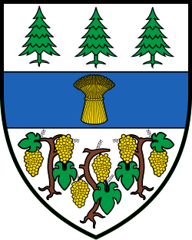
Argent, on a fess azure a garb or, in chief three fir trees and in base three vine branches leaved and fructed, all proper. On a white field, a horizontal blue band bears a yellow sheaf of wheat. Above stand three green fir trees, below hang three vine branches with leaves and grapes. The figures recall the village's resources: fir trees and vines appear in the arms as early as 1695, and the wheat was added in 1919.[7][2]
Founding of Begnins
How the village came into being is not known, but the site was occupied long before the Middle Ages: La Tène period burials have been found near the Château de Martheray, and a fragment of a Roman milestone has turned up here. In the 12th century the noble family of Begnins appears. The territory was later divided among several lordships, those of Martheray, Cottens, Menthon and Rochefort, and the Serraux, whose castles still line the village.[1][2][3]
History of Begnins
La Tène period. Burials discovered near the Château de Martheray.[1][2]
252. Date of a fragment of a Roman milestone discovered at Begnins in 1811.[2]
1145. First mention: a deed confirms the donation of tithes by the knight Guigues de Begnins to the convent of Bonmont.[2][3]
12th century. The Château de Martheray is attested.[2]
13th century. The church of Notre-Dame is built in stages.[1][2]
1293. The Begnins family comes under Savoyard authority.[2]
around 1500. The church tower is raised.[2]
1530. Destruction of a fortified house, origin of the present Château de Menthon et de Rochefort, rebuilt in the second half of the 16th century.[2]
1536. Bernese conquest: Begnins is attached to the bailiwick of Nyon.[2]
early 17th century. Destruction of the Château de Moinsel. The surrounding hamlet is said to have been wiped out by the last great plague in the Pays de Vaud.[3]
1616 and 1767. The ruined commune of Les Serraux disappears in 1616. Its merger with Begnins is dated 1767.[1][2][3]
1631. Remodelling of the manor, a group of 13th and 14th century buildings.[2]
1714. The church's side chapels are rebuilt.[2]
1727. The Château de Cottens is rebuilt.[2]
1756. A new parsonage is built.[1][2]
1791-1910. Begnins hosts large fairs.[2][3]
1802. During the Bourla-Papey uprising, archives are burned at the castles of Cottens and Martheray.[2]
1906-1954. A tramway links Begnins with Gland.[1][2]
1907-1917. Phylloxera, downy mildew and powdery mildew devastate the vineyards.[2]
1969. Construction of the Catholic chapel of Saint-Michel.[2]
Population of Begnins
Sources and references: [1][5]
| 1764 | 454 |
| 1803 | 567 |
| 1850 | 734 |
| 1900 | 782 |
| 1920 | 669 |
| 1950 | 753 |
| 1980 | 1'056 |
| 2000 | 1'335 |
| 2011 | 1'664 |
| 2025 | 2'047 |
Families of Begnins
De Begnins. A noble family, vassals of the lords of Prangins, recorded from 1145 to the mid-14th century. The castle of Martheray, the oldest in the village, belonged to them. In 1544 André de Begnins acquired most of the lordship of Martheray and built the present house there.[1][8]
Burgher families before 1800. Brandt, Brière, Charbonnier, Dessiex, Dumas, Dutruit, Dutruy, Francfort, Gaudin, Gervaix, Henriod, Lacombe, Morzier, Sallaz, Sinner, Tallant and Tallent, with no precise date.[14]
In the 19th century. A single entry, in 1825, under two spellings: the Stouky and the Stucky, from Röthenbach im Emmental BE.[14]
Show more families (1)
From 1901 to 1962. Seventeen entries. The first came from Italy: Salero in 1916, Nicola in 1931, Lincio in 1939, then Rainoldi in 1951. The Kovarik, from Czechoslovakia, were registered in 1948. The year 1956 brought six: Hugli of Seedorf BE, Joost of Langnau im Emmental BE, Jufer of Melchnau BE, Plüss of Murgenthal AG, Schacher of Neunkirch SH and Stähly of Rapperswil BE. They were joined by the Reyren of Saanen BE (1955), the Flury of Lommiswil SO and the Marin, from Belgium (1957), the Haldi of Saanen BE (1958) and the Stutz of Arni-Islisberg AG (1959). The Jaussi, of Wattenwil BE, closed the list in 1962.[14]
Notable people of Begnins
Philippe-Sirice Bridel (Begnins 1757 - Montreux 1845). The son of a pastor, he was born in Begnins. A pastor in Basel, Château-d'Œx and then Montreux, "Dean Bridel" took an interest in popular traditions, dialect and geography. From 1783 he published the Etrennes helvétiennes, followed by the Conservateur suisse.[9]
Jean-Louis-Philippe Bridel (Begnins 1759 - Lausanne 1821). Brother of the above, also born in Begnins. Sent out by the Directory of the Helvetic Republic as a "missionary of liberty", he later taught theology at the Lausanne academy. His articles in the Etrennes helvétiennes were the first art criticism published in French-speaking Switzerland.[10]
Albert Bonnard (Begnins 1858 - Geneva 1917). A doctor's son born in Begnins. As a journalist he ran the foreign news section of the Gazette de Lausanne from 1882 to 1909, then edited the Journal de Genève until his death.[11]
Catherine Colomb (Saint-Prex 1892 - Prilly 1965). The novelist spent her childhood and youth in Begnins, raised by her maternal grandmother. Her novel "Châteaux en enfance" came out in 1945. She received the Prix Rambert in 1962.[12]
Economy of Begnins, past and present
Vines, fields and forests. East of the La Côte vineyards, Begnins long lived from farming, wine-growing and forestry. In the 13th and 14th centuries its inhabitants quarrelled over pastures with the neighbouring charterhouse of Oujon. In the 18th century the herds were large enough to employ a communal herdsman. In 1920 the Confederation helped replant the ravaged vineyard with new grape varieties. Land consolidation began in 1930. In the mid-20th century there were twenty-seven farms, some of which delivered their milk to the cheese dairy.[1][2]
Huguenot craftsmen. At the end of the 17th century Protestant refugees from France settled in the village. Pastors, doctors, teachers, blacksmiths and other craftsmen contributed to its material and intellectual prosperity.[2]
Fairs, inns and stagecoaches. In the 19th century Begnins was a regional centre. Its annual fairs drew crowds, and a stagecoach service run by the Geneva postal administration served the village. In 1803 the municipality bought the Logis de l'Ours to turn it into its communal inn. In 1830 it acquired the Écu vaudois to benefit from the crowds on fair days.[1][2]
From tram to motorway. After the tram to Gland closed, the Société des autobus du Pied-du-Jura and the PTT took over in 1965. The nearby Geneva-Lausanne motorway made Begnins a residential village in the 1960s.[1][2]
Historic sites in Begnins
Church of Notre-Dame. Reformed church dating back to the 13th century, built in stages. Rectangular tower raised around 1500, side chapels rebuilt in 1714. Cultural property of regional importance.[1][2][4]
Château de Martheray. Attested in the 12th century. The square main block, with a high hipped roof, dates from the mid-16th century, with a tower of 1672 and a central pediment of 1856. Cultural property of regional importance.[2][4]
Château de Cottens. Turret from the late 15th century. The castle was rebuilt in 1727.[2]
Château de Menthon et de Rochefort. Building whose origins go back to the second half of the 16th century, remodelled in the 18th century.[2]
Manor. Group of 13th and 14th century buildings, remodelled in 1631 and again around 1780-1790.[2]
Chapel of Saint-Michel. Catholic chapel built in 1969.[2]
Site of national importance. Begnins is listed as a village in the Federal Inventory of Swiss Heritage Sites of national importance (ISOS), with top ratings for its setting and its spatial and historical-architectural qualities.[2]
Vineyards. The vineyards of Begnins, on La Côte, cover about 100 hectares. According to the municipality, they may date back to the 10th century.[3]
Remains in Begnins
Roman milestone. Fragment of a stone indicating road distances, dated 252, discovered in 1811.[2]
Ancient burials. La Tène period burials and early medieval skeletons have been uncovered near the Château de Martheray.[2]
Château de Bioley. Fortified castle of which nothing remains today.[2][3]
Château de Moinsel. Destroyed in the early 17th century, together with the surrounding hamlet.[2][3]
Protected heritage in Begnins
Cultural property of regional significance (B objects)[6]
- Château du Martheray
- Eglise réformée Notre-Dame
- Manoir de Rochefort avec dépendance et deux fontaines
Legends of Begnins
The treasure of Bioley. Of the vanished fortified castle of Bioley only a legend remains: that of a treasure buried beneath its ruins.[3]
Traditions and festivals in Begnins
Le Bourru. The winegrowers of Begnins, Luins, Vinzel and Bursins open their cellars for tastings of bourru, a young wine still fermenting and low in alcohol. Some twenty cellars take part, and visitors go from one to the next with their tasting glass.[13][3]
Sources
- Dictionnaire historique de la Suisse, « Begnins » (Germain Hausmann, version du 10.05.2004)
- Inventaire fédéral des sites construits d'importance nationale (ISOS), « Begnins » (2012)
- Feuille des avis officiels du canton de Vaud, Alphabet des communes, « Begnins »
- Office fédéral de la protection de la population, Inventaire PBC, liste cantonale VD (état au 1.1.2026)
- Statistique Vaud, « Population résidante permanente au 31 décembre 2025 »
- Federal Office for Civil Protection (FOCP), Swiss Inventory of Cultural Property (PCP), list for the canton of Vaud (as of 1.1.2026)
- IPI, Swissreg, emblems database: coat of arms of Begnins (no. 101491)
- Historical Dictionary of Switzerland (HDS), article "Martheray"
- Historical Dictionary of Switzerland (HDS), article "Bridel, Philippe-Sirice"
- Historical Dictionary of Switzerland (HDS), article "Bridel, Jean-Louis-Philippe"
- Historical Dictionary of Switzerland (HDS), article "Bonnard, Albert"
- Historical Dictionary of Switzerland (HDS), article "Colomb, Catherine"
- La Côte Tourisme, "Le Bourru"
- Register of Swiss Surnames, 3rd edition (1989), search Commune "Begnins", Canton VD
Published by Sébastien Jörg ·
Localities of the municipality with a page
Other villages near Begnins
Missing information, or do you have a source? Suggest a correction or addition. Every submission is checked before it's published.
Suggest a change