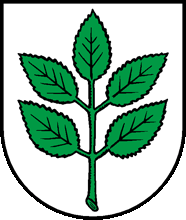
Constantine
Beneath the church of Saint-Martin in Constantine, renovated in 1675-1680 by Abraham Dünz I, an 11th-century necropolis has been uncovered.
Entry based on 8 sources · Our method · Reusable text (CC BY-SA)
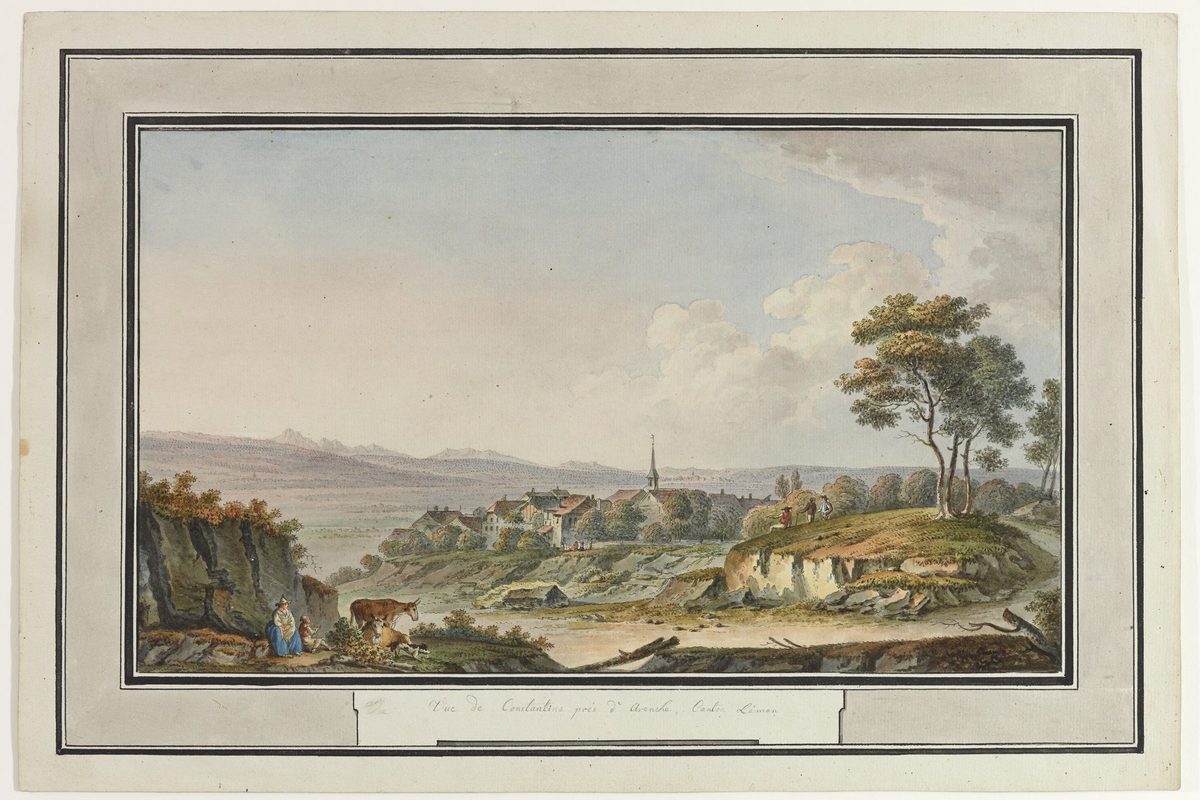
Origin of the name Constantine
Constantine is first mentioned in 1228 in the Latin form « Costantina ». For « Constantine », no etymology is certain. It may derive from a Gallo-Roman estate name formed on a Latin personal name, a hypothesis often put forward for place names in the region, but one that has not been confirmed.[1][4]
Founding of Constantine
No founder, whether person or institution, is known: Constantine grew up gradually, under seigneurial and later Bernese administration. The village lies on the southern slope of the Vully massif, between Lake Neuchâtel and Lake Morat, a few kilometres north of Avenches. In the 12th-13th centuries its territory belonged to the bishopric of Sion. In the 13th century Pierre II de Savoie acquired the fief of Charbuens, and the village was attached to the castellany of Cudrefin, under the House of Savoie, which then held much of the Vully.[1]
History of Constantine
1228. First attested written mention of the village, in the Latin form « Costantina ».[1][4]
13th century. The territory initially belonged to the bishopric of Sion, before Pierre II de Savoie acquired the fief of Charbuens. Constantine was then attached to the castellany of Cudrefin, under the House of Savoie.[1]
13th-15th century. The Vully region, including Constantine, remained largely under the rule of the House of Savoie, before being progressively divided between the influence of Berne and that of Fribourg.
1536. Following the conquest of the Pays de Vaud by Berne, Constantine came under Bernese administration, incorporated into the bailiwick of Avenches. The locality was governed by a council of twelve members and fell under the jurisdiction of the Mayorie de Cudrefin.[1]
1550. The village has 24 hearths (households).[1]
1668-1671. The vicarage is renovated by the architect Abraham Dünz I.[1]
1675-1680. The church, dedicated to Saint Martin, is renovated by the same architect, Abraham Dünz I.[1]
17th century. Construction or acquisition of Constantine Castle by the de Pury family.[1][4]
1764. 328 inhabitants are recorded for the combined entity formed by Constantine and Montmagny, which were then administratively linked.[1]
1803. The Pays de Vaud becomes an independent canton of the Swiss Confederation. Constantine is part of it.
1811. Constantine and Montmagny, united until then, separate into two independent municipalities.[1][4]
1850. The municipality of Constantine has 193 inhabitants.[1]
1900. The population stands at 189 inhabitants.[1]
1919. Constantine Castle is converted into a holiday and rest home.[1][4]
2011-07-01. Constantine merges with Bellerive, Chabrey, Montmagny, Mur, Vallamand and Villars-le-Grand to form the new municipality of Vully-les-Lacs, ending its existence as an independent municipality.[1][4]
Population of Constantine
Sources and references: [1]
| 1550 | 24 hearths (households, not a number of inhabitants) |
| 1764 | 328 (figure combined with Montmagny) |
| 1850 | 193 |
| 1900 | 189 |
| 2000 | 280 |
Families of Constantine
Citizen families before 1800. Berthoud, Boulard and Gentizon, without a precise date.[8]
In the 19th century. The de Tribolet-Hardy family (from Neuchâtel NE) obtains citizenship in 1824 and the Cuanillon family (from Vallamand VD) in 1863.[8]
From 1901 to 1962. From Switzerland come the Schlozer family from Riehen BS (1956), the Borel family from Couvet NE, the Riesen family from Oberbalm BE and the Zosso family from St. Antoni FR (1957) and the Hurni family from Gurbrü BE (1962). The last family registered, in 1962, is the Hurni family.[8]
Economy of Constantine, past and present
Vines, fields and tourism. In the municipality of Vully-les-Lacs, which Constantine has belonged to since 2011, farming, wine growing and tourism are the main activities. The vineyard covers about sixty hectares, worked by 24 winegrowers.[4]
Disasters and major events in Constantine
The fight at Salavaux in 1802. On 27 September 1802, troops of the Helvetic Republic defeated a column of the federalist army at Salavaux. The village was then split between Bellerive and Constantine.[7]
Historic sites in Constantine
Saint-Martin church. Parish church dedicated to Saint Martin, renovated between 1675 and 1680 by the architect Abraham Dünz I. It is built above a necropolis dating from the 11th century.[1]
The vicarage. Building renovated by the architect Abraham Dünz I between 1668 and 1671, at the same time as the work carried out on the church.[1]
Constantine Castle. 17th-century building, owned by the de Pury family. It was converted into a holiday and rest home from 1919.[1][4]
Remains in Constantine
11th-century necropolis. Remains of a necropolis dated to the 11th century were uncovered beneath the present-day Saint-Martin church.[1]
Roman road of the Vully. The Roman road of the Vully ran through the municipality's territory.[1]
Protected heritage in Constantine
Cultural property of regional significance (B objects)[6]
- Salavaux, château avec portail et fontaine
Sources
- Dictionnaire historique de la Suisse - Constantine
- Dictionnaire historique de la Suisse - Vully-les-Lacs
- Dictionnaire historique de la Suisse - Vully (région)
- Feuille des avis officiels du canton de Vaud - fiche Vully-les-Lacs
- Site officiel de la commune de Vully-les-Lacs
- Federal Office for Civil Protection (FOCP), Swiss Inventory of Cultural Property (PCP), list for the canton of Vaud (as of 1.1.2026)
- Historical Dictionary of Switzerland, "Salavaux" (Gilbert Marion, version of 06.01.2017)
- Register of Swiss Surnames, 3rd edition (1989), search Commune "Constantine", Canton VD
Published by Sébastien Jörg ·
Other villages near Constantine
Missing information, or do you have a source? Suggest a correction or addition. Every submission is checked before it's published.
Suggest a change