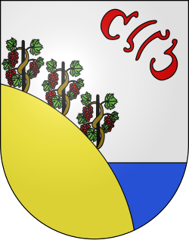
Cormondrèche
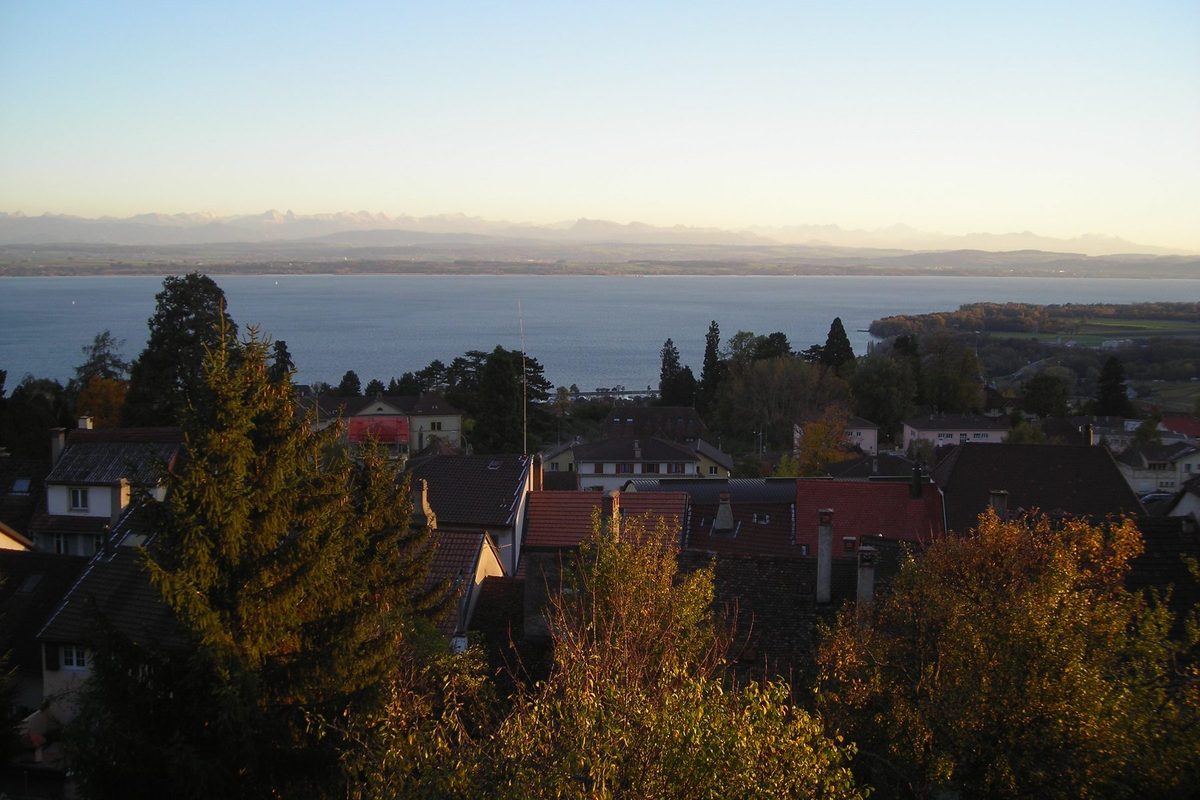
On a terrace above the lake, a winegrowing street village whose Grand-Rue is lined with winegrowers' and burghers' houses from the 16th to 18th centuries. Part of Neuchâtel since 2021.
Entry based on 9 sources · Our method · Reusable text (CC BY-SA)
Origin of the name Cormondrèche
The village appears around 1220 as « Cormundreschi ». Older forms, not yet confirmed, are given for 1179 (« Cormundresge », sometimes dated 1178) and for 1215 (« Cormundresche »). The name is usually explained by Latin curtis (estate) followed by a Germanic personal name, reconstructed as « Munderic »: it would be « Munderic's estate ». The inhabitants are called Cormontants. In patois the village is reportedly called « Cmondretche » and nicknamed « La Tchère Frétche » (fresh flesh), its inhabitants being nicknamed the Brêmes.[1][2]
Founding of Cormondrèche
There is no known founder or founding act for Cormondrèche. The village is thought to have grown out of an early medieval farming estate (curtis), though this is not established. The territory of the former municipality of Corcelles-Cormondrèche has yielded, from earlier times, Hallstatt-period burial mounds and a 7th-century grave. A street village on a terrace, Cormondrèche shared with Corcelles a general commune that managed the forests granted by the count of Neuchâtel, as well as the church, worship, poor relief and policing. The corporation of Cormondrèche, for its part, ran its own schools, fountains and night watch. The village belonged to the mairie of La Côte, then formed a political municipality with Corcelles, which has since joined the municipality of Neuchâtel.[1][4]
History of Cormondrèche
Hallstatt period. Burial mounds are raised on the territory of the former municipality of Corcelles-Cormondrèche.[1]
7th century. A grave from this period was found on the territory of the former municipality.[1]
1092. Foundation of the priory of Corcelles in the neighbouring village, around a church dedicated to Notre-Dame.[1]
1179. First written record of the name. The form « Cormundresge », sometimes dated 1178, is not yet confirmed.[2]
around 1220. The village appears as « Cormundreschi ». The form « Cormundresche » is reportedly also recorded for 1215.[1]
1357-1359. The count of Neuchâtel grants forests to the communities of Corcelles and Cormondrèche. They become their main wealth.[1][4]
15th century. Corcelles and Cormondrèche together count some fifty hearths, about 200 inhabitants.[4]
1530. With the Reformation the secularised property of the priory of Corcelles is divided between the countess of Neuchâtel and the lord of Colombier.[1]
1569. Claude de Montmollin, former mayor of La Côte, has a house built on the site of the present castle.[2][4]
early 17th century. Until the mid-19th century the corporation of Cormondrèche runs the schools, fountains and night watch.[1]
1629. A plague epidemic reportedly claimed 160 victims in Cormondrèche.
1707. Personal union of the principality of Neuchâtel with the kingdom of Prussia.[6]
1720. After passing through the Merveilleux, Chambrier, Marval and Montmollin families, the property goes to Charles-Louis de Chambrier.
1796. Establishment of a joint watch service between Corcelles and Cormondrèche.
1806. The principality of Neuchâtel is ceded by the king of Prussia to Napoleon I, who gives it to his marshal Alexandre Berthier.[6]
1814. Neuchâtel becomes a canton of the Swiss Confederation while again becoming a principality of the King of Prussia, until the revolution of 1848.[6]
1838. End of the joint parish with Coffrane, Les Geneveys-sur-Coffrane and Montmollin.[1][4]
1848. End of the mairie of La Côte. Cormondrèche belongs to the district of Boudry until 2017.[1]
1859-1860. Construction of the Jura industriel line and of Corcelles-Peseux station. The railway separates the two villages.[1][2][4]
1861. Construction of the old school building of Corcelles.[4]
1875-1888. The cantonal law on municipalities in force from 1875, supplemented in 1888, leads to the political municipality of Corcelles-Cormondrèche. Its founding year is uncertain: 1875 or 1888.[4]
1881. After many works and extensions the castle takes on its present appearance.[4]
1902. Opening of tram line no. 4 linking Neuchâtel to Corcelles.[2]
20th century. Once agricultural and winegrowing, the locality industrialises and becomes a suburban municipality.[1]
1976. The trolleybus replaces the tram on the line serving Corcelles.[1][2][4]
2004. The cantonal road H10 running through the locality is diverted into a semi-covered trench.
2021. On 1 January Corcelles-Cormondrèche merges with Neuchâtel, Peseux and Valangin. Cormondrèche becomes a locality of the new municipality of Neuchâtel.[1][3]
Population of Cormondrèche
Sources and references: [1][4][5]
| 15th century | 50 hearths (households), about 200 inhabitants (Corcelles and Cormondrèche combined) |
| 1750 | 562 (former municipality of Corcelles-Cormondrèche) |
| 1850 | 823 |
| 1900 | 1'460 |
| 1950 | 2'243 |
| 1990 | 3'336 |
| 2000 | 3'914 |
| 2010 | 4'624 |
| 2020 | 4'752 (cantonal census at 31.12.2020) |
Families of Cormondrèche
De Montmollin. Originally from the village of Montmollin, the family is recorded in Neuchâtel from the early 15th century and ennobled in 1657. Claude (1530-1573) is mayor of Rochefort, then of La Côte and Travers. The Montmollin are present in Corcelles-Cormondrèche from 1688. In the 18th century they provide more members of the Council of State than any other family, with twelve councillors between 1707 and 1806.[9]
Citizen families before 1800. The Register lists the families of the former commune of Corcelles-Cormondrèche, without separating the two villages. Twenty of them held citizenship before 1800, with no precise date: Bedeaux, Bourquin, Bulard, Clerc, Colin, Cornu, de Chambrier, de Pury, Dothaux, Droz, Humbert, Matthieu, Morard, Morel, Nicoud, Perregaux, Philippin, Renaud, Theynet and Vaucher.[8]
In the 19th century. The de Montmollin, the Marion and the Jeanmonod (from Provence VD) are registered with no precise date. The year 1889 alone accounts for nine families. The dated entries begin with the Roquier and the Schoene (from Germany) in 1863, the Johann (from Germany) in 1877, the Baur (from Germany) in 1886, the Gerster (from Twann BE) and the Giroud (from Grandevent VD) in 1888 and the Aeschlimann (from Langnau im Emmental BE), the Bardet (from Villars-le-Grand VD), the Burgdorfer (from Vinelz BE), the Laubscher (from Müntschemier BE), the Meylan (from Le Lieu VD), the Pelleaux (from Pomy VD), the Vogel (from Gurbrü BE), the Weber (from Brüttelen BE) and the Wenker (from Gampelen BE) in 1889. Then come the Goeser (from Germany), the Hirschi (from Guggisberg BE), the Niklaus (from Müntschemier BE) and the Pfenniger (from Büron LU) in 1890, the Jungen (from Frutigen BE) and the Kleinhans (from Germany) in 1892, the Steinmann (from Konolfingen BE) in 1893, the Hämmerli (from Vinelz BE), the Imhof (from Iffwil BE) and the Roux (from Essertines-sur-Yverdon VD) in 1895 and the Goumaz (from Fétigny FR) in 1897. The last entries, in 1900, concern the Kaech (from Gampelen BE) and the Rossetti (from Italy, also registered in 1925).[8]
Show more families (1)
From 1901 to 1962. Thirty-eight families, fourteen of them from Bern. First come the Weber (from Brüttelen BE) in 1902, the Hirschy (from Trub BE) in 1903, the Cand (from Rances VD) in 1905, the Oelschläger (from Germany) in 1910 and the Borradori (from Gordola TI) and the Jordi (from Wyssachen BE) in 1913. Then come the Gerber (from Langnau im Emmental BE), the Hamm (from Germany), the Stähli (from Oberhofen am Thunersee BE, also registered in 1925) and the Sunier (from Nods BE) in 1917, the Berchtold (from Homberg BE) in 1921, the Joly-Bournot (from France) in 1923, the Choffat (from Tramelan BE), the Grandjean (from Bellerive VD) and the La Roche in 1925 and the Steiger (from Meilen ZH) in 1926. Next the Muster (from Hasle bei Burgdorf BE) and the Wyss (from Wimmis BE) in 1927, the Honegger (from Uster ZH) and the Pfisterer in 1928, the Minder (from Huttwil BE) in 1929, the Antenen (from Oberdiessbach BE) and the Bassino (from Italy) in 1931 and the Mühlemann (from Bönigen BE) in 1932. After them come the Giger (from Bremgarten bei Bern BE) and the Roulin (from Forel FR) in 1937, the Mulder (from the Netherlands) in 1938, the Vivien (from Genève GE) in 1944, the Bubloz (from La Chaux near Cossonay VD) in 1946 and the Mariotti (from Italy) in 1950. They are followed by the Gartenmann (from Bronschhofen SG) in 1952, the Curtit (from Italy) in 1953, the Meia (from Italy) in 1955, the Murtez (from Turkey) in 1957 and the Tempelhof in 1960. Then come the Sjögren (from Sweden) and the Vuille in 1961. The last entry, in 1962, concerns the Pantillon (from Vully-le-Bas FR).[8]
Economy of Cormondrèche, past and present
Vines and cellars. Like Corcelles, Cormondrèche remained a village of farmers and winegrowers until the late 19th century. The monks of Môtiers owned vines here and a cellar on the Grand-Rue. The building belongs to the Association des viticulteurs de la Côte, and a wine press still recalls the wine-growing life of the old village.[2][4]
The right to wood. In 1357 Count Louis of Neuchâtel allowed the inhabitants to take wood from his forests. In return each household paid 61 litres of oats. This due, known as the wood oats, was bought out by the commune in 1837.[1][4]
Tavern, forge and factories. Built in 1745 at Grand-Rue 27, the Corporation house brought a tavern, a forge, the school and the teacher's lodging under one roof. In the late 19th century the Prieuré held a watch factory, then a cigar factory. The former commune of Corcelles-Cormondrèche later industrialised and counted a multitude of small firms.[1][4]
Disasters and major events in Cormondrèche
The billeting of 1806 to 1814. Under French rule soldiers lodged with villagers in Cormondrèche as in Corcelles, and the families received compensation. In 1813 the villages also housed German and Swiss German troops marching on France.[4]
Historic sites in Cormondrèche
Cormondrèche Castle. Located at Rue du Château 2, it replaces the house built in 1569 by Claude de Montmollin, former mayor of La Côte. The property passed to the Merveilleux, Chambrier, Marval and Montmollin families, then in 1720 to Charles-Louis de Chambrier. After many works and extensions the building took on its present appearance in 1881. It now hosts concerts.[2][4]
Grand-Rue de Cormondrèche. Historic main artery of the village, lined with winegrowers' and bourgeois houses from the 16th to 18th centuries, witnesses to the village's wine-growing vocation until the mid-20th century. Several remarkable buildings stand there, including the Caves du Prieuré, the Maison de Lully and the Manoir.
Caves du Prieuré (Grand-Rue 25). The name of this house, which never housed a monastery, recalls the cellar and vineyards owned by the monks of the priory of Môtiers. It now belongs to the Association des viticulteurs de la Côte.[2][4]
Maison de Lully (Grand-Rue 28). An early 16th-century house with remarkable architectural features inside. Its name reportedly recalls Joseph de Praroman, lord of Lully, owner in the 18th century.[4]
Le Manoir. A winegrower's house on the Grand-Rue made up of four buildings, standing on a plot occupied before the 16th century and mentioned from 1529.[4]
Themed trails of Corcelles-Cormondrèche. Three themed walks of about one hour each (maximum 3 km each) allow visitors to discover the historic centre of the village, the vineyards with views over the lake and the Alps, and the forest, dotted with around forty explanatory panels.[2]
Remains in Cormondrèche
Hallstatt-period burial mounds. Hallstatt-period burial mounds were found on the territory of the former municipality of Corcelles-Cormondrèche. Their exact location is not given.[1]
7th-century grave. A 7th-century grave was found on the territory of the former municipality of Corcelles-Cormondrèche.[1]
Memory of the Môtiers priory wine cellar. The house called « Caves du Prieuré », Grand-Rue 25, keeps in its name the memory of the cellar and vineyards that the priory of Môtiers owned in Cormondrèche.[2][4]
Protected heritage in Cormondrèche
Cultural property of regional significance (B objects)[7]
- Le Manoir
Sources
- Dictionnaire historique de la Suisse, « Corcelles-Cormondrèche » (version du 28.10.2021)
- Ville de Neuchâtel, site officiel : page Corcelles-Cormondrèche (tourisme et patrimoine)
- Ville de Neuchâtel, site officiel (informations générales sur la fusion de 2021)
- Ville de Neuchâtel, « Histoire des villages de Corcelles et Cormondrèche » (Ann Robert, PDF)
- État de Neuchâtel, arrêté du 10 février 2021 portant homologation des résultats du recensement cantonal de la population du 31 décembre 2020
- Dictionnaire historique de la Suisse, « Neuchâtel (canton) » (Lionel Bartolini), version du 30.05.2017
- Federal Office for Civil Protection (FOCP), Swiss Inventory of Cultural Property (PCP), list for the canton of Neuchâtel (as of 1.1.2026)
- Register of Swiss Surnames, 3rd edition (1989), search Commune "Corcelles-Cormondrèche", Canton NE
- Historical Dictionary of Switzerland (HDS), article "Montmollin, de" (Myriam Volorio Perriard), German version of 18.04.2008
Published by Sébastien Jörg ·
Other villages near Cormondrèche
Missing information, or do you have a source? Suggest a correction or addition. Every submission is checked before it's published.
Suggest a change