
Courfaivre
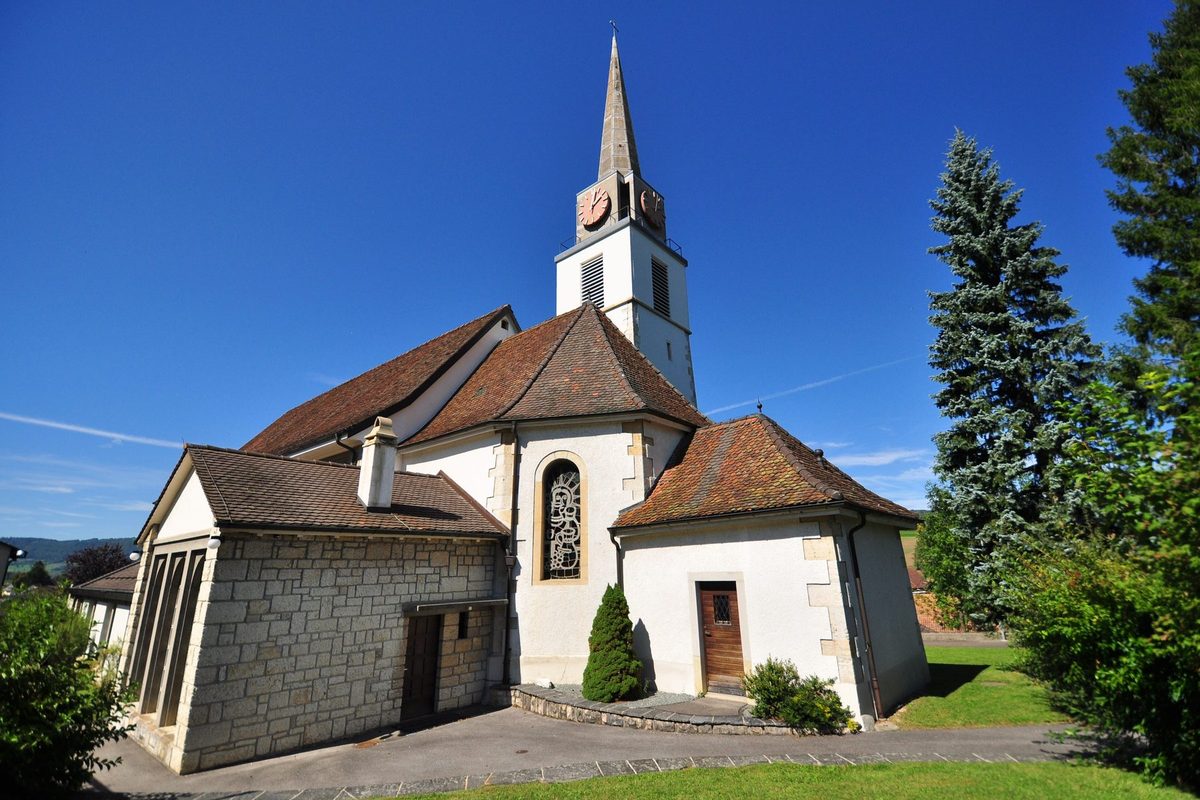
Courfaivre saw the Condor cycle factory founded in 1893, and its church received windows by Fernand Léger in 1954, then a tapestry by Jean Lurçat.
Entry based on 8 sources · Our method · Reusable text (CC BY-SA)
Origin of the name Courfaivre
The form « Curfavro » is attested in 1147. An older mention, « Curtifavra » in 968, is unconfirmed. The name is said to come from the Romance « corte », farm estate (from Latin « cohors »), probably followed by the Latin personal name « Faber ». The inhabitants are reportedly nicknamed the « Mergats », tomcats in the local dialect.[1]
Founding of Courfaivre
Neither the founder of Courfaivre nor the circumstances of its birth are known. Several archaeological sites nevertheless show occupation from the Late Bronze Age and the Iron Age, then in Roman times and the early Middle Ages. In the 12th century the Cistercian abbey of Lucelle held property there. Until 1792 Courfaivre was one of the thirteen free villages of the Delémont valley, a lordship of the Prince-Bishopric of Basel. The village remained agricultural until the late 19th century.[1]
History of Courfaivre
Late Bronze Age and Iron Age. Pottery sherds attest occupation of the area.[1]
1st century AD. Roman coin hoard; a glass cinerary urn also dates from Roman times.[1]
Early Middle Ages. Cemeteries; a mainly Merovingian burial ground (7th century) is excavated at the place called Courtes Méchielles, between Courfaivre and Bassecourt.[1][3]
968. The name reportedly appears as « Curtifavra ».
1147. Mention « Curfavro »; the Cistercian abbey of Lucelle holds property in Courfaivre.[1]
1271. Like the other free villages of the Delémont valley, Courfaivre reportedly passes to the Prince-Bishopric of Basel.
1327. First mention of the parish.[1]
1675. 240 communicants are counted.[1]
1701-1702. Rebuilding of the church of Saint-Germain d'Auxerre.[1]
1793-1813. Courfaivre belongs to the French departments of Mont-Terrible (1793-1800), then Haut-Rhin (1800-1813).[1]
1815. Attachment to the canton of Bern, in the bailiwick and then the district of Delémont, until 1978.[1]
1853. Courfaivre becomes a mixed municipality.[1]
1876. Opening of the station on the Delémont-Porrentruy line.[1]
1893. Founding of the Condor bicycle, motorcycle and machine factory, which boomed between the wars.[1]
1950. From this date, mechanical, watch-case and metal construction workshops set up.[1]
1953-1954. Renovation of the church, with a tabernacle by Remo Rossi (1953) and stained glass by Fernand Léger (1954).[1]
1957. Choir tapestry by Jean Lurçat.[1]
1979. Courfaivre becomes part of the new canton of Jura.
2000. Condor remains the village's main company (about 60 workers). The secondary sector provides more than a third of jobs.[1]
2013. Merger with Bassecourt, Glovelier, Soulce and Undervelier into the municipality of Haute-Sorne (1 January).[1]
Population of Courfaivre
Sources and references: [1]
| 1675 | 240 communicants |
| 1818 | 554 |
| 1850 | 668 |
| 1870 | 595 |
| 1900 | 659 |
| 1910 | 777 |
| 1950 | 1'214 |
| 2000 | 1'537 |
| 2010 | 1'609 |
| 2012 | 1'600 |
Families of Courfaivre
Citizen families before 1800. This list is that of the former municipality of Courfaivre, part of Haute-Sorne since 2013. Sixteen families there are old ones: Bamat, Bandelier, Baumat, Berbier, Citherlet, Eray, Ferlin, Fleury, Girardin, Hennemann, Joset, Lopinat, Monnerat, Pic, Rolle and Tendon.[8]
From 1901 to 1962. The Jallon, from France, are registered in 1905 and in 1933, the Dubail in 1906. Next come the Willig from Germany (1919), the Gelso from Italy and the Stehlin from France (1923), then the Badiali from Italy (1941), the Nicolussi from Austria (1943) and the Brancucci from Italy (1944).[8]
Economy of Courfaivre, past and present
Tile works, milk and syndicate. In 1800 a request seeks to work peat bogs and coal deposits at Courfaivre. A tile works is authorised in 1804. The dairy opens in 1888, and a new one is inaugurated on 20 December 1958. The agricultural syndicate of Courfaivre and surroundings is founded on 19 March 1920.[7]
From velocipedes to Condor. In 1891 a factory at Courfaivre is leased to make watch parts. On 1 June 1894 Scheffer Frères & Cie begins building velocipedes there. The Manufacture suisse de vélocipèdes is founded on 5 September 1896, and the Condor brand is registered on 13 March 1900. A building notice for a new factory appears in 1908. In 1914 the firm becomes the Manufacture suisse de cycles et motocycles.[7]
Watch cases. Girco SA, a watch case factory, is inaugurated on 26 September 1970.[7]
Disasters and major events in Courfaivre
The destruction of 1642. On 17 December 1642, during the Thirty Years' War, the village is partly destroyed.[7]
The scarlet fever of 1883. A scarlet fever epidemic kills 13 children.[7]
Historic sites in Courfaivre
Church of Saint-Germain d'Auxerre. The parish is mentioned from 1327. Rebuilt in 1701-1702 and renovated in 1953-1954, the church, a cultural property of national importance, houses a tabernacle by Remo Rossi (1953), stained glass by Fernand Léger (1954) and a choir tapestry by Jean Lurçat (1957). It reportedly also holds a statue of Saint Germanus (1706-1707) by Johannes Schneider.[1][4]
Former Condor factory. Founded in 1893, the Condor bicycle, motorcycle and machine factory made Courfaivre an industrial village. It was still the village's main company in 2000.[1]
Remains in Courfaivre
Protohistoric sites. Several sites have yielded Late Bronze Age and Iron Age sherds.[1]
Roman finds. Coin hoard of the 1st century AD and a glass cinerary urn.[1]
Early medieval cemeteries. Early medieval cemeteries, including the Courtes Méchielles burial ground between Courfaivre and Bassecourt: some forty graves, mainly Merovingian (7th century), excavated by Auguste Quiquerez in 1841-1844 among the remains of Roman buildings.[1][3]
Protected heritage in Courfaivre
Cultural property of national significance (A objects in the PCP inventory)[4]
- Eglise St-Germain-d'Auxerre
Cultural property of regional significance (B objects)[4]
- Le Chételay, site archéologique du Haut Moyen Age
Legends of Courfaivre
The sabbath on the Chételat. Local tradition and the records of witch trials named the Chételat rock at Courfaivre as a place where the witches' sabbath was held. According to Quiquerez, this was probably the memory of an old pagan place of worship, where some people still lit fires long after Christianity arrived.[6]
Sources
- Dictionnaire historique de la Suisse, « Courfaivre » (François Kohler)
- geo.admin.ch (swisstopo), recherche de lieux « Courfaivre »
- Dictionnaire du Jura (diju.ch), « Courtes Méchielles (site archéologique, Courfaivre) », d'après C. Juillerat et F. Schifferdecker (réd.), Guide archéologique du Jura et du Jura bernois, 1997 (notice du 01.12.2005)
- Office fédéral de la protection de la population (OFPP), Inventaire PBC, liste cantonale du canton du Jura (état au 1.1.2026)
- République et Canton du Jura, Gouvernement, réponse à la question écrite n° 3074 « Fusions de communes : où en est-on ? » (23 octobre 2018)
- Auguste Quiquerez, Le Mont-Terrible, 1862, p. 185-186
- Chronologie jurassienne (Denis Moine), « Courfaivre »
- Register of Swiss Surnames, 3rd edition (1989), search Commune "Courfaivre", Canton JU
Published by Sébastien Jörg ·
Other villages near Courfaivre
Missing information, or do you have a source? Suggest a correction or addition. Every submission is checked before it's published.
Suggest a change