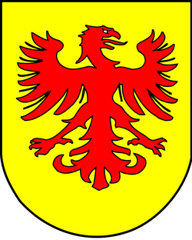
Courtemaîche
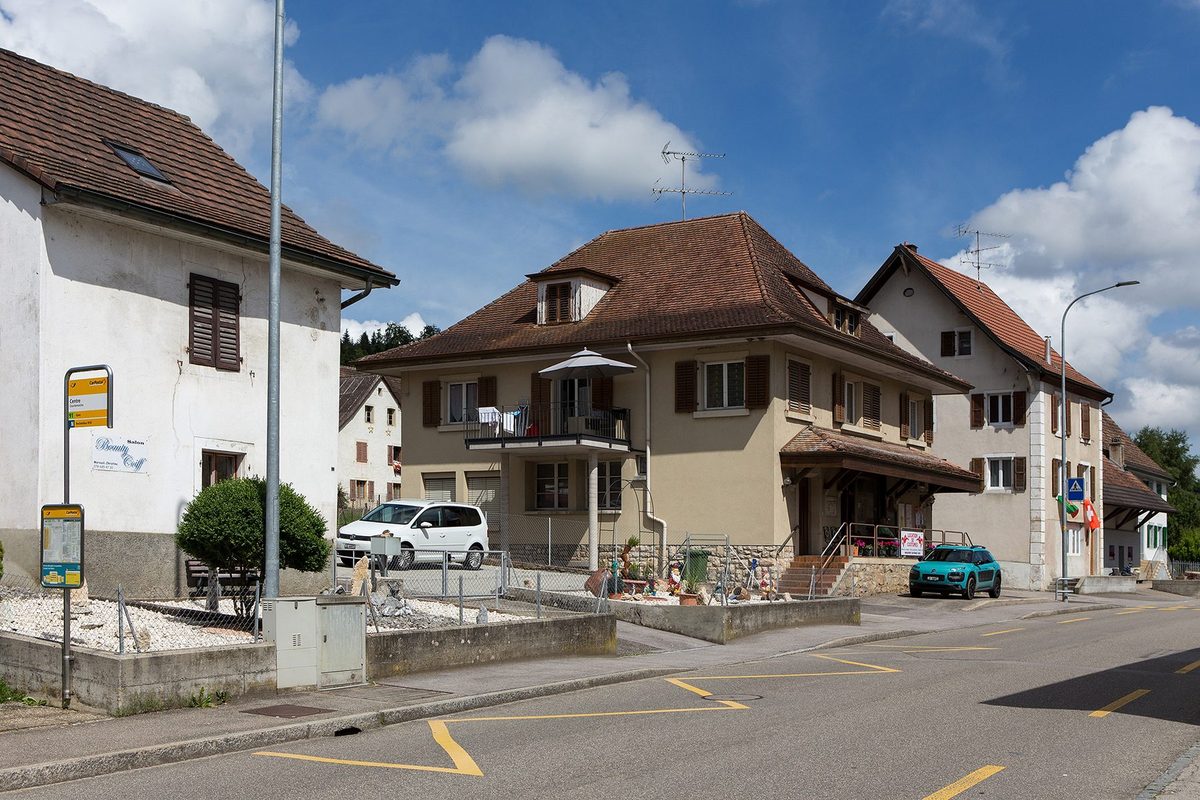
Origin of the name Courtemaîche
Old form « Cordomasge » in 1139. In the 12th century forms such as « Cordemasche » reportedly appear. The etymology of the name remains unexplained.[1]
Founding of Courtemaîche
Neither the founder nor the date of the village's creation is known, but the site was occupied long before the Middle Ages, as the prehistoric Bâme cave shows. In the Middle Ages the chapter of Moutier-Grandval and the abbey of Bellelay held property there, and in the 16th century the de Couthenans family, from Franche-Comté, lived there. Courtemaîche then belonged to the mairie of Bure, in the Prince-Bishopric of Basel, while its parish came under the diocese of Besançon. The hamlet of Grandgourt, to the north, grew up around a convent founded in the 12th century, which became a priory of the abbey of Bellelay.[1][2]
History of Courtemaîche
Late Neolithic. Traces of occupation in the prehistoric Bâme cave, still used in the early Iron Age.[1]
1139. Courtemaîche is recorded as « Cordomasge ».[1]
1182. First mention of the convent of Grandgourt, then a daughter house of the abbey of Bellelay, in a privilege of Pope Lucius III.[2]
1188. Grandgourt becomes an abbey in its own right.[2]
1208. Bellelay recovers Grandgourt and makes it a priory.[2]
16th century. The de Couthenans family, from Franche-Comté, lives in Courtemaîche.[1]
1627. Construction of the church of Saint-Timothée-et-Saint-Symphorien.[1]
1738-1744. Rebuilding of the Grandgourt priory.[2]
1770. Construction of the two-arched Grandgourt bridge over the Allaine.[2]
1779. The parish passes from the diocese of Besançon to that of Basel.[1]
1793-1815. Courtemaîche is attached to the French departments of Mont-Terrible, then Haut-Rhin.[1]
1798. The Grandgourt estate is sold as national property.[2]
1815-1978. The village belongs to the canton of Bern (bailiwick, then district of Porrentruy).[1]
1836. Courtemaîche becomes a mixed municipality.[1]
1855. The parish church is rebuilt.[1]
1860. The Grandgourt church, partly destroyed in 1801, is demolished to widen the road.[2]
1872. Arrival of the railway, which encourages the beginnings of industrialisation.[1]
around 1950. Courtemaîche is a centre for making jewel bearings for watchmaking, an activity that has now almost disappeared.[1]
1960. Land consolidation; the church is renovated the following year.[1]
1968. Opening of the military line from Courtemaîche to the Bure training ground (date uncertain).
1979. Courtemaîche joins the new canton of Jura.
2009. On 1 January Courtemaîche merges with Buix and Montignez into the municipality of Basse-Allaine.[1][4]
Population of Courtemaîche
Sources and references: [1]
| 1764 | 282 |
| 1818 | 326 |
| 1850 | 426 |
| 1900 | 680 |
| 1910 | 779 |
| 1950 | 745 |
| 1980 | 600 |
| 2000 | 633 |
| 2008 | 618 |
Historic sites in Courtemaîche
Church of Saint-Timothée-et-Saint-Symphorien. A first church was built in 1627. It was rebuilt in 1855 and renovated in 1961.[1]
Grandgourt priory. Convent built in the 12th century in a gorge of the Allaine, recorded in 1182 as a daughter house of Bellelay, an abbey in 1188 and then a priory of Bellelay from 1208. Its origins are uncertain: one tradition attributes it to the canons of Lanthenans (Franche-Comté), another to the Cluniac movement. Rebuilt in 1738-1744 and sold as national property in 1798, it became a farm in the 19th century and a major fish farm in the 20th century. Restored in 1976-1977, this large building with rich interior decoration has housed a training and treatment centre since 2001. The houses of Grandgourt on the left bank of the Allaine reportedly belonged to Courtemaîche, those on the right bank to Montignez.[2]
Grandgourt bridge. Two-arched stone bridge over the Allaine, built in 1770.[2]
Former estate of the de Couthenans family. The de Couthenans family, from Franche-Comté, lived in Courtemaîche in the 16th century. Their former estate is said to date from 1530, which is not confirmed.[1]
Saint-Symphorien chapel. Chapel reportedly located north of the village.
Remains in Courtemaîche
Bâme cave. Prehistoric cave that has yielded traces of occupation from the Late Neolithic and the early Iron Age. Cultural property of regional significance (federal PCP inventory).[1][3]
Sources
- Dictionnaire historique de la Suisse, « Courtemaîche » (Dominique Prongué), version du 28.05.2020
- Dictionnaire historique de la Suisse, « Grandgourt » (Dominique Prongué), version du 17.11.2016
- Office fédéral de la protection de la population (OFPP), Inventaire PBC, liste cantonale du canton du Jura (état au 1.1.2026)
- République et Canton du Jura, Gouvernement, message au Parlement relatif à la révision de la législation en matière de fusion de communes (30 mars 2011)
- geo.admin.ch (swisstopo), recherche de lieux « Courtemaîche »
Other villages near Courtemaîche
Missing information, or do you have a source? Suggest a correction or addition. Every submission is checked before it's published.
Suggest a change