Denens
A Romainmôtier parchment dated 3 March 1005 names «Disnens» for the first time. In 2005 the village celebrated this millennium. Vines have been grown here since the 11th century.
Entry based on 10 sources · Our method · Reusable text (CC BY-SA)
Origin of the name Denens
First mentioned in 1005 as «Disnens», in a parchment of the monastery of Romainmôtier dated 3 March 1005.[1][2]
Coat of arms of Denens
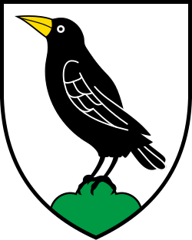
Argent, on a mount of three hillocks vert a raven sable beaked Or. On a white field, a black raven with a yellow beak stands on a green hill with three peaks. Created in 1920, the arms take up a coat of arms found on a document at the castle of Denens and attributed to an old seigneurial family.[8][9]
Founding of Denens
Denens first belonged to the lands of Vufflens-le-Château. The lordship then passed through several hands, including those of the Compey, the Tavel and the von Büren families. From the 11th century the inhabitants grew vines. Denens has no known founder.[1]
History of Denens
1005. First mention, as «Disnens», in a parchment of the monastery of Romainmôtier (3 March 1005).[1][2]
11th century. Beginning of wine-growing in Denens.[1]
1177. The church, dedicated to Saint Lazarus, is a parish church and belongs to the Great St Bernard.[1]
1300. Until this date the village belongs to the lands of Vufflens-le-Château. The lordship of Denens then passes through several hands.[1]
1370. Peronnette de Saillon, last heiress of Denens castle, reportedly marries Simon de Compey that year.
1453. The village has 20 hearths (households).[1]
15th century. Construction of the present church.[1]
1536. Bernese conquest; Denens belongs to the Bernese bailiwick of Morges and is run by the assembly of burghers. At the Reformation it becomes an annex of the parish of Vufflens-le-Château.
1798. Denens belongs to the district of Morges.[1]
1920. Creation of the municipal coat of arms, when a medal was struck for mobilised soldiers, based on arms found on a document kept in the castle.[2]
1940. The building of the cantonal road linking Denens to Morges contributes to the village's growth.[1]
1970s. Two villa districts develop east and west of the village.[1]
2005. Denens celebrates the millennium of its first written mention.[2]
2008. The new Vaud districts come into force. Denens remains in the district of Morges.[3][6]
Population of Denens
Sources and references: [1][3]
| 1453 | 20 hearths (households) |
| 1764 | 122 |
| 1850 | 269 |
| 1860 | 285 |
| 1900 | 225 |
| 1950 | 210 |
| 1960 | 189 |
| 2000 | 581 |
| 2025 | 748 |
Families of Denens
Duin. Until 1300 Denens belonged to the Duin, lords of Vufflens-le-Château.[9]
Tavel. The Tavel were among the lords of Denens. They held the lordship until Marianne de Tavel, only daughter of Louis-Elie-Sigismond, married Louis de Buren in 1796.[9][1]
Citizen families before 1800. Amaron, Chevillard, Cotty, Dottrens and Pernet, without a precise date.[10]
Show more families (2)
In the 19th century. Jacot and Sauty, as well as the Vullierat family (from Tolochenaz VD), without a precise date.[10]
From 1901 to 1962. The Assfalg family comes from Germany (1944). From Switzerland come the Gilgen family from Wahlern BE, the Hugi family from Zimmerwald BE and the Mühlemann family from Seeberg BE (1956). They are joined by the Panchaud family (1958).[10]
Notable people of Denens
Count Amadeus VI. In 1363 Count Amadeus VI owned the castle of Denens.[9]
Economy of Denens, past and present
The vineyards. Grown since the 11th century, vines surround the village and cover 10% of the municipality's 300 hectares, according to the FAO. Five producers work here.[1][9]
Fields, orchards and cattle. Denens is a rural municipality dominated by farming, winegrowing and fruit growing. Farmers also live from field crops: cereals, rapeseed, maize, endives, potatoes and beet. Two suckler cow breeders and three milk producers remain, and their milk is processed at the cheese dairy in Romanel. The municipality also owns 11 hectares of forest on the territory of Hautemorges.[1][9]
Historic sites in Denens
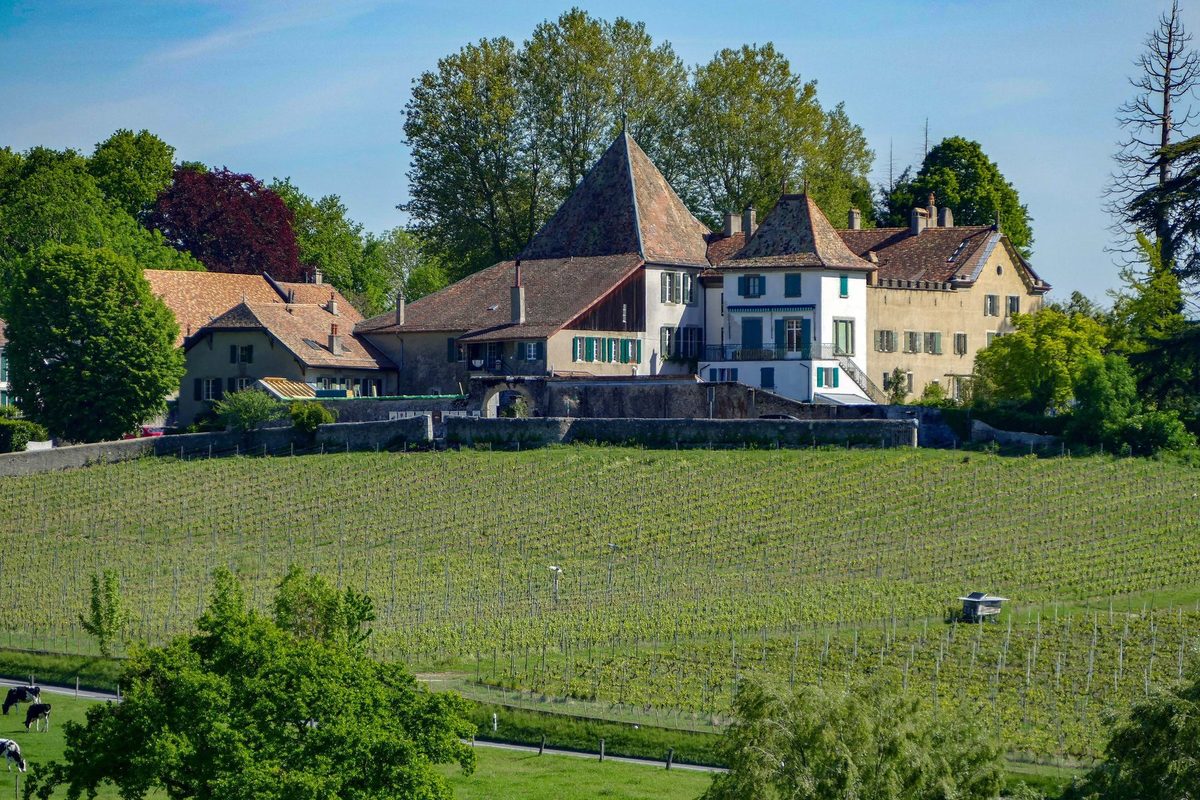
Denens castle. Seat of the lordship of Denens, held notably by the Compey, the Tavel and the von Büren. Altered several times during the Bernese period, it has kept important parts of the old fortress. The castle, with its outbuildings, gateway and enclosure wall, is a cultural property of regional significance.[1][5]
Church. Church dedicated to Saint Lazarus, a parish church in 1177 belonging to the Great St Bernard. The present building dates from the 15th century. Since the Reformation it has been an annex of the parish of Vufflens-le-Château.[1]
Remains in Denens
Parts of the old fortress. Despite alterations in the Bernese period, Denens castle retains important parts of the medieval fortress.[1]
Protected heritage in Denens
Cultural property of regional significance (B objects)[7]
- Château avec communs, bûcher, portail et mur d'enceinte
- Habitation, rural et fontaine
Legends of Denens
The scarecrows. The Société de l'Epouvantail holds a scarecrow competition in Denens. It celebrated its twentieth anniversary in August 2015. Scarecrows reportedly ward off evil spells, according to a local tradition that is not confirmed.[2]
The «Fouette-Grenouilles» and the «Choucas». The inhabitants bear the patois nickname «Lè Fouta renaille» (the frog-whippers) and are also called «les Choucas» (the jackdaws). The municipal coat of arms, created in 1920, shows a black raven standing on a three-peaked mount.[2][4]
Traditions and festivals in Denens
The Scarecrow festival. In 1995 the Denens winegrowers' group held the first of six scarecrow festivals and competitions. After this success the village proclaimed itself "Capitale mondiale de l'Epouvantail" (world capital of the scarecrow).[9]
Les Hurluberlus. The Hurluberlus theatre troupe performs every year in late October and early November. It made its name with "la Castou".[9]
Marking the trees. Every autumn the municipal council organises the marking of the trees to be felled. At the start of the year it presents the commune to residents over a small meal, usually a fondue.[9]
Sources
- François Béboux, « Denens », Dictionnaire historique de la Suisse (DHS), version du 22.08.2005
- Feuille des avis officiels du canton de Vaud, « Denens » (armoiries, sobriquet et historique)
- Statistique Vaud, « Population résidante permanente au 31 décembre 2025 »
- Union des communes vaudoises, annuaire, « Denens » (sobriquet)
- Office fédéral de la protection de la population, Inventaire PBC, liste cantonale VD (état au 1.1.2026)
- État de Vaud, communiqué du 12.07.2007, « Organisation des préfectures et adaptation au nouveau découpage territorial »
- Federal Office for Civil Protection (FOCP), Swiss Inventory of Cultural Property (PCP), list for the canton of Vaud (as of 1.1.2026)
- IPI, Swissreg, emblems database: coat of arms of Denens (no. 101782)
- Official Gazette of the Canton of Vaud (FAO), "Alphabet des communes vaudoises: Denens"
- Register of Swiss Surnames, 3rd edition (1989), search Commune "Denens", Canton VD
Published by Sébastien Jörg ·
Other villages near Denens
Missing information, or do you have a source? Suggest a correction or addition. Every submission is checked before it's published.
Suggest a change