Ecublens
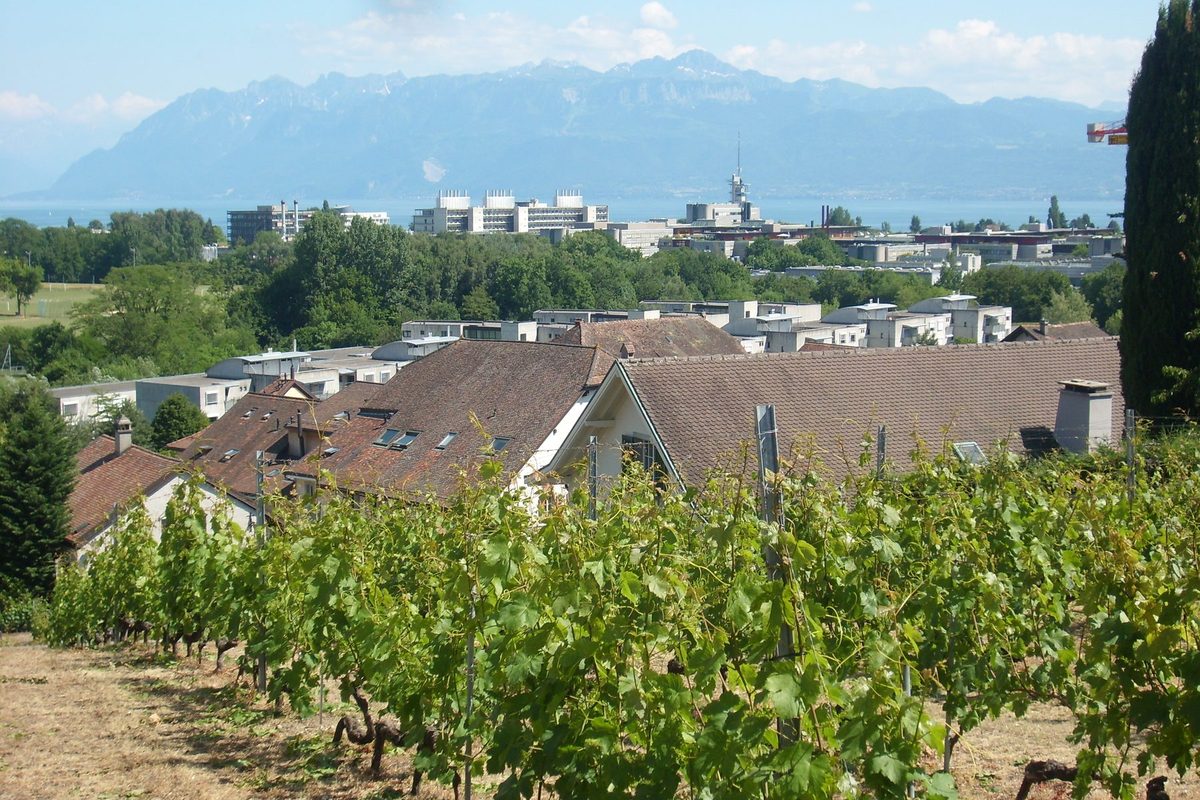
Commune west of Lausanne, originally farming and winegrowing, where the University of Lausanne settled in 1970 and EPFL in 1977.
Entry based on 6 sources · Our method · Reusable text (CC BY-SA)
Origin of the name Ecublens
The place is mentioned in 958 or 959 in the form «in villa Escublens», then in 964 as «Scubilingis». The ending, derived from the suffix «-ingos», is typical of place names of Burgundian origin. The meaning of the first element has not yet been established.[1]
Coat of arms of Ecublens
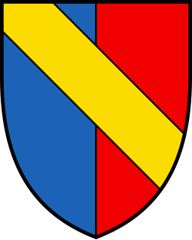
Per pale azure and gules, overall a bend or. The shield is split vertically, blue on the left and red on the right. A yellow band crosses it diagonally, from the upper left to the lower right corner.[4][5]
Founding of Ecublens
Ecublens has no known founder. The area has been frequented since prehistory: a Hallstatt grave at Dorigny, three Bronze Age graves and several La Tène graves at Valeyre and Bassenges. In the 10th century it was part of the territory of Renens. Its church, dedicated to Saint Peter and mentioned in 1228, depended on the priory of Saint-Sulpice. Originally given over to farming and winegrowing, the village grew rapidly from the 1960s and 1970s. The University of Lausanne (1970) and then EPFL (1977) settled on the Dorigny site.[1]
History of Ecublens
Bronze Age. Three graves at Valeyre.[1]
Hallstatt period. Grave at Dorigny.[1]
La Tène period. Several graves at Bassenges and Valeyre.[1]
958-959. First mention, in the form "in villa Escublens".[1]
964. The name appears in the form "Scubilingis".[1]
10th century. The place is part of the territory of Renens.[1]
1228. The church, dedicated to Saint Peter and attached to the priory of Saint-Sulpice, is mentioned.[1]
1416. The village has 38 hearths (households).[1]
1536. Bernese conquest; Ecublens becomes part of the bailiwick of Lausanne.
around 1770. Étienne de Loys has the Château de Dorigny built.[1]
1798. The village has 413 inhabitants.[1]
1900. The village has 777 inhabitants.[1]
1960s-1970s. Many industrial firms move in.[1]
1970. The University of Lausanne moves to Dorigny.[1]
1970. The commune has 6'379 inhabitants.[1]
1977. The Swiss Federal Institute of Technology in Lausanne (EPFL) and the Cantonal and University Library move to Dorigny.[1]
2000. The commune has 10'227 inhabitants.[1]
Population of Ecublens
Sources and references: [1][2]
| 1416 | 38 hearths (households) |
| 1764 | 268 |
| 1798 | 413 |
| 1850 | 613 |
| 1900 | 777 |
| 1950 | 1'269 |
| 1960 | 2'240 |
| 1970 | 6'379 |
| 2000 | 10'227 |
| 2025 | 13'758 |
Families of Ecublens
Citizen families before 1800. Clerc, de Loys, Grand, Jaquenod, Jaquenoud, Masson and Musy, without a precise date.[6]
In the 19th century. Cevey and Ducret, without a precise date.[6]
From 1901 to 1962. 15 registrations. Several families come from abroad: from France (Moccand in 1917, Dunand in 1929 and Silvant in 1960) and from Italy (Radice in 1925 and Cardis in 1953). From Switzerland come the Bader family from Holderbank SO, the Brechbühl family from Trachselwald BE, the Greppin family from Develier JU, the Jacolet family from Autavaux FR and the Zumbrunnen family from Zweisimmen BE (1956), the Gloor family from Hallwil AG (1956 and 1962), the Rothen family from Guggisberg BE, the Rusch family from Appenzell AI and the Schneider family from Buchholterberg BE (1957) and the Oppliger family from Heimiswil BE (1958). The last family registered, in 1962, is the Gloor family.[6]
Notable people of Ecublens
Lenin. During his exile in Switzerland, the Russian revolutionary made a few short stays in Ecublens.[5]
Economy of Ecublens, past and present
Fields and vines. Ecublens originally lived from farming and winegrowing. The hamlet of Renges remains mainly agricultural. Its vines still cover more than 7'000 m².[1][5]
Companies. From the late 1950s large companies settled here: Socsil SA in 1959, Socorex-Isba SA in 1962, Nokia-Maillefer SA and Sapal SA in 1964, A.R.L. SA in 1970, Thévenaz-Leduc SA and Sirec SA in 1972. The administration of Migros-Vaud followed in 1979. Nearly 800 companies and shops operate in Ecublens.[1][5]
The universities. At Dorigny the University of Lausanne, the Cantonal and University Library and the EPFL take up 20% of the municipal area. More than 40'000 people, students and staff, come there every day. The EPFL Innovation Park alone counts more than 500 start-ups.[1][5]
Disasters and major events in Ecublens
The troops of Charles the Bold in 1476. On 9 May 1476 Charles the Bold paraded his troops at Ecublens, on today's EPFL site.[5]
Bonaparte at Ecublens in 1800. On 12 May 1800 First Consul Napoleon Bonaparte reviewed two divisions at the same place.[5]
Historic sites in Ecublens
EPFL and University of Lausanne campus. Established at Dorigny from 1970 and 1977, these two universities occupy 20 % of the commune's territory, on the lakeshore.[1]
Château de Dorigny. Built around 1770 by Étienne de Loys, it now stands on the university site.[1]
Church of Saint-Pierre. Mentioned from 1228, it depended on the priory of Saint-Sulpice.[1]
Remains in Ecublens
Prehistoric graves of Dorigny, Valeyre and Bassenges. A Hallstatt grave at Dorigny, three Bronze Age graves at Valeyre and several La Tène graves bear witness to early occupation of the area.[1]
Protected heritage in Ecublens
Cultural property of national significance (A objects in the PCP inventory)[3]
- Archives de la construction moderne (EPFL)
- Bibliothèque cantonale et universitaire de Lausanne, BCUL site Unithèque
- Fondation Jean Monnet pour l'Europe, Archives et bibliothèque
Cultural property of regional significance (B objects)[3]
- Bibliothèque de l'EPFL
- Bolo's Computer Museum
- Centre de recherches sur les lettres romandes, Bibliothèque cantonale et universitaire, BCUL site Unithèque
- Château-de-la-Motte, vestiges d'une motte féodale
- Institut Benjamin Constant, Bibliothèque cantonale et universitaire, BCUL site Unithèque
Traditions and festivals in Ecublens
The Branle-pantets. The people of Ecublens bear the nickname « Branle-pantets ».[5]
Sources
- Dictionnaire historique de la Suisse, « Ecublens (VD) »
- Statistique Vaud, « Population résidante permanente au 31 décembre 2025 »
- Federal Office for Civil Protection (FOCP), Swiss Inventory of Cultural Property (PCP), list for the canton of Vaud (as of 1.1.2026)
- IPI, Swissreg, emblems database: coat of arms of Ecublens (no. 101661)
- Official Gazette of the Canton of Vaud (FAO), "Alphabet des communes vaudoises: Ecublens"
- Register of Swiss Surnames, 3rd edition (1989), search Commune "Ecublens", Canton VD
Published by Sébastien Jörg ·
Other villages near Ecublens
Missing information, or do you have a source? Suggest a correction or addition. Every submission is checked before it's published.
Suggest a change