Faoug
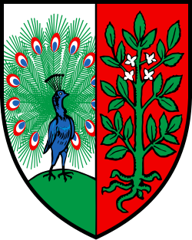
A beech for the French name, a peacock for the German name Pfauen: the coat of arms of Faoug, on the shore of Lake Morat, shows both.
Entry based on 10 sources · Our method · Reusable text (CC BY-SA)
Origin of the name Faoug
The name is attested in 1228 as «Fol». Later forms are «Fo» (1290) and «Foz» (1441). The German name is «Pfauen». The name is said to come from the Latin «fagus», the beech tree. The coat of arms shows a beech and, for the German name, a peacock.[1][2]
Coat of arms of Faoug
Per pale, Argent a peacock in his pride proper on a mount Vert, and Gules a beech tree eradicated Vert. The shield is divided vertically. On the left, on a white field, a peacock displaying its tail in its natural colours stands on a green mount. On the right, on a red field, rises a green beech tree with its roots. The arms already appear on a communal seal of 1713 and were definitively adopted in 1913. The German name of the village, Pfauen, means peacock, and the beech refers to the French name, which some etymologists derive from the Latin fagus (beech).[8][2]
Founding of Faoug
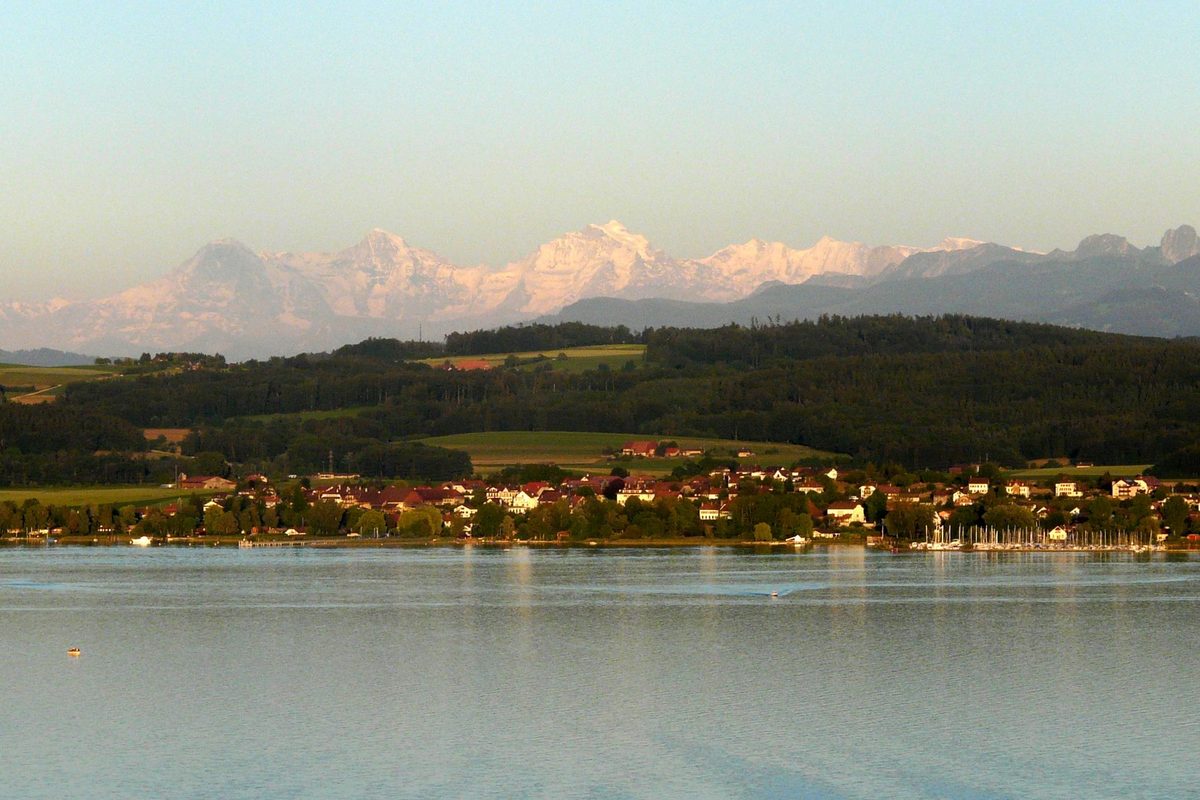
Who founded the medieval village of Faoug is not known. Yet the site, on the shore of Lake Morat, was occupied very early: several Neolithic pile-dwelling villages, a Hallstatt-period land settlement at the place called en Chaney, then a Roman villa and a small Roman cemetery. In the Middle Ages the inhabitants were subject to the Bishop of Lausanne. They owed him mounted service, a form of military service, and the guarding of a tower.[1][2]
History of Faoug
Neolithic. Several pile-dwelling villages on the shore of Lake Morat.[1][2]
Iron Age. Hallstatt-period land settlement at the place called en Chaney.[1]
Roman period. A Roman villa and a small Roman cemetery occupy the territory.[1]
1228. First mention of the place («Fol») and of the parish, with the church of Notre-Dame.[1][2]
Middle Ages. The inhabitants are subject to the Bishop of Lausanne, to whom they owe mounted service and the guarding of a tower.[1][2]
1491. The inhabitants obtain citizenship of Morat, with the consent of Bern and Fribourg.[2]
1536. Bernese conquest and Reformation; Faoug belongs to the bailiwick of Avenches until 1798.[1]
1550. The village has 24 hearths (households).[1]
1635. A school is built.[1]
1646. First mention of wine-growing.[1]
1765. The parsonage is restored.[1]
1798. Faoug is attached to the Helvetic canton of Sarine et Broye.
1846-1849. The parish is an annex of Donatyre.[1]
1876. The railway station opens.[1]
1920. A brickworks opens.[1]
1986. The parsonage is restored again.[1]
1990. A boatyard and a harbour are built; lake tourism develops.[1]
1990s. The A1 motorway attracts many German speakers, about one third of the population in 2000.[1]
2008. Faoug moves from the district of Avenches to the new district of Broye-Vully.[4][5]
Population of Faoug
Sources and references: [1][6]
| 1550 | 24 hearths (households) |
| 1764 | 203 |
| 1798 | 235 |
| 1850 | 425 |
| 1900 | 440 |
| 1950 | 458 |
| 1980 | 391 |
| 2000 | 559 |
| 2025 | 902 |
Families of Faoug
Burgher families before 1800. Cornaz, Demeyriez and Druey, with no precise date. The Druey, a farming family, held the office of mayor (Meier) of the village for centuries.[10][9]
From 1901 to 1962. Three entries: the Baumgart, from Germany, in 1946, the Kormann of Bern in 1958 and the Trefzer, also from Germany, in 1961.[10]
Notable people of Faoug
Henri Druey (Faoug 1799 - Bern 1855). Son of Jean-Daniel Druey and Suzanne-Catherine Langel, who ran the village inn. A member of the Vaud Grand Council from 1828 and a councillor of state in 1831, he led the Vaud revolution of 1845. Elected to the first Federal Council in 1848, he sat on it until his death and was President of the Confederation in 1850.[9][2]
Economy of Faoug, past and present
From vines to meadows. Vines were introduced in Faoug in 1646. In the 18th century they gave way to sown meadows and horticulture.[1]
Wine, grain and horses. The village traded in wine, with a bonded warehouse set up in the early 19th century. Grain and horses were also sold here.[1]
Workshops and a brickworks. Faoug has small engineering firms and crafts. A brickworks and a pipe factory opened in 1920.[1]
Historic sites in Faoug
Church and parsonage. Notre-Dame parish mentioned from 1228, reformed in 1536. The parsonage was restored in 1765 and 1986.[1]
Domaine Cornaz and its outbuildings. Estate listed as a cultural property of national significance.[3]
Lake Morat shore and harbour. Harbour and boatyard built in 1990, at the heart of the village's lake tourism.[1]
Remains in Faoug
Lake dwellings. Several Neolithic pile dwellings, notably at Poudrechat, Gare and Port, listed as cultural properties of regional significance.[1][3]
Hallstatt settlement of en Chaney. Land settlement of the Early Iron Age.[1]
Roman villa. A villa and a small Roman cemetery attest to the occupation of the site in the Roman period.[1]
Protected heritage in Faoug
Cultural property of national significance (A objects in the PCP inventory)[7]
- Domaine Cornaz: maison de maître et paysanne, rural et fontaine
Cultural property of regional significance (B objects)[7]
- La Gare, station lacustre néolithique
- Le Port, station lacustre néolithique
- Poudrechat, station lacustre néolithique
- Péage et maison du commis
Traditions and festivals in Faoug
Festivals at the beach. The communal beach, with its small harbour and bathing huts from the early 20th century, hosts the annual youth festival, the 1st of August and the village festival.[2]
Sources
- Dictionnaire historique de la Suisse, « Faoug »
- Feuille des avis officiels du canton de Vaud, Alphabet des communes, « Faoug »
- Office fédéral de la protection de la population, Inventaire PBC, liste cantonale VD (état au 1.1.2026)
- Canton de Vaud, Loi sur le découpage territorial (LDecTer, RSV 132.15) du 30 mai 2006
- État de Vaud, communiqué du 12.07.2007, « Organisation des préfectures et adaptation au nouveau découpage territorial »
- Statistique Vaud, « Population résidante permanente au 31 décembre 2025 »
- Federal Office for Civil Protection (FOCP), Swiss Inventory of Cultural Property (PCP), list for the canton of Vaud (as of 1.1.2026)
- IPI, Swissreg, emblems database: coat of arms of Faoug (no. 101556)
- André Lasserre, David Auberson, "Druey, Henri", Historical Dictionary of Switzerland (German version), version of 10.03.2022
- Register of Swiss Surnames, 3rd edition (1989), search Commune "Faoug", Canton VD
Published by Sébastien Jörg ·
Other villages near Faoug
Missing information, or do you have a source? Suggest a correction or addition. Every submission is checked before it's published.
Suggest a change