
Grimentz
Origin of the name Grimentz
Form « Grimiens » before 1052. Old German name « Grimensi ». The form « Grimenchy » is attested in 1245. Other forms are reportedly recorded, « Grimesi » (1243) and « Grimeynchi » (1305). The name is said to be formed from a Germanic personal name (Grimo) and a Latin suffix « -incu », meaning « property of Grimo ».
Founding of Grimentz
A former municipality of the district of Sierre, Grimentz lies on the left bank of the Gougra, in the Val d'Anniviers. Like the whole valley, the village depended in the 11th century on the bishop of Sion Aimo, then on the counts of Granges, before passing to the d'Anniviers family and the lords of Rarogne. It was the first village in the valley to constitute itself as a commune, and later formed with Saint-Jean one of the quarters of the Val d'Anniviers. After the French invasion this quarter became a third, divided into two half-thirds, Saint-Jean and Grimentz, the latter including Vissoie, which led to two great lawsuits between Grimentz and Vissoie. Ecclesiastically, Grimentz depended on the parish of Anniviers at Vissoie, then became a rectorate and finally a parish in 1933 (or 1934). Mountain farming, with the Hérens breed on the alpine pastures of Avoin, Moiry and Torrent, prevailed until the early 20th century, before the Moiry dam and tourism.
History of Grimentz
before 1052. Mention in the form « Grimiens » (or in the 1100s).
11th century. Like the whole Val d'Anniviers, Grimentz depends on the bishop of Sion Aimo, then on the counts of Granges.
1200-1360. Lordship of the d'Anniviers family.
1243. Grimentz is the first village in the valley to constitute itself as a commune.
14th century. Grimentz forms, with Saint-Jean, one of the quarters of the Val d'Anniviers.
1381. Start of the rule of the lords of Rarogne, until the end of the 15th century.
1550. Construction of the burgher house (or around 1500).
17th century. Construction of the chapel of Saint-Théodule.
1762. An oratory dedicated to Notre-Dame-de-Compassion is erected.[3]
1798. French invasion; the quarter of Grimentz becomes a third, divided into two half-thirds: Saint-Jean and Grimentz, which includes Vissoie.
1814-1824. First great lawsuit between Grimentz and Vissoie, ending in the status quo.
1825. Grimentz becomes a rectorate.
1830. Construction of the church.
1897-1914. Second great lawsuit, leading to Vissoie being made a municipality.
1933. Grimentz becomes a parish (or in 1934).
1951. The church is rebuilt.[3]
1957. Construction of the Moiry dam.
1960s and 1970s. Development of tourism.
1971. Construction of the chapel des Meyes (Notre-Dame-des-Roses).
1999. In May, a flood of the Marais torrent reportedly caused heavy damage in the village.
2009. On 1 January, Grimentz merges with Ayer, Chandolin, Saint-Jean, Saint-Luc and Vissoie into the municipality of Anniviers.[2]
Population of Grimentz
| 1850 | 230 |
| 1900 | 249 |
| 1950 | 191 |
| 1980 | 271 |
| 2000 | 404 |
Historic sites in Grimentz
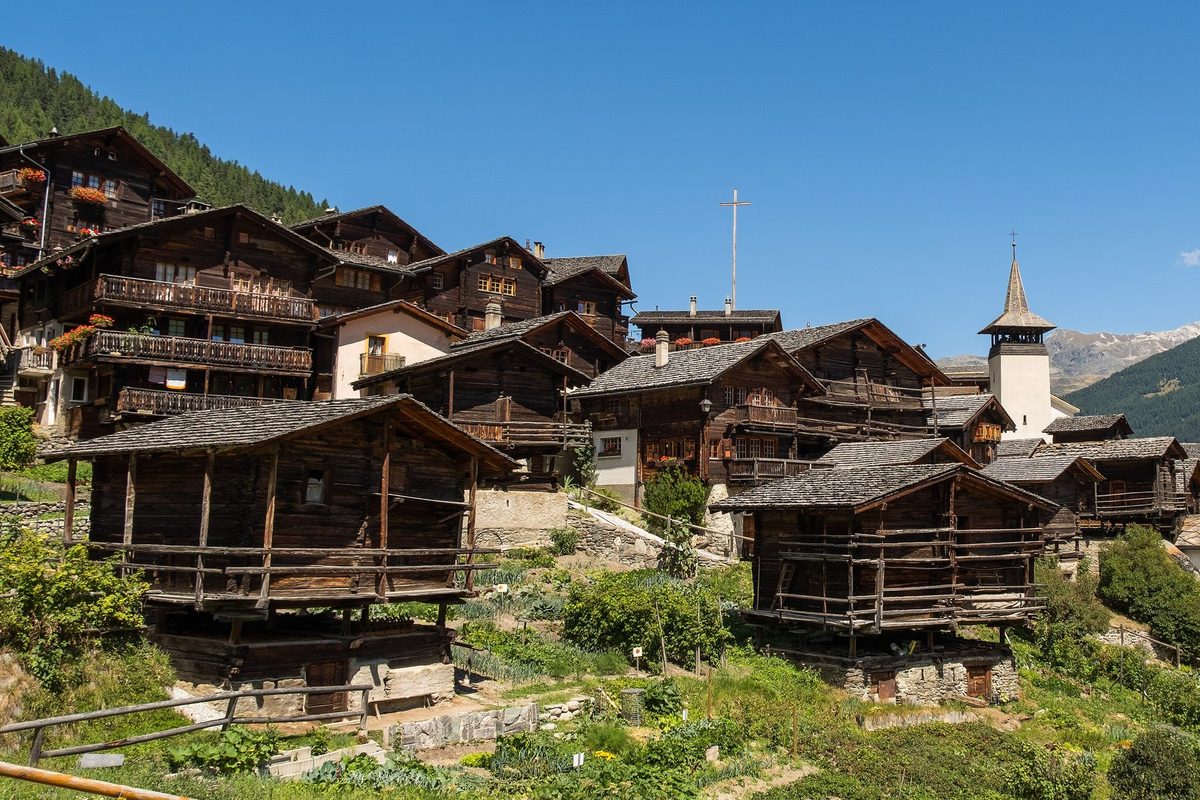
The village and its Anniviers architecture. The village has preserved an architecture typical of the Val d'Anniviers, which has made it known. A photograph by Hyppolite Chappuis around 1920 shows it before the tourist boom.
The burgher house and the glacier wine. The burgher house dates from 1550 (or around 1500). Its cellars hold the vin du Glacier (glacier wine), including the Bishop's barrel, with wine from 1886, once offered only to the bishop.[4]
Church, chapels and chapel des Meyes. The church, built in 1830, was rebuilt in 1951. The chapel of Saint-Théodule dates from the 17th century and a chapel of Notre-Dame-de-Compassion from the 18th century. A Way of the Cross leads to the chapel des Meyes, or Notre-Dame-des-Roses, built in 1971.
Alpine pastures and Moiry dam. The alpine pastures of Avoin, Moiry and Torrent were grazed by the Hérens breed. The Moiry dam, built in 1957, marks the shift to an industrial and tourist economy.
Remains in Grimentz
Cup-marked stones. Near the bridge crossing the Gougra towards the Ilôt Bosquet lies a group of cup-marked stones, with the Pirra Martera (Martyrs' Stone) at its centre, thought to date from the Neolithic or the Bronze Age.[5]
Legends of Grimentz
The Boconett. According to tradition, in 1348 girls who were herding the cattle are said to have escaped the plague. In remembrance, a share of cheese from the Torrent alpine pasture is reportedly handed out to the children every year.
Sources
- Dictionnaire historique de la Suisse, « Grimentz » (Bernard Monnet, version du 23.12.2016)
- Etat du Valais, Département des finances, des institutions et de la santé, Service des affaires intérieures et communales, « Rapport sur les finances communales 2008 » (février 2010) (fusions de communes et dates d'entrée en vigueur)
- Inventaire fédéral des sites construits à protéger en Suisse (ISOS), « Grimentz », 2e version, juin 1996
- Swiss Wine Valais, « Bourgeoisie de Grimentz » (vin du Glacier, tonneau de l'évêque)
- Val d'Anniviers Tourisme, « Cup-and-ring stones » (pierres à cupules de Grimentz)
- geo.admin.ch, recherche de lieux (coordonnées)
Other villages near Grimentz
Missing information, or do you have a source? Suggest a correction or addition. Every submission is checked before it's published.
Suggest a change