Huémoz
At about 1'000 m, on a hillside of Ollon, Huémoz held a fair from 1584 to 1904 and, from 1732 to 1884, was home to one of the first sacred-music choirs in the Pays de Vaud.
Entry based on 9 sources · Our method · Reusable text (CC BY-SA)
Origin of the name Huémoz
The hamlet appears as « Uemo » in 1300, then « Oësmoz » in 1467. The sense of the word has not been cleared up.[4]
Founding of Huémoz
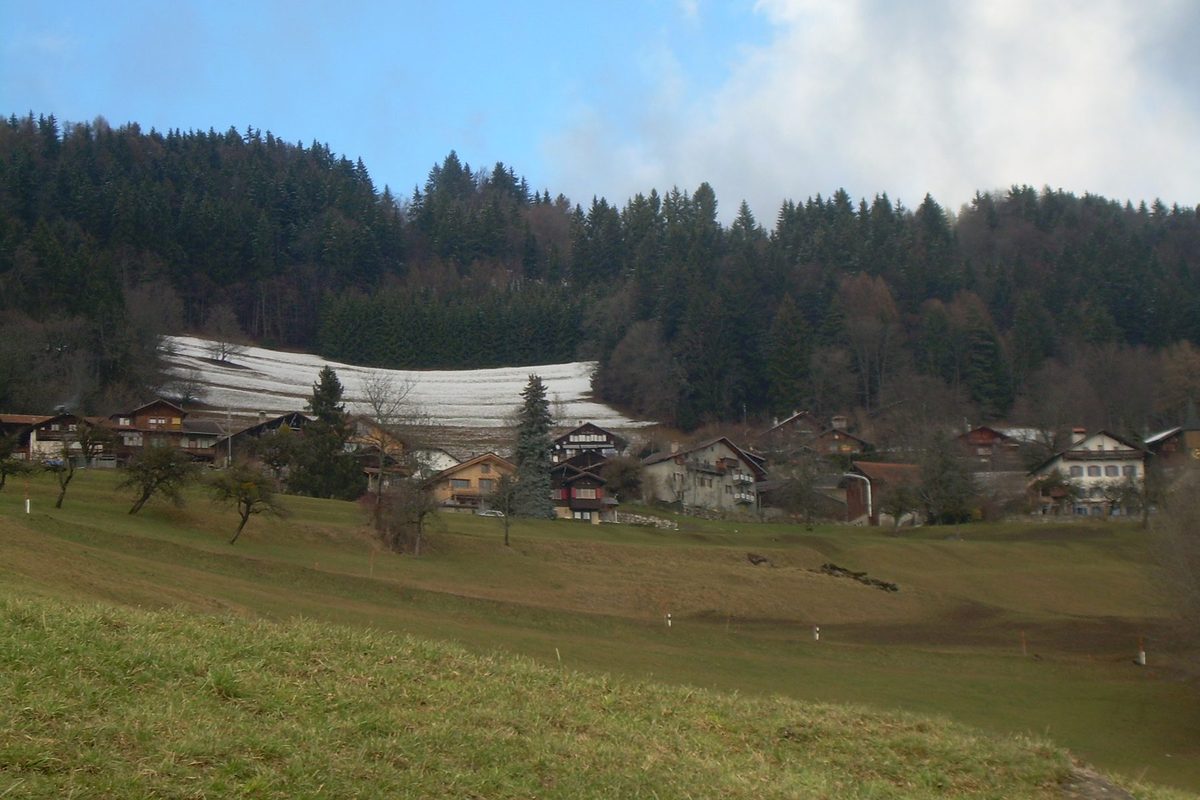
This hamlet of the municipality of Ollon lies in the Mi-Monts zone, between the plain and the alpine area of Villars-Chesières, mainly on a steep south-facing hillside. It formed one of the twelve dizains (districts) of the municipality of Ollon, and one of the six mountain dizains, with Villars, Chesières, Arveyes, Panex and Forchez. In the early 21st century its economy still relied on livestock farming, as the steep terrain limited tourist development.[2][4]
History of Huémoz
1300. First known mention of the hamlet, as « Uemo ».[4]
1398. The hamlet has 9 hearths.[4]
1440. Pope Felix V authorises the building of a church at Huémoz.[4]
1449. The chapel is founded. It was probably dedicated to Saint George.[5]
1484-1529. After the Bernese conquest the inhabitants pay Bern a due to keep their services. Governor Naegeli waives it in 1529, and from then on the pastor of Ollon comes to preach at Huémoz.[5]
1584-1904. A fair is held at Huémoz.
1732-1884. A sacred singing society exists, one of the first in the Vaud region.
1824. Huémoz becomes a Protestant parish, until 1845. The same year its inhabitants try unsuccessfully to separate from the municipality of Ollon.[2][4]
1843. Date of the present church, in whose nave the bell is kept.
1860. Huémoz again becomes a parish, until 1999. Villars is detached from it in 1947 to form an independent parish.
1874. End of the division of the municipality of Ollon into dizains, which included Huémoz.[2][4]
1899. Construction of the neoclassical school, refurbished in 1937.[4]
Around 1900. The village, in a superb setting on the Aigle-Ollon-Villars road, has 54 houses and 209 Protestants. With Les Combes the section has 60 houses and 236 people. Cattle are raised, land farmed and the nearby forests worked. It has a post office, a telephone and the Aigle-Villars mail coach. One of the temple's three bells, a very old one, bears the greeting « Ave Maria gratia plena », and above the church, at about 1050 m, a walnut tree still grows, a rare sight at that height.[5]
Population of Huémoz
Sources and references: [4]
| 1398 | 9 hearths (households) |
| 1764 | 189 |
| 1860 | 250 |
| 1930 | 211 |
| 2000 | 188 |
Notable people of Huémoz
Francis and Edith Schaeffer. In 1955 the couple opened their home in Huémoz to guests: this was the start of L'Abri, French for "shelter". From a single chalet, Swiss L'Abri has grown, by its own account, to include Chalet Bellevue for students, four staff chalets and Farel House, its library and chapel.[8][9]
Economy of Huémoz, past and present
Seasonal herding. The farmers of Huémoz followed their livestock through the seasons with their families: down to the Rhône plain, up to the intermediate pastures between 1'200 and 1'600 metres, then to the alpine pastures of Bretaye and La Croix. They also worked vineyards at Crétel d'Antagnes, lower down the slope, where they gathered chestnuts. Until the late 19th century the terraces near the houses were sown with cereals. They have become meadows. In the second half of the 20th century farms closed or merged. In 2013 the ISOS counted only two, moved out of the old village in the 2000s.[4]
Guesthouses, chalets and workshops. The carriage road from Ollon to Chesières, built mainly between 1864 and 1868, made access from the plain easier. Huémoz did not share the hotel boom of Chesières and Villars, but the proximity brought two guesthouses, the first holiday chalets, then housing in the 20th century. Shops closed in the second half of the 20th century, a café-restaurant stayed open until the early 21st century. A small craft zone developed from the 1980s. Two carpentry firms occupy former farm buildings, an antiques shop the old bakery.[4][7]
Historic sites in Huémoz
Huémoz church. A church was authorised in 1440 by Pope Felix V. The present church is dated 1843. Work was completed in 1845 and the building was restored in 1932 and 1963. Three-sided choir, small bell turret above the entrance front.[4]
Protected heritage in Huémoz
Cultural property of regional significance (B objects)[6]
- Huémoz, église réformée
Sources
- Jean-Jacques Bouquet, « Huémoz », Dictionnaire historique de la Suisse, version du 03.05.2005
- Emmanuel Abetel, « Ollon », Dictionnaire historique de la Suisse, version du 30.11.2010
- Statistique Vaud, « Population résidante permanente au 31 décembre 2025 »
- Office fédéral de la culture, Inventaire fédéral des sites construits d'importance nationale à protéger en Suisse (ISOS), « Huémoz, commune d'Ollon » (2e version, 11.2013)
- Dictionnaire géographique de la Suisse, tome II (Neuchâtel, Attinger, 1903)
- Federal Office for Civil Protection (FOCP), Swiss Inventory of Cultural Property (PCP), list for the canton of Vaud (as of 1.1.2026)
- Official Gazette of the Canton of Vaud (FAO), "Alphabet des communes vaudoises: Ollon"
- Swiss L'Abri, "About L'Abri" page
- Swiss L'Abri, "History" page
Published by Sébastien Jörg ·
Other villages near Huémoz
Missing information, or do you have a source? Suggest a correction or addition. Every submission is checked before it's published.
Suggest a change