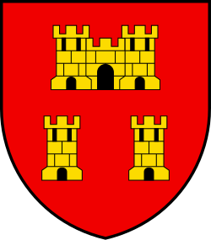
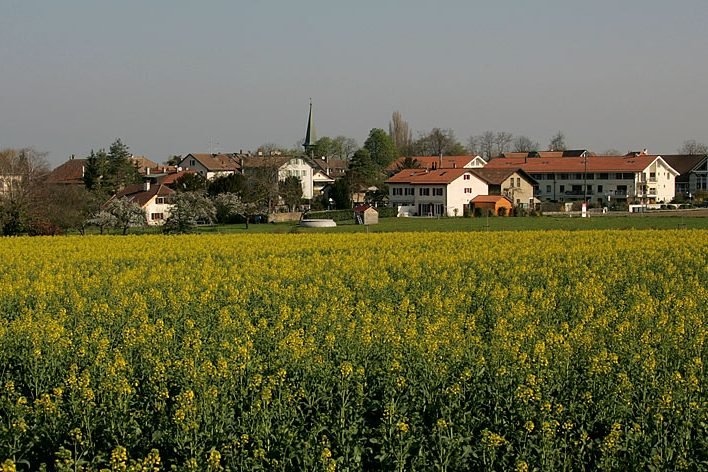
Jussy
Origin of the name Jussy
The name appears in 1180 as « Jussiacum Episcopi », meaning « Jussy of the bishop ». It is said to come from a Gallo-Roman estate, « Jussiacum », formed on the Roman family name Justius, but this origin is not confirmed.[1]
Founding of Jussy
Nobody knows who founded the village. A first sanctuary stood on the site of the church as early as the Carolingian period. In the Middle Ages Jussy was at the centre of the episcopal mandement of the same name and had three castles: Le Crest, Lullier and the bishop's castle. The latter stood at the heart of a fortified bourg, today's hamlet of Le Château, where the bishop stayed from time to time. After the fortress was burned, the people of Jussy asked to come under the rule of Genève, and the mandement passed to the Seigneurie. Long an enclave, Jussy was only joined to the rest of the canton by the Treaty of Turin. The municipality included the village of Gy until 1850 and has remained agricultural.[1]
History of Jussy
Carolingian period. A first sanctuary stands on the site of the church. Its traces were found in the excavations of 1973.[1]
1180. First mention of the name, as « Jussiacum Episcopi ».[1]
1261. First mention of the forest of Jussy, which covers about 400 hectares.[1]
1305. First mention of Lullier, as « Lullye ». The hamlet is a fief of the chapter of Saint-Pierre.[3]
1313. First mention of Le Crest, a fortified house built in the 13th century at the entrance to the village.[2]
1534. The episcopal fortress of Jussy becomes the main centre of resistance of the bishop and the Duke of Savoy against Genève.[1]
1536. The fortress is burned and the parish adopts the Reformation.[1]
1590. During the war against Savoy, Genève places a garrison at Le Crest and then, no longer able to maintain it, orders the fortress to be dismantled.[2]
1621. Agrippa d'Aubigné, who has bought the site from Louis Franc, obtains permission to rebuild the Château du Crest, which becomes a meeting place for men of letters.[2]
1637. Renée Burlamaqui, widow of Agrippa d'Aubigné, sells Le Crest to Jacques Micheli. Six Micheli are its lords until the Revolution.[2]
1645-1760. Part of Jussy forms the fief of Les Arales, granted to the Ducommun, to Théodore Ferrier and then to the Loys.[1]
Around 1665-1856. The forest of Jussy belongs to the Hôpital général.[1]
1681. The so-called Brogny stalls, from the 15th century, are installed in the church of Sainte-Marie-Madeleine.[1]
1725. Construction of the fortified house of Les Grands Bois.[1]
1794. In January the « expédition de Jussy » leads to the occupation of Le Crest and the estate of La Gara, wrongly suspected of being centres of conspiracy, and to the imprisonment of their owners.[1][2]
1798-1814. Jussy is a French municipality, in the Léman department.[1]
1816. The Treaty of Turin ends Jussy's status as an enclave by attaching the neighbouring municipalities to the canton. Part of the former fief of Les Arales is ceded to Savoy.[1]
1974. Opening of the Lullier horticultural centre, whose engineering school joins the University of Applied Sciences and Arts Western Switzerland (HES-SO) in 2003.[3]
1991. Construction of the Les Beillans school and sports centre.[1]
1995. Yves Micheli places the Château du Crest and the family heritage in a private foundation, the Fondation Micheli-du-Crest.[2]
Population of Jussy
Sources and references: [1][5]
| 1789 | 860 |
| 1850 | 1'020 |
| 1860 | 705 |
| 1900 | 617 |
| 1950 | 650 |
| 2000 | 1'107 |
| 2025 | 1'256 |
Historic sites in Jussy
Le Château. Hamlet where the fortified bourg stood around the bishop's castle, a temporary residence of the bishops of Genève and the centre of resistance against Genève in 1534-1536.[1]
Château du Crest. Cultural property of national importance at the entrance to the village, on the site of a 13th-century fortified house. Dismantled in 1590, it was rebuilt from 1621 by Agrippa d'Aubigné and has belonged to the Micheli since 1637. In the 19th century the botanist Marc Micheli grew rare trees and plants there and added a square tower to the east side. The family's descendants still own it.[2][4]
Lullier. Hamlet divided into Petit and Grand Lullier, a fief of the chapter of Saint-Pierre. A fortified house surrounded by a moat, with a drawbridge, stood at the place called ès Canevet. The powerful de Jussy family still lived there in the 16th century, and Jeanne de Jussie was one of its last members. The Lullier horticultural centre opened there in 1974 and the cantonal agronomy laboratory moved there in 1987.[3]
Church of Sainte-Marie-Madeleine. Church enlarged several times, built over the traces of a Carolingian sanctuary, which houses the so-called Brogny stalls. The parish has been Reformed since 1536.[1]
Forest of Jussy. Woodland of about 400 hectares cited from 1261, owned by the Hôpital général from about 1665 to 1856. After a land consolidation, much of the woodland belongs to the State.[1]
Fortified house of Les Grands Bois. Fortified house built in 1725.[1]
Remains in Jussy
Carolingian sanctuary. Traces of a first sanctuary from the Carolingian period, uncovered in the 1973 excavations in the church of Sainte-Marie-Madeleine.[1]
Brogny stalls. 15th-century choir stalls, brought to Jussy in 1681 and kept in the church.[1]
Bishop's castle. Episcopal castle at the centre of a fortified bourg in the hamlet of Le Château, used as a temporary residence by the bishop; burned in 1536.[1]
Sources
- Dictionnaire historique de la Suisse, « Jussy » (Marie-Claude Loup Micheli), version de 1998 remaniée le 26.07.2007
- Dictionnaire historique de la Suisse, « Crest, Le » (Marie-Claude Loup Micheli), version de 1998 remaniée le 17.08.2005
- Dictionnaire historique de la Suisse, « Lullier » (Marie-Claude Loup Micheli), version de 1998 remaniée le 01.12.2009
- Office fédéral de la protection de la population, Inventaire PBC, liste cantonale GE (état au 1.1.2026) : n° 2595, château du Crest et dépendances, objet A
- Office cantonal de la statistique (OCSTAT), Mémento statistique du canton de Genève 2026, tableau Population résidante par commune, en 2025
Localities of the municipality with a page
Other villages near Jussy
Missing information, or do you have a source? Suggest a correction or addition. Every submission is checked before it's published.
Suggest a change