Le Pâquier
Le Pâquier takes its name from grazing land, recorded in 1328. Above the village, the Col des Pontins led towards the Bishopric of Basel, and its toll was abolished in 1818.
Entry based on 13 sources · Our method · Reusable text (CC BY-SA)
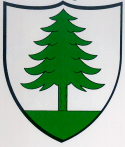
Coat of arms: Public domain, Wikimedia Commons
Origin of the name Le Pâquier
The place is recorded in 1328 in the form « Pasquier ». The word pâquier (formerly pasquier) means a pasture, often a common one. It is traced back to the Latin « pascua », pasture. The name thus describes what the place originally was: grazing land. The coat of arms shows a fir tree, evoking the commune's wooded pastures. The inhabitants are nicknamed the Corbés or Corbeaux.[1][8][9]
Founding of Le Pâquier
Le Pâquier has no known founder or founding act. The name suggests that a pasture came before the village. It lies at the north-eastern end of the Val-de-Ruz, on the road from Neuchâtel to Saint-Imier. It belonged to the lordship and later the mairie of Valangin, and has been part of the parish of Dombresson from the beginning. The village community is mentioned from 1540. Higher up, on the present Bernese border, runs the once busy Col des Pontins.[1]
History of Le Pâquier
1328. First written mention, in the form « Pasquier ».[1]
1531. Le Pâquier has 8 hearths. In the same year the Reformation is introduced in the parish of Dombresson, to which it belongs.[1][2]
1540. First mention of the community of Le Pâquier.[1]
1592. The lordship of Valangin, to which the village belongs, is joined to Neuchâtel.[3]
1818. Abolition of the Pertuis-Bugnenets toll, on the once busy Col des Pontins, on the way to the Prince-Bishopric of Basel.[1]
1865. A private house is converted into a school.[1]
1943. Creation of the Combe Biosse nature reserve, on the foothills of the Chasseral.[1]
1972. Enlargement of the Combe Biosse reserve.[1]
1982-2008. Pupils from the hamlets of La Joux-du-Plâne and Derrière-Pertuis are grouped together at Derrière-Pertuis.[1]
20th century. Winter sports develop: the small Crêt-du-Puy ski area above the village and the Les Bugnenets resort.[1][12]
1 January 2013. Le Pâquier merges with Boudevilliers, Cernier, Chézard-Saint-Martin, Coffrane, Dombresson, Engollon, Fenin-Vilars-Saules, Fontainemelon, Fontaines, Les Geneveys-sur-Coffrane, Les Hauts-Geneveys, Montmollin, Savagnier and Villiers to form the municipality of Val-de-Ruz.[1][6]
Population of Le Pâquier
Sources and references: [1]
| 1531 | 8 hearths (households) |
| 1750 | 174 |
| 1850 | 333 |
| 1900 | 281 |
| 1950 | 211 |
| 2000 | 231 |
| 2012 | 212 |
Families of Le Pâquier
Citizen families before 1800. Cuche, L'Epée, Maumary and Vauthier, with no precise date.[13]
In the 19th century. Girard, Jacot, Jaquet, Jeanfavre and Margraitner, with no precise date.[13]
From 1901 to 1962. Only three entries: the Wittwer family from Linden BE in 1901, the Cometti family from Italy in 1946 and the Miltenoff family from Bulgaria in 1959.[13]
Economy of Le Pâquier, past and present
Fields, timber and crafts. Le Pâquier lives from farming, forestry and crafts.[1]
Skiing. At 1'091 metres, the Les Bugnenets winter resort offers downhill runs and cross-country trails. Most of its visitors come from the region.[1]
Historic sites in Le Pâquier
The Col des Pontins and the former toll. On the present Bernese border, the Col des Pontins was once a busy pass. The Pertuis-Bugnenets toll, on the way to the Prince-Bishopric of Basel, was levied there until its abolition in 1818.[1]
The Combe Biosse nature reserve. Created in 1943 on the foothills of the Chasseral, the reserve was enlarged in 1972.[1]
The Les Bugnenets and Crêt-du-Puy ski areas. The Les Bugnenets winter resort (1'091 m) offers downhill and cross-country runs to a regional clientele. The small family ski area of Crêt-du-Puy, just above the village, runs without artificial snow.[1][12]
A village between pastures and forests. The territory ranges from about 850 to 1'430 metres. Reportedly more than half is wooded and almost half is farmland. Farming, forestry and crafts have supported the village.[1]
The Le Pâquier forge. A craft forge still in operation keeps a traditional trade alive in the village. It has taken part in the European Artistic Crafts Days.
Traditions and festivals in Le Pâquier
The egg race. Every spring the village association holds an egg race, and an archive photograph shows the 1904 edition. The association, with some forty member families, runs one activity each season, including a torrée in autumn.[11]
Sources
- Dictionnaire historique de la Suisse, « Pâquier, Le (NE) » (Maurice Evard)
- Dictionnaire historique de la Suisse, « Dombresson » (Maurice Evard)
- Dictionnaire historique de la Suisse, « Seigneurie de Valangin »
- État de Neuchâtel, arrêté du 6 février 2013 portant homologation des résultats du recensement cantonal de la population du 31 décembre 2012
- Commune de Val-de-Ruz, « Histoire »
- Commune de Val-de-Ruz, « La commune en bref »
- Office fédéral de la statistique, « Portraits régionaux, chiffres-clés des communes »
- Chemins des Chouettes du Val-de-Ruz, panneau « Villages vaudruziens : blasons, noms, surnoms »
- habitants.ch, « Le Pâquier et ses habitants les Corbés »
- Ville de Neuchâtel, « Repères historiques »
- Association villageoise du Pâquier
- Suisse Tourisme (MySwitzerland), bulletin d'enneigement « Le Pâquier / Crêt-du-Puy »
- Register of Swiss Surnames, 3rd edition (1989), search Commune "Le Pâquier", Canton NE
Published by Sébastien Jörg ·
Other villages near Le Pâquier
Missing information, or do you have a source? Suggest a correction or addition. Every submission is checked before it's published.
Suggest a change