Pizy
In 1374 Guillaume de Pizy, provost of the Grand-Saint-Bernard and a native of the place, founded at Pizy a fortified hospice with a chapel for the upkeep of twelve canons.
Entry based on 6 sources · Our method · Reusable text (CC BY-SA)
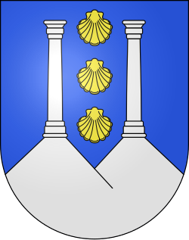
Coat of arms: CC BY 3.0, Own work, Wikimedia Commons
Origin of the name Pizy
The name Pizy is first attested in 1188 in the Latinized form 'Pisis'. The exact origin of the place name is not established.
Founding of Pizy
Pizy appears in documents from 1188. A local noble family, probably of seigneurial rank, is already attested on the site at that time. The village developed around isolated farms scattered between Aubonne and Gimel, at the foot of the Vaud Jura. In 1374 (or shortly before, as the announcement of his death is dated 2 August 1374), Guillaume de Pizy, a native of the place, canon and then provost of the Grand-Saint-Bernard from 1360, founded at Pizy a fortified hospice with a chapel, financed from his personal fortune and intended for the upkeep of twelve canons. From 1376 the hospice was placed under the protection of the lords of Aubonne, and Pizy's fate remained tied to that of this neighbouring seigneury.[2]
History of Pizy
1188. First written mention of the place in the form 'Pisis'. A local noble family is attested at the same period.
1360. Guillaume de Pizy becomes provost of the Grand-Saint-Bernard.[2]
1374. Guillaume de Pizy founds at Pizy a fortified hospice with a chapel, endowed with income for the upkeep of twelve canons. He dies the same year (his death is announced on 2 August 1374).
1376. The hospice of Pizy is placed under the protection of the lords of Aubonne.
15th century. The hospice, which was meant to be united with the priory of Etoy, becomes a mere dependency of it.
1536. The Protestant Reformation leads to the suppression of the hospice and of the Saint-Sylvestre chapel, which until then had formed an autonomous parish.
16th-18th centuries. The domain of Pizy comes under the Bernese bailiwick of Aubonne.
1798. End of the Bernese regime with the creation of the Helvetic Republic. Pizy joins the territorial organization of the new canton of Vaud.
19th-20th centuries. Pizy remains an independent municipality of the district of Aubonne, with an essentially agricultural and rural character.
2006. Pizy, with 71 inhabitants, turns to its neighbour Aubonne with a view to merging, notably for lack of volunteers for the municipal authorities.[4]
2008. On 1 January the district of Aubonne disappears. Pizy is attached to the new district of Morges.[5]
1 July 2011. Merger of Pizy with the municipality of Aubonne, described as a peaceful and unanimous union. Pizy ceases to exist as an independent municipality after more than eight centuries of attested existence.[3][4]
2021. Ten years later, the merged municipality of Aubonne in turn unites with Montherod, continuing the movement of communal mergers set in motion by the merger of Pizy.[3][4]
Population of Pizy
Sources and references: [4]
| 1764 | 68 inhabitants |
| 1850 | 139 inhabitants |
| 1900 | 103 inhabitants |
| 1950 | 90 inhabitants |
| 2000 | 65 inhabitants |
| 2006 | 71 inhabitants |
Families of Pizy
Citizen families before 1800. Thirty-one families. Ducart, Duvanney, Ewalt, Goin and Rebuz are citizens with no precise date. The others are admitted in the 18th century: the Huguenin in 1727, the Dentz, Theintz and Thentz in 1728, the Fontolliet, Griottier and Gouzy (from La Neuveville BE) in 1742, the Théodor in 1743, the Kohler and the de Fischer (from Bern) in 1744, the Butty in 1745, the Bourl'honne (from Montricher VD) in 1749, the Anthonet (from France) and the Pause in 1751, the Eperon in 1753. Then come the Cordier (from Germany) in 1762, the Stein (from Germany) in 1763, the Roth (from Austria) in 1764, the Brunner (from Germany) in 1765, the Morhardt in 1769, the Hertel (from France), Ochs and Reverchon (from France) in 1770, the Manger (from Germany) in 1771, the Baud (from France) in 1772 and the Loth (from Germany) in 1776.[6]
In the 19th century. Nine families, all with no precise date: Cavillier, Court, Cuénez, Deininger, Jäger, Landfried, Rauschert, Schnäbeli and Seibel.[6]
From 1901 to 1962. Thirty-two registrations, almost all from abroad. From Italy: Ogheri (1901), Gallarotti (1910), Di Laurenzio (1911), Zambone-dit-Zamboni (1917), Bertusi (1926), Salvalai (1927), Guarischetti (1931), Magni (1955) and Carlin (1958). From France: Jacquot (1911), Chaplet and Huit (1923), Broussoux and Duret (1924), Samuel (1925), Duverney and Pittet (1929), Ducret (1933) and Guntz (1953). From Germany: Dreyfuss (1910), Voss (1911), Schweitzer (1916), Kraus (1924), Borst (1926), Rebstein (1927), Moll (1951) and Uhlmann (1953). From Austria: Schagerl (1915) and Roettig (1926). From Hungary: Poldini (1924). The Passot, in 1955, have no place of origin listed.[6]
Notable people of Pizy
Guillaume de Pizy. Born into a noble family whose castle stood at Pizy, he is a canon of the Great St Bernard and prior of Étoy in 1359. He arbitrates many disputes throughout the Pays de Vaud. On 25 April 1372 he presides over the provincial chapter of the Augustinian canons at Belley, in the Bugey.[2]
Economy of Pizy, past and present
A rural village. Pizy lives mainly from farming. The village also has a small joinery and a retirement home.[1]
Historic sites in Pizy
Site of the former fortified hospice of Pizy. Founded in 1374 by Guillaume de Pizy, provost of the Grand-Saint-Bernard, this fortified hospice with a chapel durably marked the history of the place before its suppression in 1536 during the Reformation. Its exact location and current state of preservation would deserve to be verified through a visit or an additional source.
Saint-Sylvestre chapel (no longer extant). Chapel attached to the hospice, which formed an autonomous parish until its suppression in 1536 during the Protestant Reformation. No visible trace of it is known.
Hamlets and isolated farms between Aubonne and Gimel. The territory of the former municipality of Pizy is historically characterized by scattered settlement, made up of isolated farms, a reflection of its rural and agricultural character preserved until the 2011 merger.
Remains in Pizy
Necropolis remains and Bronze Age objects at Mauremont. Archaeological discoveries at the Mauremont site, on the territory of the former municipality of Pizy, have brought to light the remains of a necropolis as well as various objects dated to the Bronze Age. Precise details (finer dating, nature of the objects, excavations carried out) are not yet known.
Sources
- Dictionnaire historique de la Suisse, « Pizy »
- Dictionnaire historique de la Suisse, Ansgar Wildermann, « Pizy, Guillaume de », version du 28.09.2010
- Dictionnaire historique de la Suisse, Germain Hausmann, « Aubonne (commune) », version du 22.07.2021
- Sarah Rempe, « L'histoire d'une union évidente », Journal de Morges, 12 février 2021
- État de Vaud, communiqué du 12.07.2007, « Organisation des préfectures et adaptation au nouveau découpage territorial »
- Register of Swiss Surnames, 3rd edition (1989), search Commune "Pizy", Canton VD
Published by Sébastien Jörg ·
Other villages near Pizy
Missing information, or do you have a source? Suggest a correction or addition. Every submission is checked before it's published.
Suggest a change