
Saint-Brais
Origin of the name Saint-Brais
Saint-Brais is first mentioned in 1275 in the form « Sem Bris », as a dependency of the village of Planey. The old German name is « Sankt Brix ». The name refers to the patron saint of the church, Saint Brice. No other etymology has been put forward.[1]
Founding of Saint-Brais
The caves of Saint-Brais were frequented from prehistoric times. The village of Planey, located east of the present village, appears in 1139 among the possessions of the chapter of Saint-Ursanne. In 1275 Saint-Brais was still only a dependency of it. Planey is said to have been burned by French soldiers in 1637, and the present village grew up around the parish church of Saint-Brice. Saint-Brais belonged to the provostship of Saint-Ursanne, in the Prince-Bishopric of Basel.[1][2]
History of Saint-Brais
Around 40'000-35'000 BC. A Neanderthal incisor is left in cave 2.[1]
Around 10'000 BC. Knapped flints and bone tools from the end of the Ice Age in cave 1, which also yielded Neolithic finds.[1]
1450-1200 BC. Pottery from the end of the Middle Bronze Age and the beginning of the Late Bronze Age in the three caves.[1]
1139. The neighbouring village of Planey appears among the possessions of the chapter of Saint-Ursanne.[1]
1275. Mention of « Sem Bris », a dependency of the village of Planey.[1]
1637. Planey is said to have been burned by French soldiers.[1]
1656. The church of Saint-Brice is rebuilt.[1]
1765. The church is rebuilt again.[1]
1793-1813. Saint-Brais belongs to the French departments of Mont-Terrible and then Haut-Rhin.[1]
1815-1978. Saint-Brais belongs to the canton of Bern.[1]
Mid-19th century. Saint-Brais becomes a mixed municipality with two sections, Saint-Brais and Les Métairies.[1]
1935. Frédéric-Edouard Koby begins excavating the caves, work that continues into the 1960s.[1][2]
1955. Discovery in cave II (territory of Glovelier) of an upper left incisor of a Mousterian human, the first Neanderthal remain known in Switzerland.[1][2]
1965. Renovation of the church of Saint-Brice.[1]
2009. Installation of the first two wind turbines in the canton of Jura.[1]
Population of Saint-Brais
Sources and references: [1]
| 1818 | 307 |
| 1850 | 463 |
| 1870 | 562 |
| 1900 | 394 |
| 1950 | 343 |
| 2000 | 212 |
| 2010 | 221 |
| 2025 | 248 |
Historic sites in Saint-Brais
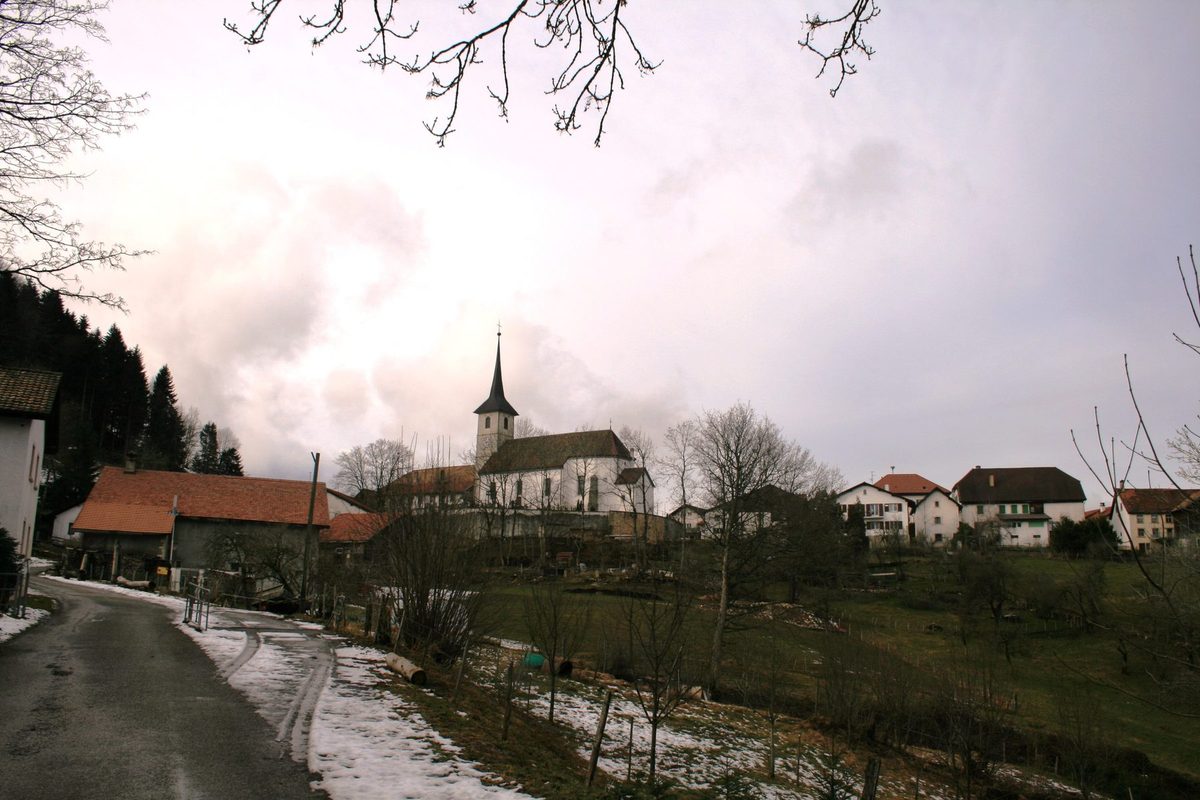
Church of Saint-Brice. Parish church around which the village grew. Rebuilt in 1656 and 1765 and renovated in 1965, it has a porch tower in dressed stone. A cultural property of regional importance. The parish also includes Montfavergier.[1][3]
Bollement pond. Pond that once supplied water power to a mill and a sawmill, now a nature reserve.[1]
Remains in Saint-Brais
Caves of Saint-Brais. Three caves lying between 950 and 1'000 m, explored by Frédéric-Edouard Koby from 1935 into the 1960s: Neanderthal incisor (1955, cave II), Pleistocene fauna including the cave bear, flints and bone tools from the end of the Ice Age and the Neolithic, Bronze Age pottery. Caves I and II lie on the territory of Glovelier (municipality of Haute-Sorne), cave III on that of Saint-Brais. The shelters « Saint-Brais I et II » and « Le Mont / Saint-Brais III » are cultural properties of national importance.[1][2][3]
Lost village of Planey. Village located east of the present village, mentioned in 1139 among the possessions of the chapter of Saint-Ursanne. Saint-Brais depended on it in 1275. It is said to have been burned in 1637.[1]
Sources
- Dictionnaire historique de la Suisse, « Saint-Brais » (François Schifferdecker, François Kohler), version du 13.07.2020
- Office de la culture du Jura, Section d'archéologie et paléontologie, « Les grottes de Glovelier et Saint-Brais »
- Office fédéral de la protection de la population (OFPP), Inventaire PBC, liste cantonale du canton du Jura (état au 1.1.2026)
- Statistique Jura, tableau JU-T.01.01.03, population résidante permanente au 31 décembre 2025
- geo.admin.ch (swisstopo), recherche de lieux « Saint-Brais »
Localities of the municipality with a page
Other villages near Saint-Brais
Missing information, or do you have a source? Suggest a correction or addition. Every submission is checked before it's published.
Suggest a change