Villars-Mendraz
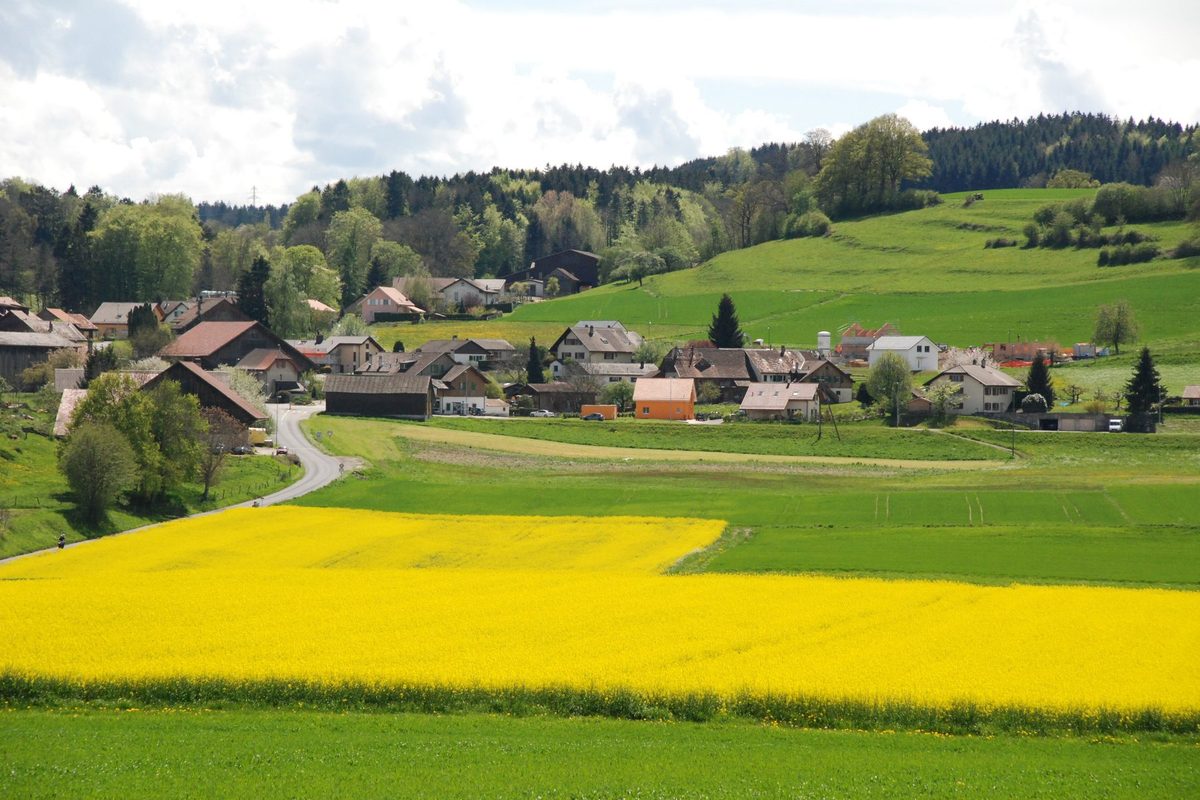
A former village of the Vaud Jorat, born from a medieval clearing under monastic influence, today a hamlet of the municipality of Jorat-Menthue.
Entry based on 7 sources · Our method · Reusable text (CC BY-SA)
Origin of the name Villars-Mendraz
The first reliable mention of the village dates from 1453, as «Villarmendra». A form «Vilar Mundri», dated 1235, is also linked to it. The name reportedly comes from the Latin villa Munderici, the «estate of Munderic», a personal name of Germanic origin.[1][3]
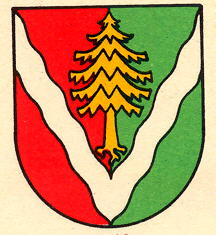
Coat of arms of Villars-Mendraz
Per pale gules and vert, a chevron wavy reversed argent, in chief a fir tree eradicated or. These are the arms of the former municipality. The shield is red on the left and green on the right. A white wavy chevron, point downwards, crosses it. Above stands a yellow fir tree with its roots showing.[3]
Founding of Villars-Mendraz
Nobody knows who founded Villars-Mendraz. It is a rural settlement probably born from a medieval clearing at the edge of the wooded Jorat massif, in an area where several religious institutions held land from the Middle Ages: the priory of Lutry and the Cistercian abbey of Hautcrêt held landed property there. In 1247, the lord Guillaume de Goumoëns granted the clergy and the inhabitants of the area full use of his Jorat wood, called «Bois de l'Évêque», for forestry and various agricultural uses, which shows that an organized village community already existed at that date. Like a large part of the medieval Pays de Vaud, the village then fell within the Savoyard sphere, before coming under Bernese administration after the conquest of the Pays de Vaud in 1536.[1][3]
History of Villars-Mendraz
1247. Guillaume de Goumoëns grants the clergy and the inhabitants of the area full use of the «Bois de l'Évêque» (Jorat Wood), attesting to the existence of a structured village community.[3]
1333. The mairie (local lordship of low justice) of Villars-Mendraz is held by a certain Hugues.[1]
Middle Ages (precise dates not determined). Existence of a parish with a church dedicated to Saint Peter, the presentation right (right to appoint the priest) of which belongs to the priory of Lutry.[1]
1453. First reliable mention, as «Villarmendra». A form «Vilar Mundri» of 1235 is reportedly also linked to it, though this is not confirmed.[1][3]
1536. Bernese conquest of the Pays de Vaud: Villars-Mendraz becomes part of the bailiwick of Moudon, through the châtellenie of Villarzel.[1][3]
16th century (after the Reformation). The parish is abolished with the introduction of the Reformation. The Saint-Pierre church becomes an annex of the parish of Saint-Cierges.[1]
17th century. The mairie of Villars-Mendraz passes to the Demierre family, of Moudon.[1]
1723. Territorial exchange with the neighbouring municipality of Sottens.[3]
1727. Territorial boundary agreement with Montaubion-Chardonney.[3]
1752. Before the bailiff Samuel Egger, the municipality's territorial boundaries, still valid today, are set.[1][3]
1753. The mairie of Villars-Mendraz passes to the Constant d'Hermenches family.[1]
1798. Fall of the Ancien Régime. Under the Helvetic Republic, Villars-Mendraz is attached to the canton of Léman.
1803. With the Act of Mediation, Villars-Mendraz becomes part of the new canton of Vaud.
1798-2007. The municipality is part of the district of Moudon.[1]
1910. The annex parish is united with that of Peney-le-Jorat, a union that would last until 2000.[1]
1977. Adoption of a communal zoning plan, marking the village's gradual transition from an agricultural economy to a residential vocation.[1]
1991. Creation of a communal arboretum on the occasion of the 700th anniversary of the Swiss Confederation.
1999. The municipality acquires the Café de la Poste, which becomes the village's official meeting place.[4]
2008. On 1 January, the new Vaud districts come into force: the district of Moudon disappears and Villars-Mendraz joins the Gros-de-Vaud district.[6]
2011. Closure of the village's primary school class as part of the regional school centralisation.[4]
1 July 2011. Villars-Mendraz merges with Montaubion-Chardonney, Peney-le-Jorat, Sottens and Villars-Tiercelin to form the new municipality of Jorat-Menthue.[1][5]
Population of Villars-Mendraz
Sources and references: [1]
| 1416 | 4 hearths (tax units/households) |
| 1764 | 94 inhabitants |
| 1798 | 105 inhabitants |
| 1850 | 200 inhabitants |
| 1900 | 137 inhabitants |
| 1950 | 112 inhabitants |
| 1970 | 84 inhabitants |
| 2000 | 190 inhabitants |
Families of Villars-Mendraz
Citizen families before 1800. Cornu, Devallonné, Dufour, Dumard, Dunand, Jaton and Liard, all with no precise date.[7]
From 1901 to 1962. Only two families: the Goutte, from France, in 1948, and the Schori of Radelfingen BE in 1956.[7]
Economy of Villars-Mendraz, past and present
From fields to Lausanne offices. Still agricultural, Villars-Mendraz has 43% of its jobs in the primary sector in 2005, but is becoming a residential community. About three in four working residents work outside the village, mainly in the Lausanne area. The others are self-employed: farmers, a baker, a painter, a mechanic, craftsmen.[1][4]
The Bishop's Wood. From 1247 the inhabitants may take wood from the Bishop's Wood in the Jorat for heating, building and selling, hunt there and graze their herds. The division of this wood, a source of disputes and lawsuits, is marked by seven boundary stones. When the boundaries are fixed in 1752, the municipality still owns forests at Peney-le-Jorat, Montaubion-Chardonney and Villars-Tiercelin.[1][3]
Historic sites in Villars-Mendraz
Le Café de la Poste. Owned by the municipality since 1999, this establishment is the village's main meeting place and hub of social life, in a hamlet where three-quarters of working residents now work outside the locality.[4]
The 700th anniversary arboretum. A communal arboretum was planted in 1991 on the occasion of the celebrations of the 700th anniversary of the Swiss Confederation, marking the village's attachment to its wooded areas, historically at the heart of its economy (Jorat wood).
The former Saint-Pierre parish church. In the Middle Ages the village had a church and a parish dedicated to Saint Peter, the presentation right of which depended on the priory of Lutry. After the Reformation, the building became an annex of the parish of Saint-Cierges. Whether it survives today, and in what condition, is uncertain.[1]
Sources
- Dictionnaire historique de la Suisse (DHS), article « Villars-Mendraz »
- Historisches Lexikon der Schweiz (HLS), Artikel „Villars-Mendraz" (version allemande)
- Commune de Jorat-Menthue, page « Historique »
- Commune de Jorat-Menthue, page « Présentation »
- État de Vaud, Décret du 12 octobre 2010 sur la fusion des communes de Montaubion-Chardonney, Peney-le-Jorat, Sottens, Villars-Mendraz et Villars-Tiercelin
- État de Vaud, communiqué du 12.07.2007, « Organisation des préfectures et adaptation au nouveau découpage territorial »
- Register of Swiss Surnames, 3rd edition (1989), search Commune "Villars-Mendraz", Canton VD
Published by Sébastien Jörg ·
Other villages near Villars-Mendraz
Missing information, or do you have a source? Suggest a correction or addition. Every submission is checked before it's published.
Suggest a change