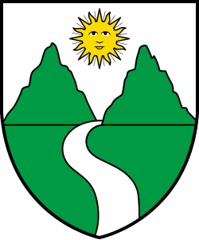
Zwischbergen
Origin of the name Zwischbergen
The name appears in the forms « Zewischeneberuen » (1304) and « Zwisbergen » (1390). It is said to describe the valley, framed to the north and south by peaks of up to 3'500 metres, though this is uncertain. In Upper Valais dialect the municipality is reportedly called « Zwischbärgu ».
Founding of Zwischbergen
Zwischbergen is said to be a medieval Walser foundation, though this is uncertain. The municipality, in the district of Brig, lies on the south side of the Simplon Pass and is bordered on three sides by Italy. Its centre is the village of Gondo, where the Zwischbergental, running south-west, begins. The municipality also includes the hamlets of Bellegge, Bifig, Bord, Egerten, Furgge, Hof and Katzhalden. The parish of Gondo already existed in the 16th century. It was refounded in 1637, detached from the diocese of Novara and joined to that of Sion in 1822, then entrusted in 1990 to the parish priest of Simplon. From the 17th century until 1875 the von Stockalper family owned a gold mine in the municipality. The gold mining company, which struck its own coins, went bankrupt in 1896. The economy also relies on alpine pastures and on energy produced from the Grosswasser stream, with the Zwischbergen dam and the Gondo power station brought into service in 1952. Paths lead over the Zwischbergen Pass to the Saas valley and over the Monscera Pass to Italy.
History of Zwischbergen
1304. Recorded as « Zewischeneberuen ».
1390. Recorded as « Zwisbergen ».
16th century. The parish of Gondo already exists.
1637. The parish of Gondo is refounded.
1642. The chapel at Bord is built.
1660-1691. The gold mines reportedly reached their peak under Kaspar Stockalper.
1715. The pilgrimage chapel of Maria Bru is built.
1741. Franz Joseph Burgener operates an iron mine.
1822. The parish is detached from the diocese of Novara and joined to the diocese of Sion.
1875. End of the von Stockalper family's ownership of the gold mine, held since the 17th century.
1896. Bankruptcy of the gold mining company, which struck its own coins.
1952. The Zwischbergen dam and the Gondo power station are brought into service.
1990. The parish is served by the parish priest of Simplon.
2000. On 14 October a landslide kills 13 people in Gondo, destroys the heart of the village and reduces most of the Stockalper Tower to rubble.[2]
2004. The rebuilt village is reportedly inaugurated on 14 October.
Population of Zwischbergen
Sources and references: [4]
| 1798 | 59 inhabitants |
| 1850 | 43 inhabitants |
| 1900 | 131 inhabitants |
| 1950 | 249 inhabitants |
| 2000 | 78 inhabitants |
| 2025 | 75 inhabitants |
Historic sites in Zwischbergen
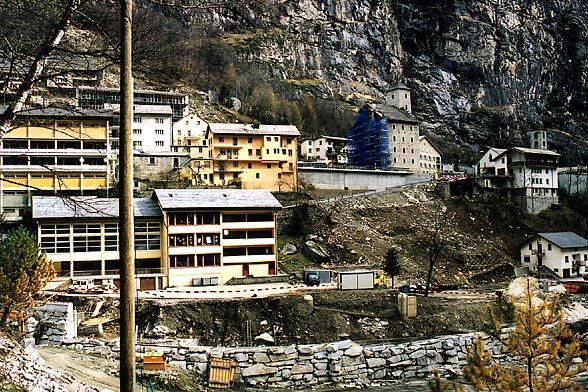
Gondo. Centre of the municipality, on the Simplon road at the Italian border, starting point of the Zwischbergental. The landslide of 14 October 2000 killed 13 people here and destroyed the heart of the village.[2]
Church of St Mark in Gondo. Parish church, parts of which date back to the High Middle Ages.
Stockalper Tower (Stockalperturm). Building in Gondo erected in the 17th century. Largely reduced to rubble in 2000 except for its oldest part, it was rebuilt and reopened as a hotel and restaurant.[2]
Chapel of Maria Bru. Pilgrimage chapel built in 1715.
Chapel at Bord. Chapel built in 1642 in the hamlet of Bord.
Zwischbergental. Valley running south-west from Gondo, with the Zwischbergen dam brought into service in 1952. Paths lead from here to the Zwischbergen Pass and the Monscera Pass.
Remains in Zwischbergen
Former gold mines of Gondo. Gold mine owned by the von Stockalper family from the 17th century to 1875. The company that later worked it went bankrupt in 1896. Gold-bearing ore has been mined here since Roman times, and the mines can be visited with a guide.[3]
Sources
- Historisches Lexikon der Schweiz, « Zwischbergen » (Alois Grichting, version du 03.03.2014)
- swissinfo.ch, « Gondo marks tenth anniversary of disaster » (14.10.2010)
- Association des musées suisses (museums.ch), « Ecomuseum - Goldminenmuseum », Gondo
- Office fédéral de la statistique (OFS), STATPOP, chiffres provisoires au 31.12.2025, via citypopulation.de
- geo.admin.ch, recherche de lieux (coordonnées de Gondo)
Localities of the municipality with a page
Other villages near Zwischbergen
Missing information, or do you have a source? Suggest a correction or addition. Every submission is checked before it's published.
Suggest a change