Allaman
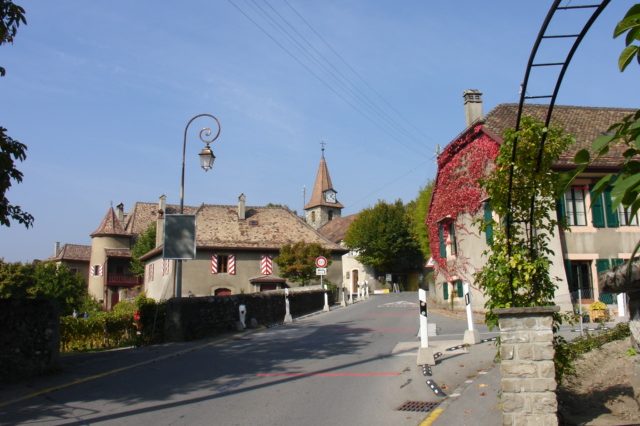
On Lake Geneva, Allaman castle controlled the crossing of the Aubonne. The pacifist Jean-Jacques de Sellon reportedly received Joseph Bonaparte there.
Entry based on 16 sources · Our method · Reusable text (CC BY-SA)
Origin of the name Allaman
The place appears in 1234 in the form « Alamant ». The name reportedly corresponds to the adjective « alaman(d) » and would designate a place inhabited by a certain A(l)lamandus, Alamannus or Alamant, or by a speaker of Alemannic German.[1]
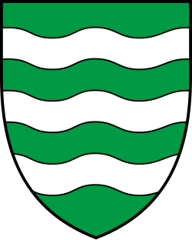
Coat of arms of Allaman
Vert, three bars wavy argent. Three white wavy horizontal bands cross a green field. They stand for three streams: the Aubonne, the Eau Noire and the Bief de l'Armary. An old shield of uncertain origin, argent three bars wavy gules, already appears in a minute book of 1732. The commune took up these arms in 1921, in the colours of the canton.[8][9]
Founding of Allaman
Who founded Allaman is not known, but the area was occupied early: Neolithic graves, stone slab graves possibly of the Bronze Age, and Roman coins and building remains have been found there. In the Middle Ages a lordship developed, whose castle controlled the crossing of the Aubonne.[1]
History of Allaman
Neolithic. Neolithic graves in the municipality.[1]
Bronze Age. Burials in stone cists (Bronze Age attribution uncertain).[1]
Roman period. Roman coins and building remains.[1]
1234. First mention of the place in the form « Alamant ».[1]
1291-1292. The castle is reportedly built at this time, according to dendrochronological dating that is not confirmed.
1530. The castle is burned. The fire is attributed to the Confederates during the affair of the Knights of the Spoon (Chevaliers de la Cuiller), but this is not established.[1]
1536. After the Reformation, the church is attached to the parish of Perroy.
1536-1798. Under Bernese rule, Allaman belongs to the bailiwick of Morges.
1547. The de Cerjat family acquires the castle and reportedly carries out major works.
1723. Renovation of the castle.[1]
1798. Allaman is attached to the district of Aubonne.[1]
1803. Allaman belongs to the district of Rolle.[1]
1838. The Rochefort estate becomes the property of the City of Lausanne.[1]
1858. Opening of a station on the Lausanne-Geneva line.[1]
1895. Opening of a secondary railway line, later replaced by a bus service. The Cornaz cement pipe factory is established.[1]
1964. Access to the motorway.[1]
1990. Wine growing still employs 18.5 % of the working population.[1]
2008. Allaman becomes part of the new district of Morges, created by the territorial reorganisation of 2006.[4][5]
Population of Allaman
Sources and references: [1][6]
| 1764 | 119 |
| 1850 | 292 |
| 1900 | 334 |
| 1950 | 369 |
| 2000 | 392 |
| 2025 | 412 |
Families of Allaman
Cerjat. A Moudon family attested from 1299, which produced many magistrates and entered the nobility at the end of the Middle Ages. From the 15th century several branches held seigneuries, among them Allaman. The family is still represented in Belgium and Brazil.[11]
Sellon. A Genevan family from Nîmes. The Huguenot refugee Jean became a burgher of Geneva in 1699 and traded internationally. His son Gaspard (1702-1785), a member of the Council of Two Hundred, acquired the seigneurie of Allaman in 1755. Another Jean (1736-1810), made a count of the Holy Roman Empire in 1786, was Cavour's grandfather.[12]
Friderici. From Moritzberg, near Hildesheim in Lower Saxony, the family has held the burghership of Allaman since 1848. Charles, a postal contractor on the Morges-Aclens-Cossonay route, founded the firm in 1890 to carry Vaud wines to German-speaking Switzerland. The third generation turned it into a large transport company working in Switzerland and abroad.[13]
Show more families (3)
Burgher families before 1800. The Cauderay and the Croutaz appear with no precise date. They were followed by the Chalumeau, from France (1705), the Roman (1788) and the Mayland (1792).[10]
In the 19th century. The Jordan and the Mauris are registered with no precise date. In 1812 came the Robert from Le Locle NE and the Vuilleumier from Tramelan-Dessus BE, then the Bangueret in 1820. Germany supplied the most families: Greiner (1821), Baum (1823), Fritsch and Muller (1829), Burger (1830), Rudhard (1841) and Friderici (1848). Two families came from Savoy, the Chavanne in 1824 and the Pittolaz in 1859.[10]
From 1901 to 1962. Four entries: the Peila, from Italy (1950), the Franco, also from Italy (1953 and 1954), and the de Siebenthal from Saanen BE (1957). The last registered were the Vontobel, from Rüti ZH, in 1958.[10]
Notable people of Allaman
Jean-Jacques de Sellon (Geneva 1782 - Belfort 1839). The son of Jean, lord of Allaman, he campaigned against the death penalty and founded the Geneva Société de la Paix in 1830. He was also a collector and patron.[14]
Camillo Benso, Count of Cavour (Turin 1810 - Turin 1861). His mother, Adèle de Sellon, was Jean-Jacques's sister, and he stayed many times with his mother's family in Geneva and Allaman. A member of the Sardinian government from 1851 to 1861, he brought Napoleon III into the liberation of northern Italy.[15]
Henri Cornaz (Faoug 1869 - Saint-Prex 1948). With his brother Paul he opened cement-products factories at Faoug in 1893 and at Allaman in 1895. He founded the Saint-Prex glassworks in 1911 and sat on the Grand Conseil from 1909 to 1929.[16]
Economy of Allaman, past and present
Vines. The sunny slopes carry vineyards. Those of the castle estate were replanted from 1959.[9]
Kiwis, fruit and vegetables. Fruit and vegetable growing complement the vines. The Domaine de la Pêcherie et de la Frésaire grows 20 hectares of organic kiwis, nearly 80 % of Swiss production, about 350 tonnes a year.[9]
Fishing, concrete and shops. Allaman has more professional fishermen than any other place around Lake Geneva. Founded in 1895 to make cement pipes, the Cornaz firm still produces concrete elements. To the north, near the station, large shopping centres have opened.[9][1]
Historic sites in Allaman
Allaman Castle. The castle controlled the crossing of the Aubonne. Already fortified in 1379, it was burned in 1530 and renovated in 1723. It combines work from the Middle Ages to the mid-19th century: courtyard façades rebuilt from 1609, a classical frontispiece around 1755, Parisian wallpapers around 1790 and neo-Gothic turrets in 1847. It belonged notably to the de Cerjat family from 1547, then to the Sellon family in the 18th century. The pacifist Jean-Jacques de Sellon (1782-1839) reportedly received figures such as Joseph Bonaparte there. Cultural property of national significance.[1][3]
Church of Saint-Jean-Baptiste. Church of the 15th-16th centuries, under the patronage of the chapter of Genève, with a seigneurial chapel. It became an annex of Perroy at the Reformation and is a cultural property of regional significance.[1][3]
Rochefort fortified house. Castle of the co-lords of Aubonne, who shared the lordship with the lords of Allaman. This wine estate has belonged to the City of Lausanne since 1838. Cultural property of regional significance.[1][3]
Remains in Allaman
Prehistoric burials. Neolithic graves and stone cists possibly of the Bronze Age discovered in the municipality.[1]
Roman remains. Coins and building remains from the Roman period.[1]
Protected heritage in Allaman
Cultural property of national significance (A objects in the PCP inventory)[7]
- Château avec dépendance et rural
Cultural property of regional significance (B objects)[7]
- Château de Rochefort et rural
- Eglise réformée Saint-Jean-Baptiste
Traditions and festivals in Allaman
La Goujonnette. This festival brings together the fishermen and the wine-growers who make their own wine in Allaman and the neighbouring communes.[9]
Sources
- Dictionnaire historique de la Suisse, « Allaman »
- Inventaire PBC, fiche 5898 « Château » (Allaman), texte de la Société d'histoire de l'art en Suisse (Guide artistique de la Suisse)
- Office fédéral de la protection de la population, Inventaire PBC, liste cantonale VD (état au 1.1.2026)
- Canton de Vaud, Loi sur le découpage territorial (LDecTer, RSV 132.15) du 30 mai 2006
- État de Vaud, communiqué du 12.07.2007, « Les préfètes et les préfets sont attribués aux nouveaux districts »
- Statistique Vaud, « Population résidante permanente au 31 décembre 2025 »
- Federal Office for Civil Protection (FOCP), Swiss Inventory of Cultural Property (PCP), list for the canton of Vaud (as of 1.1.2026)
- IPI, Swissreg, emblems database: coat of arms of Allaman (no. 102096)
- Official Gazette of the Canton of Vaud (FAO), "Alphabet des communes vaudoises: Allaman"
- Register of Swiss Surnames, 3rd edition (1989), search Commune "Allaman", Canton VD
- Historical Dictionary of Switzerland (HDS), article "Cerjat"
- Historical Dictionary of Switzerland (HDS), article "Sellon"
- Historical Dictionary of Switzerland (HDS), article "Friderici"
- Historical Dictionary of Switzerland (HDS), article "Sellon, Jean-Jacques de"
- Historical Dictionary of Switzerland (HDS), article "Cavour, Camillo Benso, comte de"
- Historical Dictionary of Switzerland (HDS), article "Cornaz, Henri"
Published by Sébastien Jörg ·
Other villages near Allaman
Missing information, or do you have a source? Suggest a correction or addition. Every submission is checked before it's published.
Suggest a change