Etoy
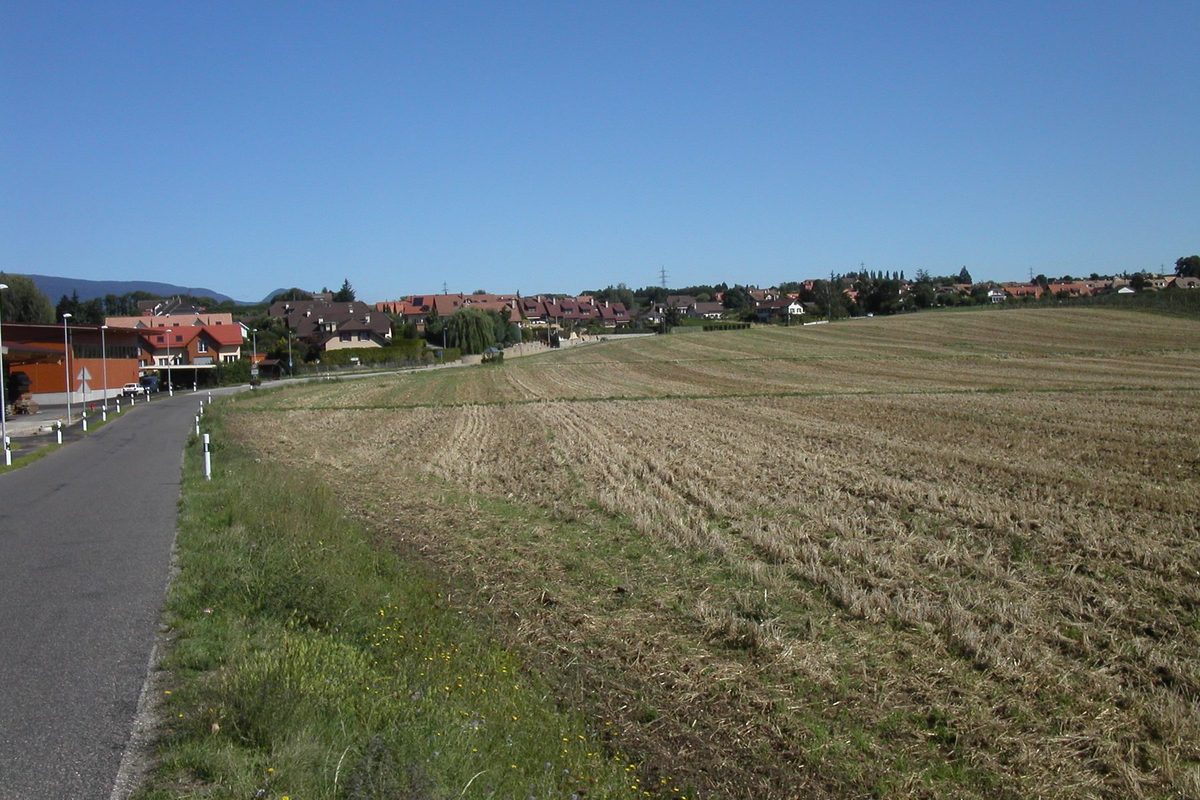
A former priory of the Grand-Saint-Bernard turned château on the shore of Lake Léman, Etoy is also home to one of Chiquita's two world headquarters.
Entry based on 14 sources · Our method · Reusable text (CC BY-SA)
Origin of the name Etoy
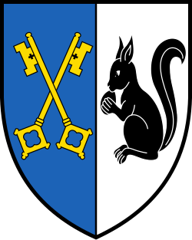
The name appears in writing in 1145 as «Stuie», in a deed in which a certain Ulrich de Stuie acts on behalf of the local priory, already in existence. Then come «Cella de Stoi» (1177, for the priory) and «Estue» (1228). It reportedly derives from the Old French «estui», a place where something is stored, but this explanation is uncertain. The inhabitants are called the Etierruz and bear the nickname Écureuils (squirrels). In 1920 this nickname inspired part of the municipal arms: a black squirrel beside the golden keys of Bourg-Saint-Pierre, inherited from the village's religious past.[1][2][3]
Coat of arms of Etoy
Per pale Azure two keys in saltire Or, and Argent a squirrel Sable. The shield is divided vertically. On the left, two yellow keys cross on a blue field. On the right, a black squirrel stands out on a white field. The keys come from the arms of Bourg-Saint-Pierre and recall the abbey of Saint-Pierre-de-Mont-Joux, which held land in the area as early as the 10th century. The squirrel refers to the inhabitants' nickname in the local dialect, the "Etierruz". In 1920 the commune gave its mobilised soldiers a medal bearing these recently adopted arms.[12][2][3]
Founding of Etoy
No dated act of foundation explains how Etoy came about. The area was occupied long before the Middle Ages: a Neolithic hammer-axe, a La Tène gold ring and a Roman villa have been found there. In 1145 the abbey of the Grand-Saint-Bernard (Mont-Joux) already held a priory dedicated to Saint Nicholas here. Who established it is unknown. Some attribute it to the lords of Aubonne, its advocates, others to the knights of Hauteville, one of whom confirmed in 1206 his ancestors' donations to the house of Etoy. In the 14th century the provost of Mont-Joux governed the priory directly. It usually housed five to seven religious. The village, inhabited by church serfs, only appears in 1215.[1][2][3]
History of Etoy
1145. First known written mention of the place, in the form «Stuie», in a deed in which Ulrich de Stuie acts on behalf of the priory. The abbey of the Grand-Saint-Bernard holds a priory dedicated to Saint Nicholas there.[1][2][3]
1177. Pope Alexander III recognises the «Cella de Stoi» as a possession of the Grand-Saint-Bernard congregation.[2][3]
1206. Pierre d'Hauteville confirms the donations made by his ancestors to the house of Etoy, one of the clues used in discussing the priory's origins.[2][3]
1215. First mention of the village, inhabited by church serfs.[1]
1228. Mention of the parish; the name is written «Estue».[1]
14th century. The priory is governed directly by the provost of Mont-Joux (Grand-Saint-Bernard).[1]
1536. Reformation: the priory is suppressed; only the church tower remains of its buildings. Its secularised property forms a lordship of Etoy, which Bern buys back in 1720.
1701. Under Bernese administration, Etoy is attached to the new bailiwick of Aubonne.[1]
1798-1803. During the Helvetic Republic, Etoy belongs to the district of Aubonne.
1803. Etoy is attached to the district of Morges.[1]
1850. The municipality has 474 inhabitants.[1]
14 April 1858. Opening of the Morges-Coppet section of the Lausanne-Geneva line, with a station at Etoy (date uncertain).
1872. The teacher Auguste Buchet founds L'Espérance in Etoy, a home for people with profound intellectual disabilities.[1][4]
1900. The municipality has 663 inhabitants.[1]
1920. The municipal arms, combining the golden keys of Bourg-Saint-Pierre and the squirrel of the local nickname, are adopted.
1980. The municipality has 891 inhabitants.[1]
1984. The population passes the 1'000 mark.[3]
1998. The population passes the 2'000 mark.[3]
2008. On 1 January 2008 Etoy becomes part of the new district of Morges, created by the Vaud territorial reform.[9][10]
2019. Chiquita Brands International has one of its two world headquarters in Etoy, with about 90 employees.[7]
2025. The municipality has 3'013 inhabitants on 31 December.[8]
Population of Etoy
Sources and references: [1][3][8]
| 1850 | 474 |
| 1900 | 663 |
| 1980 | 891 |
| 1984 | 1'000 |
| 1998 | 2'000 |
| 2025 | 3'013 |
Families of Etoy
Burgher families before 1800. Bercher, Berger, Buchet, Buclin, Corthay, Giriens, Humbert, Magnollay, Martin, Pion and Thury, with no precise date, as well as the de Loriol family, from France.[14]
In the 19th century. The Lapalud family, with no precise date. Then the Bohren of Saanen BE in 1849 and the Ebermann, from Germany, in 1898.[14]
From 1901 to 1962. Four Swiss families, all registered at the end of the period: the Grandjean-Perrenoud-Comtesse of La Sagne NE in 1956, the Imhof of Fahrni BE and the Zumkeller of Progens FR in 1957, and finally the Maillard of Hennens FR in 1958.[14]
Notable people of Etoy
René Thury (Plainpalais 1860 - Geneva 1938). Electrical engineer, a citizen of Etoy, where his family holds burgher rights. He designed dynamos, developed a long-distance electricity distribution system in 1889 and became a consulting engineer in 1910.[13][14]
Economy of Etoy, past and present
Orchards, vines and a nursery. Farming, fruit growing and winegrowing are still present in Etoy. Since 1902 a nursery here has propagated vine plants.[2]
The industrial zone. It was created in the 1950s for the first Swiss factory making precast reinforced concrete elements. Pfister moved in during the 1970s and opened its Centre de l'Habitat in the early 1980s. The zone lies along the motorway and the Lausanne-Geneva railway. In 1996 a cantonal land-use plan turned it into "Littoral Parc", which encouraged technology and pharmaceutical groups to settle there.[1][2]
Historic sites in Etoy
Etoy Castle. Former priory of the Grand-Saint-Bernard, secularised at the Reformation. Its tower has disappeared and it now looks like a patrician house. It belonged to the de Mestral family, housed the family of the writer Guy de Pourtalès for more than fifty years, then an ecumenical community of sisters for twelve years. The castle (former priory) and its park are listed in the federal inventory of cultural property (regional importance).[2][3][6]
Saint Nicholas Church. Former church of the priory of Saint-Nicolas. It retains a 12th-century triumphal arch. The bell tower, a former defence tower with loopholes and the only remnant of the priory buildings, holds a bell dated 1630. The church is listed in the federal inventory of cultural property (regional importance).[2][3][6]
L'Espérance. Founded in 1872 by the teacher Auguste Buchet to care for people with profound intellectual disabilities, it is today a medical-educational institution.[1][4]
Etoy railway station. Station on the Lausanne-Geneva line, opened with the Morges-Coppet section on 14 April 1858 (date uncertain).
Remains in Etoy
Remains of the medieval priory. Of the priory of Saint-Nicolas, held by the Grand-Saint-Bernard from 1145 and suppressed at the Reformation, only the church bell tower remains. The castle, designated as the former priory, occupies the site.[1][6]
12th-century triumphal arch. Romanesque triumphal arch of the 12th century, preserved in the church of Saint-Nicolas despite later alterations.[2][3]
Protected heritage in Etoy
Cultural property of regional significance (B objects)[11]
- Château (ancien prieuré) avec parc
- Eglise réformée Saint-Nicolas
- Maison aux arcades
Traditions and festivals in Etoy
The village festival. It takes place every three years. Local life also includes an abbaye (shooting society), a youth society and a brass band.[2]
Sources
- Germain Hausmann, « Etoy », Dictionnaire historique de la Suisse, version du 03.04.2014
- Feuille des avis officiels du canton de Vaud, Alphabet des communes, « Etoy »
- Commune d'Etoy, « Un peu d'histoire »
- Commune d'Etoy, « Découvrir Etoy »
- Localcities, fiche « Commune Etoy »
- Office fédéral de la protection de la population, Inventaire PBC, liste cantonale VD (état au 1.1.2026)
- Olivier Grivat, « Le roi de la banane règne depuis les bords du Léman », swissinfo.ch, 25.04.2019
- Statistique Vaud, « Population résidante permanente au 31 décembre 2025 »
- Canton de Vaud, Loi sur le découpage territorial (LDecTer, RSV 132.15) du 30 mai 2006
- État de Vaud, communiqué du 12.07.2007, « Les préfètes et les préfets sont attribués aux nouveaux districts »
- Federal Office for Civil Protection (FOCP), Swiss Inventory of Cultural Property (PCP), list for the canton of Vaud (as of 1.1.2026)
- IPI, Swissreg, emblems database: coat of arms of Etoy (no. 101371)
- Serge Paquier, "Thury, René", Historical Dictionary of Switzerland, version of 25.02.2014
- Register of Swiss Surnames, 3rd edition (1989), search Commune "Etoy", Canton VD
Published by Sébastien Jörg ·
Other villages near Etoy
Missing information, or do you have a source? Suggest a correction or addition. Every submission is checked before it's published.
Suggest a change