Lavigny
Since 1996 the château built in 1770 by Gabriel-Henri de Mestral has hosted an international writers' residence, in memory of the publisher Heinrich Maria Ledig-Rowohlt.
Entry based on 11 sources · Our method · Reusable text (CC BY-SA)
Origin of the name Lavigny
First mention in 1145 in the form «Lauiniaco». The name is said to derive from the Roman family name Lavinius. The inhabitants later saw a link with the vine, hence the coat of arms with a vine stock.[1][3]
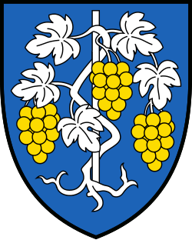
Coat of arms of Lavigny
Azure, a vine stock argent fructed with three bunches Or. On a blue field a white vine stock bears three yellow bunches of grapes. These are canting arms: convinced that the village's name came from the vine, the inhabitants had a seal engraved with a vine stock in the 18th century. The present colours only date from 1924.[9][3]
Founding of Lavigny
Nobody knows who founded Lavigny. The site has been occupied since Roman times, from which remains survive, then in the early Middle Ages, with the cemeteries of Les Pommeries and La Vaudalle. From the 12th to the 17th century a noble family bore the village's name.[1]
History of Lavigny
Roman period. Roman remains in the municipal area.[1]
early Middle Ages. Cemeteries at Les Pommeries and La Vaudalle.[1]
1145. First mention, as «Lauiniaco».[1]
12th-17th century. A noble family of Lavigny is recorded.[1]
1348. Mention of a confraternity of the Holy Spirit.[1]
1416. The village has 20 hearths (households).[1]
1537-1846. The Saint-Maurice church, previously attached to the parish of Etoy, belongs to the parish of Aubonne.[1]
1770. Gabriel-Henri de Mestral, lord of Lavigny, has the castle built on the site of a former fortified house.[4]
1798. Lavigny belongs to the district of Morges.[1]
1824. South of the castle, the neoclassical Tronchin house is built. It is reportedly the work of the architect Jules Renevier.
1863. After a period attached to Saint-Livres, the church returns to the parish of Aubonne.[1]
1906. Foundation of the Institution de Lavigny, a renowned neurological centre.[1]
1972. The publisher Heinrich Maria Ledig-Rowohlt acquires the castle.[4]
1974. Creation of a municipal council (legislative).[1]
1979. Rebuilding of the Institution's hospital complex. Adoption of a zoning plan.[1]
1985. New municipal house.[1]
1996. Creation of an international writers' residence at the castle, in memory of the publisher Heinrich Maria Ledig-Rowohlt (Ledig-Rowohlt foundation).[5]
2008. The new Vaud districts come into force. Lavigny remains in the district of Morges.[7]
Population of Lavigny
Sources and references: [1][2]
| 1416 | 20 hearths (households) |
| 1798 | 265 |
| 1850 | 328 |
| 1900 | 287 |
| 1950 | 438 |
| 1980 | 490 |
| 2000 | 701 |
| 2025 | 1'108 |
Families of Lavigny
Burgher families before 1800. Ten families are listed without a precise date: Attenon, Bégos, Bègue, Christin, Corday, Cordey, de Mestral, Moinat, Moynat and Tronchin. Three more are admitted in the 18th century, the Matthey from Le Locle NE and the Zbinden from Guggisberg BE in 1770, then the Breitenstein from Germany in 1791.[10]
In the 19th century. The Filletaz, Fillettaz, Filliettaz and Fusay are registered without a precise date, as are the Schmidt from Worb BE. The Loewer and the Löwer, from Germany, follow in 1822.[10]
From 1901 to 1962. The Chappuis and the Moffrand, from France, are registered in 1906, the Ghelfi from Italy in 1917. Next come the Lupi from Italy in 1945, the Millioud from China in 1952, then the Krebs from Niederwichtrach BE and the Napoli from Italy in 1956. The last, in 1957, are the Fuchs from Remigen AG.[10]
Notable people of Lavigny
Henri Tronchin (1794-1865). Born in Lavigny, Henri Tronchin had the manor house known as the Grand Lavigny built between 1821 and 1823. An artillery captain in Dutch service and later a federal lieutenant colonel, he co-founded the Evangelical Society of Geneva in 1831 and funded its school of theology.[11]
Economy of Lavigny, past and present
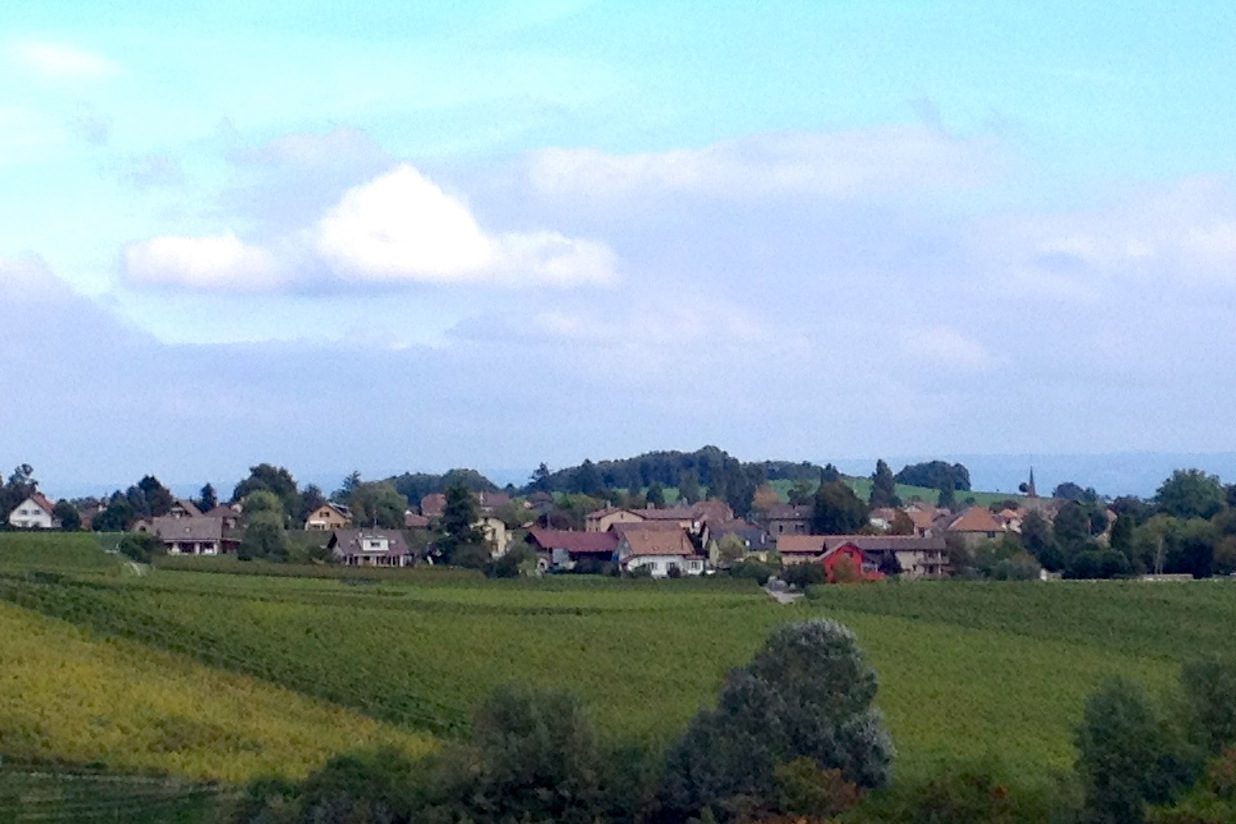
The vineyards. Farming, wine growing, crafts and the hospital are Lavigny's main activities. Vines cover a large part of the territory. Three grower-winemakers sell their wine on site or at the Auberge de la Croix-Blanche.[1][3]
The Institution de Lavigny. More than a century after its founding, the Institution cares for people with neurological conditions. It combines a hospital, socio-educational housing, vocational workshops and a special school. Its Advent calendar has made it well known.[1][3]
A residential village. With the zoning plan of 1979 Lavigny became a residential municipality. Since the 1980s some of the inhabitants have worked in Lausanne or Morges. Locally, small firms offer services in building, car repair, accounting or as a driving school. A biogas plant processes a large share of the canton's organic waste. Between 2022 and 2024 the municipality created 19 affordable flats with the Equitim Foundation and opened a grocery with a tea room and post office counter.[1][3]
Historic sites in Lavigny
Lavigny castle. Built in 1770 by Gabriel-Henri de Mestral, lord of Lavigny, on the site of a former fortified house. The castle with farm building and fountain is a cultural property of regional importance. Owned by the publisher Heinrich Maria Ledig-Rowohlt and his wife Jane from 1972, it has housed since 1996 an international writers' residence supported by the Ledig-Rowohlt foundation.[4][5][6]
Saint-Maurice church. The village church, attached in turn to the parishes of Etoy, Aubonne (1537-1846) and Saint-Livres, before returning to Aubonne in 1863.[1]
Institution de Lavigny. Neurological centre founded in 1906. The hospital complex was rebuilt in 1979.[1]
Tronchin house. Neoclassical building erected in 1824 south of the castle, probably by the architect Jules Renevier.
Village listed in the ISOS. The whole village of Lavigny is said to be listed in the Federal Inventory of Swiss Heritage Sites (ISOS).
Remains in Lavigny
Roman remains. Remains from the Roman period have been uncovered in the municipal area.[1]
Early medieval cemeteries. Early medieval cemeteries have been discovered at Les Pommeries and La Vaudalle.[1]
Protected heritage in Lavigny
Cultural property of regional significance (B objects)[8]
- Château avec rural et fontaine
Legends of Lavigny
The «Grenouilles». The inhabitants are nicknamed «Grenouilles» (frogs), because of the Gouille pond east of the village, recognized as a site of biological value of prime importance at national level.[3]
Sources
- Dictionnaire historique de la Suisse, François Béboux, « Lavigny », version du 15.05.2006
- Statistique Vaud, « Population résidante permanente au 31 décembre 2025 »
- Feuille des avis officiels du canton de Vaud, Alphabet des communes vaudoises, « Lavigny »
- Château de Lavigny, page « Le château »
- Swiss Literature, « Château de Lavigny, writers' residence »
- Office fédéral de la protection de la population, Inventaire suisse des biens culturels d'importance nationale et régionale, liste du canton de Vaud (état au 1.1.2026)
- État de Vaud, communiqué du 12.07.2007, « Les préfètes et les préfets sont attribués aux nouveaux districts »
- Federal Office for Civil Protection (FOCP), Swiss Inventory of Cultural Property (PCP), list for the canton of Vaud (as of 1.1.2026)
- IPI, Swissreg, emblems database: coat of arms of Lavigny (no. 101378)
- Register of Swiss Surnames, 3rd edition (1989), search Commune "Lavigny", Canton VD
- Dictionnaire historique de la Suisse, « Tronchin, Henri », version du 03.05.2012
Published by Sébastien Jörg ·
Other villages near Lavigny
Missing information, or do you have a source? Suggest a correction or addition. Every submission is checked before it's published.
Suggest a change