Assens
Village of the Gros-de-Vaud known for its shared (simultaneum) church, used for two and a half centuries by Catholics and Protestants, and for the Early Iron Age burial mound found in the Bois des Allemands.
Entry based on 14 sources · Our method · Reusable text (CC BY-SA)
Origin of the name Assens
The exact origin of the name Assens remains uncertain. It is reportedly Burgundian: the original form «Assensa» is said to have meant land granted for a cens (an annual rent), and a charter of 1102 is said to give the Latin form «Astelegus». The first attested mention is «Ascens», in 1228; 13th-century parish records also use «Astiens» and «Astens», before the name settled as «Assens».[1]
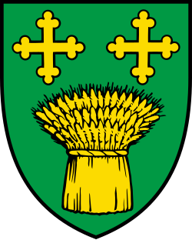
Coat of arms of Assens
Vert, a garb Or, in chief two crosses botonny of the same. A yellow sheaf of wheat stands on a green field, beneath two yellow crosses with trefoil ends. Adopted in 1930, the arms combine two crosses for the two faiths, Catholic and Reformed, which have shared a single church since the arrangement of 1619, and a sheaf for the work of the fields.[9][10]
Founding of Assens
Neither a founder nor a founding charter is known: like most villages of the Vaud plateau, Assens formed gradually in the early Middle Ages as a rural estate, probably in the Burgundian period, before becoming a parish and a village community. The territory was occupied much earlier: an Early Iron Age burial mound attests a protohistoric presence, although no continuity with the medieval village can be established. The village appears in writing together with its parish, which belonged to the abbey of Abondance from the 15th century at the latest. No single lord founded Assens: several local noble families shared rights over the territory in the Middle Ages.[1][7]
History of Assens
around 600-450 BC. Protohistoric occupation attested by a burial mound (Early Iron Age) in the Bois des Allemands, east of the village. Two successive burials are documented there.[7]
1228. First attested mention of the village, in the form «Ascens». The parish of Assens is documented at this date.[1]
13th century. Parish records also use the forms «Astiens» and «Astens», before the name settled as «Assens».
1453-1454. The church of Saint-Germain is enlarged. The parish then belongs to the abbey of Abondance.[1]
1476-1798. Assens belongs to the common bailiwick of Orbe-Échallens, jointly administered by Fribourg and Bern.[1]
1585. After a Reformation that was hard to establish locally, the first Protestant minister is appointed in Assens. The church becomes shared (mixed), used by both Catholics and Protestants.[1]
1619. The village community refuses to choose a single confession and keeps a mixed religious arrangement. In the 18th century the council has six Catholic and six Protestant members.[1][5]
second half of the 17th century (or around 1650-1654). Creation of the church's Baroque altarpiece, attributed to the Reyff workshop in Fribourg, decorated with gilding and bas-reliefs of the Annunciation.[1][4][5]
1696. Installation of the wrought-iron screen separating the choir from the nave in the church of Saint-Germain, a date inscribed on its lock.[4]
1757. Construction of the porch bell tower of the old church of Saint-Germain (date uncertain).
1798. The bailiwick of Orbe-Échallens is abolished with the Vaud Revolution and the end of the Ancien Régime. The census of the time counts 276 inhabitants in Assens.[1]
1845. Construction of a new neoclassical Catholic church of Saint-Germain, reportedly by the architect Henri Perregaux. The old shared church then becomes exclusively Reformed, ending two and a half centuries of confessional sharing.[1][4][5]
1874. Opening of Assens station on the Lausanne-Échallens-Bercher (LEB) railway line.[1]
early 20th century. The burial mound is excavated by the cantonal archaeologist Albert Naef and local residents. An inscribed stone commemorates the work.[7]
1930s. Construction of a bypass road around the village.
1930. Adoption of the commune's coat of arms, combining two crosses (symbol of the historic mixed religious arrangement) and a sheaf of wheat (symbol of farming).
2002. Assens is twinned with the French commune of Colombey-les-Deux-Églises.
2008. Restoration of the burial mound and installation of an information panel on the site.[7]
1 January 2009. Assens merges with the neighbouring commune of Malapalud.
1 July 2021. The commune of Assens (already enlarged with Malapalud since 2009) merges with Bioley-Orjulaz, approved by voters on 24 November 2019 and submitted by the Vaud Council of State to the Grand Council for ratification. The new commune takes the name Assens.[6]
Population of Assens
Sources and references: [1]
| 1798 | 276 |
| 1850 | 356 |
| 1900 | 401 |
| 1970 | 335 |
| 2000 | 770 |
| 2020 | 1'140 |
Families of Assens
Burgher families before 1800. Barby, Baudère, Chambettaz, Depierraz and Dépierraz, Despont, Dony, Mathey and Matthey, Pellerin, Pilloud and Pollien.[11]
In the 19th century. The Blanc, the Reymond and the Panchaud from Poliez-le-Grand VD are registered with no precise date, the Hoegen, from France, in 1818.[11]
From 1901 to 1962. Four entries: the Wakenhut, from Germany (1903), the Jokovic (1951) and the Bagi, from Hungary (1952). The last registered, in 1956, were the Pichonnaz from Pont (Veveyse) FR.[11]
Notable people of Assens
Henry-Samuel Bermont (Assens 1823 - Montpellier 1870). An engineer, he worked with Frantz Mayor de Montricher on the Durance canal, then on the draining of Lake Fucino, where he directed the works from 1858.[12]
Victor-Vincent Dériaz (Assens 1816 - Lausanne 1888). From 1847 he stood in for the cantonal engineer Hippolyte de Saussure. He drew up the plans for the Barre tunnel in Lausanne (1851) and for rue Haldimand (1858), and sat on the Grand Conseil from 1849 to 1851 and from 1853 to 1871.[13]
Joseph-Victor Pellerin (Assens 1838 - Fribourg 1910). A Catholic priest ordained in 1862, he was vicar general of the diocese of Lausanne and Geneva from 1880 to 1910. After Bishop Cosandey's death in 1882, he administered the diocese.[14]
Jean-Jacques Rousseau. In 1730 Rousseau attended the church of Assens, where the Catholics of Lausanne came to hear mass.[10][1]
Economy of Assens, past and present
The fields. The number of farmers has fallen sharply over twenty years. About fifteen farms remain active, in cereals, mixed crops and milk production.[10]
Businesses and services. At Bioley-Orjulaz, joined to the commune in 2021, a former gravel pit has become a business zone employing more than a thousand people, in civil engineering, concrete, glass, landscaping and stone cutting. The LEB line links the commune to Lausanne every fifteen minutes.[10]
Disasters and major events in Assens
The Burgundian Wars, 1476. During the Burgundian Wars, Charles the Bold camped in 1476 in the forest of Orjulaz, now within the commune.[10]
Historic sites in Assens
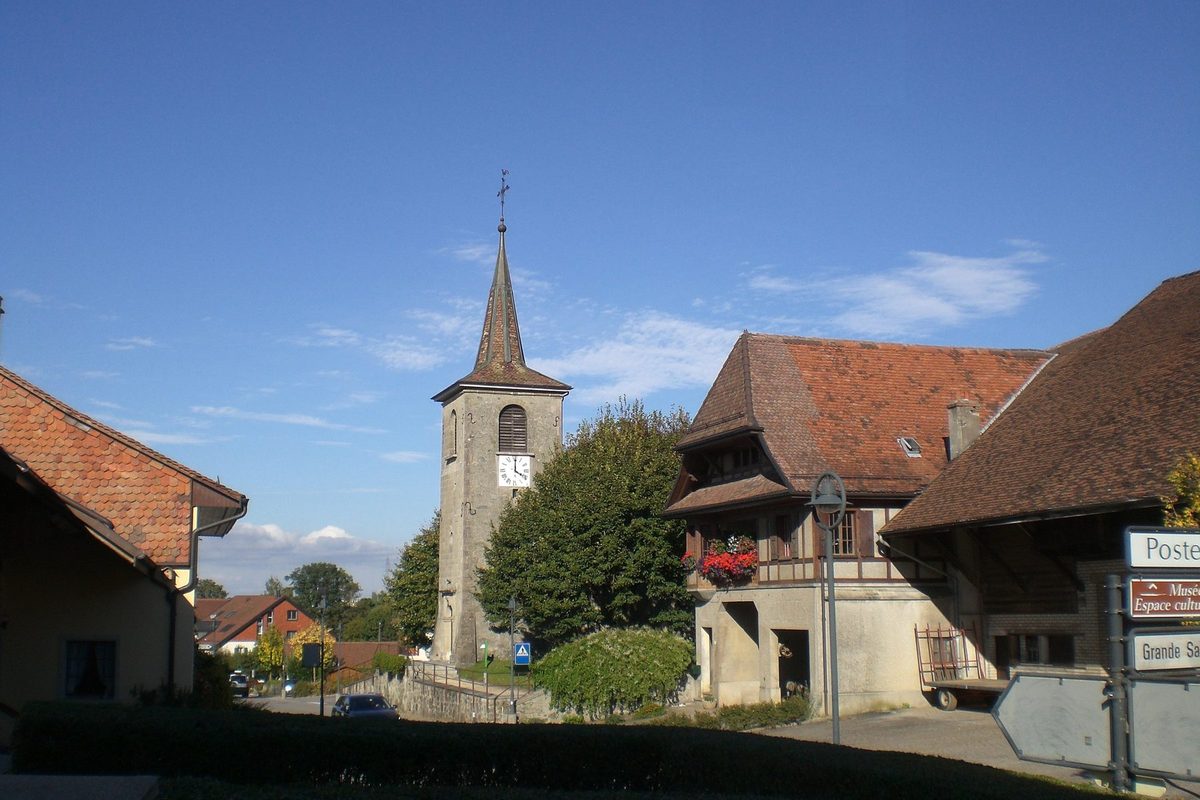
Shared church of Saint-Germain, Assens. Building erected on a promontory from the late 12th or early 13th century, enlarged in 1453-1454 and given a porch bell tower (1757, date uncertain). It keeps 15th-century Gothic frescoes, a Baroque altarpiece attributed to the Reyff workshop of Fribourg, whose wings bear reliefs of the Annunciation, and a wrought-iron screen of 1696 separating the choir from the nave. It has two separate pulpits, since from 1585 to 1845 it served both Catholic and Protestant worship (a «shared» church). Since 1845 only Reformed worship has been held there. Cultural property of regional significance.[2][4]
Catholic church of Saint-Germain (1845). Built in 1845 in neoclassical style, a few steps from the old church, for Catholic worship after the end of the shared arrangement. Its plans are reportedly by the Vaud architect Henri Perregaux. It keeps an 18th-century processional staff. Cultural property of regional significance.[2][4][5]
Assens station (Lausanne-Échallens-Bercher line). Opened in 1874, Assens station on the LEB line transformed the village, ending its isolation and starting, in the 20th century, its transition from a farming village to a residential locality near Lausanne.[1]
Bois des Allemands. Woodland east of the village containing the Celtic burial mound (see remains). A walking area giving access to the prepared archaeological site and its information panel.[7]
Remains in Assens
Assens burial mound. Located in the Bois des Allemands, east of the village, this burial mound about 19 metres across holds the grave of a woman, probably of local aristocratic rank, cremated around 600 BC (Early Iron Age). A second person was buried at its top around 450 BC. Excavated in the early 20th century by the cantonal archaeologist Albert Naef and local residents, who found bronze ornaments (an inscribed stone commemorates the work), it was restored in 2008 and given an information panel. Cultural property of regional significance.[2][7]
Protected heritage in Assens
Cultural property of regional significance (B objects)[8]
- Bois aux Allemands, tumulus de l'Age du Fer
- Eglise catholique Saint-Germain
- Eglise paritaire Saint-Germain
- Espace culturel et musée de l'histoire estudiantine
- Grenier en pierre (Bioley-Orjulaz)
Sources
- Dictionnaire historique de la Suisse, article "Assens"
- Office fédéral de la protection de la population, Inventaire PBC, liste cantonale VD (état au 1.1.2026)
- Commune d'Assens, page "Historique"
- Le Courrier, "L'église d'Assens et son retable baroque, une rareté dans notre canton !"
- Église catholique dans le canton de Vaud, paroisse d'Assens
- État de Vaud, décision du Conseil d'État sur la fusion d'Assens et de Bioley-Orjulaz
- Archeoplus, fiche du tumulus celtique d'Assens (VD)
- Federal Office for Civil Protection (FOCP), Swiss Inventory of Cultural Property (PCP), list for the canton of Vaud (as of 1.1.2026)
- IPI, Swissreg, emblems database: coat of arms of Assens (no. 102082)
- Official Gazette of the Canton of Vaud (FAO), "Alphabet des communes vaudoises: Assens"
- Register of Swiss Surnames, 3rd edition (1989), search Commune "Assens", Canton VD
- Historical Dictionary of Switzerland (HDS), article "Bermont, Henry-Samuel"
- Historical Dictionary of Switzerland (HDS), article "Dériaz, Victor-Vincent"
- Historical Dictionary of Switzerland (HDS), article "Pellerin, Joseph-Victor"
Published by Sébastien Jörg ·
Localities of the municipality with a page
Other villages near Assens
Missing information, or do you have a source? Suggest a correction or addition. Every submission is checked before it's published.
Suggest a change