Bassins
Until the 1970s Bassins was one of the richest communes in the canton, thanks to its forests and its ten alpine chalets.
Entry based on 9 sources · Our method · Reusable text (CC BY-SA)
Origin of the name Bassins
An early form «Bacins» is reportedly attested in 1195. Two explanations are put forward, without certainty: a Burgundian name derived from the personal name Basso, «at the home of Basso's people», or a Latinised personal name (Battius, Bassius) followed by a place suffix. The inhabitants are reportedly called Bachenards.
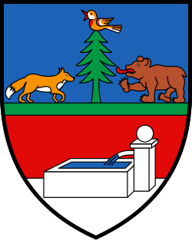
Coat of arms of Bassins
Per fess, first azure a fir tree on a mount vert, surmounted by a bird and flanked by a fox and a bear respectant proper, second gules a fountain with a rectangular basin argent on a base of the same. The shield is divided horizontally. At the top, on a blue field, a green fir tree grows from green ground. A bird perches on its tip, and a fox and a bear face each other on either side, in their natural colours. At the bottom, on a red field, a white fountain with a rectangular basin stands on white ground.[6]
Founding of Bassins
Nobody knows when the village was born. An early medieval cemetery near the church attests to early occupation. Bassins grew around its church of Notre-Dame. Owned by the Cluniac priory of Payerne, the church became the seat of a small Cluniac monastery, probably thanks to a donation by Humbert I, lord of Cossonay and Prangins, before 1164. The monks remained lords of Bassins until the Bernese conquest.[1][2][3]
History of Bassins
1148. The church of Bassins is a possession of the priory of Payerne. It becomes the seat of a Cluniac monastery.[1]
1164. First mention of a prior of Bassins, Gérold or Gérolet.[2][3]
1183. A bull of Pope Lucius III confirms Payerne's possession of the church dedicated to Notre-Dame.[2]
1195. The village reportedly appears in the form «Bacins».
late 13th century. The monastery of Bassins is united with that of Payerne. Monastic life on site ended in the 14th century.[1]
1361. Oldest known parchment: the recognition of the priory by Payerne.[2]
late 14th century. The inhabitants, until then subject to the taille, are enfranchised.[1]
1406. Foundation of the church's small chapel, dedicated to the Virgin, by Gérard de Penezat de Bassins.[2]
15th century. Foundation of the large chapel by the confraternity of the Holy Spirit.[2]
1529. The leaseholders of the convent of Payerne sublet the priory to Etienne Badel.[2]
1536. Bernese conquest: the priory is dissolved; Bassins is attached to the bailiwick of Nyon and its church becomes an annex of the parish of Arzier. The commune is run by a council of twelve members and has its own court.[1]
1542. The church property of Bassins is valued by a Bernese commissioner.[2]
1667. The church of Bassins is attached to the parish of Burtigny.[1][2]
1786-1797. Work on the church: construction of the porch and installation of two new bells.[2]
1798. Bassins becomes part of the district of Nyon.[1]
1899. A fire reportedly hits the houses opposite the Couronne inn.
1934. Major restoration of the church and installation of stained glass by the painter Marcel Poncet, of Vich.[2]
1970s. Until then Bassins is among the richest communes in the canton: it owns most of the forests on its territory and ten alpine chalets.[1]
Population of Bassins
Sources and references: [1][5]
| 1764 | 310 |
| 1850 | 394 |
| 1900 | 417 |
| 1950 | 309 |
| 1960 | 291 |
| 2000 | 832 |
| 2025 | 1'468 |
Families of Bassins
Burgher families before 1800. André, Badel, Dunand, Genevay, Mercet, Tecon, Tecoz, Treboux, Velan and Vieux, with no precise date. The commune counts the Treboux, Dunand, Genevay and Velan, formerly spelt Velen, among the typical names of Bassins.[9][2]
In the 19th century. The Bosson, with no precise date.[9]
From 1901 to 1962. Five entries, all after the Second World War. The Wieland opened the series in 1948. The others came from the canton of Bern: the Haenny of Gerzensee in 1951, the Hänni, from the same commune, in 1956, then the Hänggeli of Mühleberg and the Hofer of Bettenhausen in 1958.[9]
Notable people of Bassins
Yves Velan (Saint-Quentin 1925 - La Chaux-de-Fonds 2017). Writer, citizen of Bassins. A member of the Swiss Party of Labour (POP), he was barred from teaching in the canton of Vaud and went on to teach literature at the gymnasium in La Chaux-de-Fonds. His novel "Je" won the Prix Fénéon in 1959, and he received the Grand Prix C.F. Ramuz in 1990.[8]
Economy of Bassins, past and present
The priory's estates. In 1529 the priory's estate reached up to the crest of the Jura, between the charterhouse of Oujon, the abbey of Bonmont and the territory of Begnins. At the Bernese valuation of 1542 it owned 12 poses of vineyard at Vich, today's Clos de Payerne. It also received half of the wine tithes of Vich and Gland, and all the dues paid by the inhabitants of Bassins.[2]
Forests and alpine pastures. As owner of most of the forests on its territory and of ten alpine chalets, Bassins long remained one of the richest municipalities in the canton.[1]
Historic sites in Bassins
Church of Notre-Dame. The only surviving building of the former Cluniac priory, probably 12th century. It contains a small chapel founded in 1406 and a large chapel founded in the 15th century by the confraternity of the Holy Spirit. The porch dates from the late 18th century. Its stained glass, installed during the 1934 restoration, is the work of Marcel Poncet, a painter living in Vich. It is a cultural property of regional importance. From the cemetery the view extends over Lake Geneva, the Alps and Mont Blanc.[2][3][4]
Forests and alpine chalets. The commune owns most of the forests on its large territory and ten alpine chalets, the source of its wealth until the 1970s.[1]
Village fountains. Seven fountains, one at La Cézille and six in the old village, reportedly built around the 19th century for household needs and livestock.
Aromatic plant distillery. Bassins was home to a distillery of aromatic plants for perfumery, as well as the headquarters of the Vaud federation of mutual credit banks.[1]
Sentier des Toblerones. Hiking trail said to follow the line of Second World War anti-tank fortifications.
Remains in Bassins
Former Cluniac priory. Of the small rural priory dependent on Payerne and the abbey of Cluny, only the church has survived. Monastic life there had already ceased in the 14th century and the priory was dissolved in 1536.[1][3]
Early medieval cemetery. An early medieval cemetery has been identified at Bassins, evidence of the early occupation of the site.[1]
Protected heritage in Bassins
Cultural property of regional significance (B objects)[6]
- Eglise réformée Notre-Dame
Legends of Bassins
The «Sèche-Brebis». According to local tradition, a young shepherd is said to have dried a rain-soaked ewe in an oven. This would explain the inhabitants' nicknames, «Sèche-Brebis» or «Mange-Brebis».
Sources
- Dictionnaire historique de la Suisse, « Bassins »
- Commune de Bassins, « Bassins et son église »
- La Côte Tourisme, « L'ancien prieuré clunisien de Bassins »
- Office fédéral de la protection de la population, Inventaire PBC, liste cantonale VD (état au 1.1.2026)
- Statistique Vaud, « Population résidante permanente au 31 décembre 2025 »
- Federal Office for Civil Protection (FOCP), Swiss Inventory of Cultural Property (PCP), list for the canton of Vaud (as of 1.1.2026)
- IPI, Swissreg, emblems database: coat of arms of Bassins (no. 102131)
- Historical Dictionary of Switzerland (HDS), article "Velan, Yves"
- Register of Swiss Surnames, 3rd edition (1989), search Commune "Bassins", Canton VD
Published by Sébastien Jörg ·
Other villages near Bassins
Missing information, or do you have a source? Suggest a correction or addition. Every submission is checked before it's published.
Suggest a change