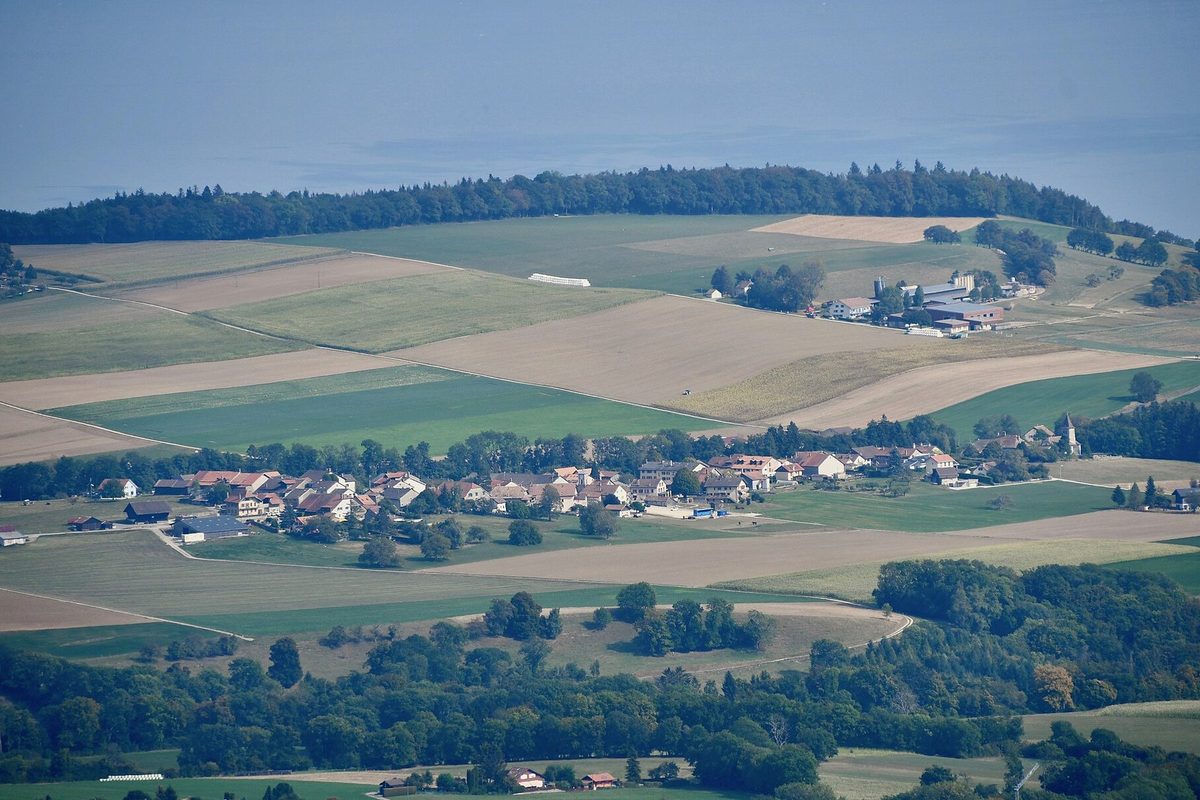
Burtigny
Above the Serine, the fortress of Bioley, besieged by the Count of Savoy in 1293, was gradually abandoned in the 14th century. Burtigny also keeps a church of Saint-Pierre of Romanesque origin.
Entry based on 11 sources · Our method · Reusable text (CC BY-SA)
Origin of the name Burtigny
The name appears in 1144 as «Britiniaco», then in 1145 as «Brettignei». The name «Burtigny» still awaits an explanation.[1]
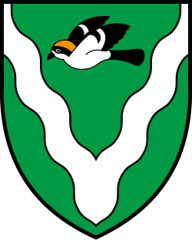
Coat of arms of Burtigny
Vert, a chevron reversed wavy argent, in chief a shrike proper volant. On a green field a white wavy chevron, point downwards, fills the lower part of the shield. Above it flies a shrike in its natural colours. This bird, the main charge of the arms, is called "matagasse" in the Vaud patois.[9][10]
Founding of Burtigny
Nobody knows who founded Burtigny. Yet the territory was inhabited long before the Common Era, as cup-marked stones, a Bronze Age foundry and Hallstatt-period burial mounds show. In the Middle Ages three houses shared the area: the lords of Prangins, Mont-le-Vieux and Aubonne. The church, for its part, depended on Bonmont Abbey. In the 14th century the rights of Aubonne prevailed.[1][4]
History of Burtigny
Bronze Age. A foundry is in operation on the territory.[1][4]
Hallstatt period. Burial mounds are built in the area.[1]
1144. First mention («Britiniaco»).[1]
1145. The name appears as «Brettignei».[1][4]
1204. The church is then a dependency of Bonmont Abbey.[1][4]
1262. Wuillierme de Prangins is described as lord of Mont, Bioley and Marchissy.[2]
1267. In a division of property, Jean de Prangins receives Prangins, Mont-le-Vieux and Bioley.[2]
1293. The Count of Savoy besieges several fortresses, including Bioley. On 9 July Louis of Savoy receives the castles of Mont and Bioley as an augmentation of his fief.[2]
1314. The castellany of Bioley has disappeared. The fortress is gradually abandoned.[2]
1337. Louis II of Savoy, Baron of Vaud, grants the monks of Bonmont the right to graze their livestock on the common pastures of Marchissy and Burtigny.[3]
1357. The rights of the lords of Aubonne become predominant.[1]
1380. Burtigny receives important property on the Marchairuz.[1]
1487. The church of Saint-Pierre is partly rebuilt in the Gothic style (date uncertain: 1487 or 1481).[1][3][4]
1527. Burtigny temporarily owns the upper part of the Vallée de Joux.[1]
1536. Under Bernese rule Burtigny belongs to the barony of Aubonne, which became a bailiwick in 1701.
1667. The Reformed parish of Burtigny loses Longirod and gains Bassins.[1][4]
1798. Burtigny is assigned to the district of Rolle.[1]
1809. The parsonage is built (date uncertain: 1809 or 1811).[1][4]
1889-1979. The orphanage «la Maison» is in operation.[1]
1955. The church is listed as a historic monument.[3]
2008. The new Vaud districts come into force: Burtigny is now part of the district of Nyon.
2025. The municipality has 406 inhabitants.[7]
Population of Burtigny
Sources and references: [1][4][7]
| 1764 | 243 |
| 1850 | 362 |
| 1900 | 369 |
| 1910 | 383 |
| 1950 | 343 |
| 1970 | 216 |
| 1990 | 287 |
| 2000 | 311 |
| 2025 | 406 |
Families of Burtigny
Burgher families before 1800. Bichet, Burnet, Du Martheray, Feignoux, Golay, Gudet, Moennath, Pilloud and Sergy, with no precise date.[11]
From 1901 to 1962. Three entries: the Goy, from France, in 1907, the Motto-Bertolino, from Italy, in 1945, and the Escher, from Simplon VS, in 1957.[11]
Economy of Burtigny, past and present
Fields and forests. Despite harsh winters, farming and forestry keep the village going. At the start of the 20th century forest covered about a third of the land, and meadows and fields the rest. The commune owns 200 ha of forest, managed without large clear-cuts.[4][10]
Tufa and the mill. From the Middle Ages to the end of the 19th century a tufa quarry was worked where the Serine meets the Moteline. Its stone was used for the bell tower of Burtigny and the towers of Rolle castle. From 1259 the convent of Bonmont owned a mill on the Serine.[4]
Corks and workshops. Founded in 1952, Suber S.A. makes cork stoppers. The factory was bought in 2002 by Suboeno S.A. A 10'000 m² craft zone, created in 2007, houses small and medium-sized firms.[1][4][10]
Disasters and major events in Burtigny
The fires of 1864 and 1881. Fire struck Burtigny twice. In 1864 it hit the lower part of the village, and the school was rebuilt the following year. In 1881 it devastated the upper part.[4]
Historic sites in Burtigny
Church of Saint-Pierre. Of Romanesque origin, it belonged to Bonmont Abbey, whose influence explains the pointed arches of the windows in the Romanesque bell tower. A parish church dedicated to Saint Peter, it was partly rebuilt in the Gothic style at the end of the 15th century and later restored. It has been a listed historic monument since 1955. After the Reformation the parish comprised Burtigny, Saint-George, Marchissy, Longirod (until 1667), Bassins (from 1667) and Le Vaud.[1][3][4]
Parsonage. The pastor's house was built in 1809, or in 1811: the date is uncertain.[1][4]
School. Built in 1838, it was hit by the fire of 1864, then restored in 1865, when a square clock tower was added.[4]
Remains in Burtigny
Bioley Castle. An oval fortress 101 metres long, south-east of the village, above the Serine, at about 650 metres altitude. A rectangular keep measuring 16 by 22 metres, set on an artificial mound, dominated its eastern part, and a double semi-concentric ditch separated it from the plateau. Mentioned in 1262, held by the Prangins family and then by Louis of Savoy, it was besieged in 1293. The castellany had disappeared by 1314. In 1868 its walls were still being used as a quarry.[2]
Cup-marked stones. Cup-marked stones bear witness to a prehistoric presence, among them the Pierre à Phébou. Four cup-marked stones in the Grandes-Tattes forest, of unknown date, are cultural properties of regional importance.[4][5]
Foundry and burial mounds. A Bronze Age foundry and Hallstatt-period burial mounds have been identified in the municipality.[1]
Protected heritage in Burtigny
Cultural property of regional significance (B objects)[8]
- Forêt des Grandes-Tattes, pierre à cupules - période inconnue
Traditions and festivals in Burtigny
The Abbaye de Burtigny. The shooting society founded in 1851 still exists under the name Société d'Abbaye de Burtigny. It is one of the local societies, alongside the firefighters' Amicale.[4][10]
Sources
- Germain Hausmann, « Burtigny », Dictionnaire historique de la Suisse (DHS), version du 03.11.2004
- Commune de Burtigny, « Le Château de Biolley »
- Commune de Burtigny, « L'Eglise »
- Inventaire fédéral ISOS, « Burtigny » (2e version, mars 2012)
- Office fédéral de la protection de la population, inventaire PBC, liste du canton de Vaud (état au 1.1.2026)
- État de Vaud, communiqué du 12.07.2007, « Les préfètes et les préfets sont attribués aux nouveaux districts »
- Statistique Vaud, « Population résidante permanente au 31 décembre 2025 »
- Federal Office for Civil Protection (FOCP), Swiss Inventory of Cultural Property (PCP), list for the canton of Vaud (as of 1.1.2026)
- IPI, Swissreg, emblems database: coat of arms of Burtigny (no. 101973)
- Official Gazette of the Canton of Vaud (FAO), "Alphabet des communes vaudoises: Burtigny"
- Register of Swiss Surnames, 3rd edition (1989), search Commune "Burtigny", Canton VD
Published by Sébastien Jörg ·
Other villages near Burtigny
Missing information, or do you have a source? Suggest a correction or addition. Every submission is checked before it's published.
Suggest a change