Berolle
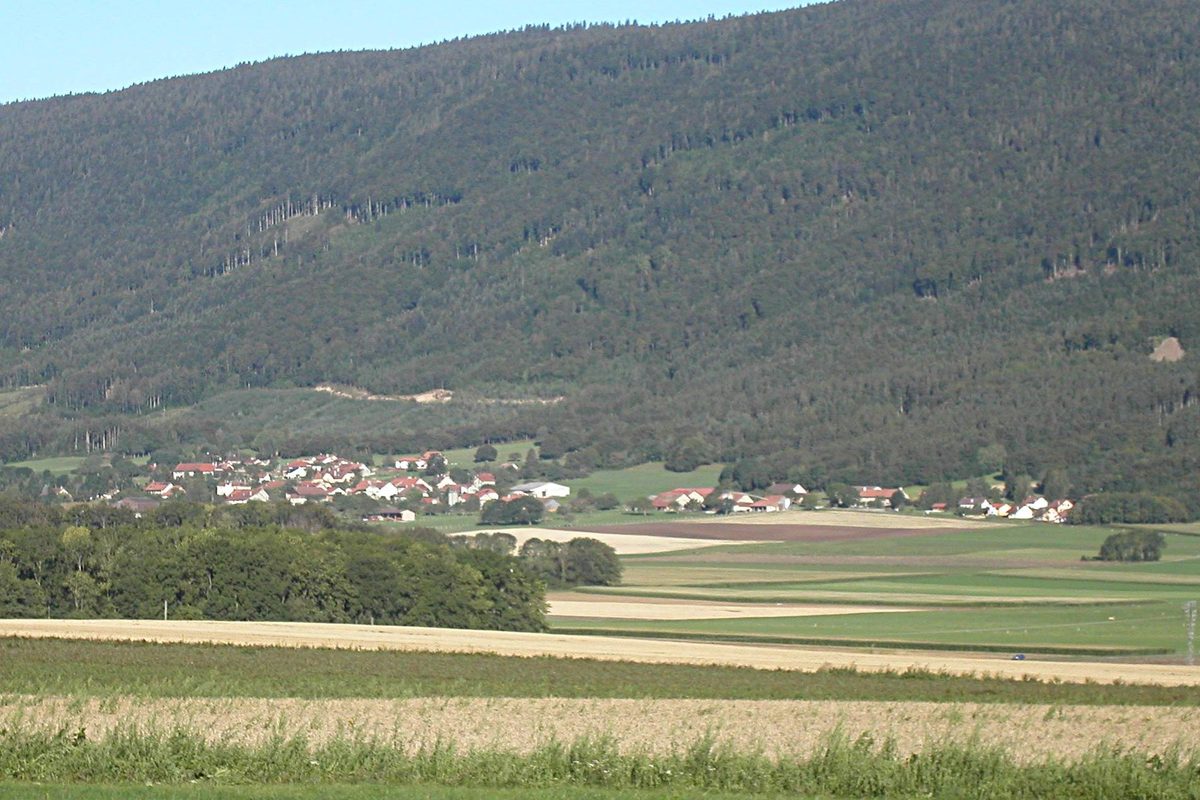
The last lord of Berolle, a small village at the foot of the Jura, was Jacques Necker, the Genevan financier and baron of Coppet.
Entry based on 11 sources · Our method · Reusable text (CC BY-SA)
Origin of the name Berolle
The place appears in 1235 in the Latinised form «Birula», then in 1453 as «Birolaz». The name «Berolle» has not yet been explained. The inhabitants bear the nickname «Sangsues» (leeches).[1][2]
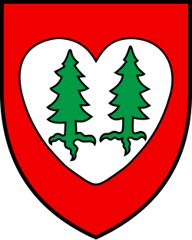
Coat of arms of Berolle
Gules, a heart argent charged with two fir trees eradicated vert. On a red field, a white heart bears two green fir trees with their roots showing. Adopted in 1919, the arms take up an old forestry mark of the municipality.[10][2]
Founding of Berolle
The territory of Berolle was inhabited long before the village's first written mention: remains of a Roman settlement have been found there and, on the hill of Arnichens, 9th-century graves. In the Middle Ages Berolle came under the barony of Mont-le-Grand and paid a tithe to the priory of Romainmôtier, on which it depended until the Bernese conquest. A parish church is attested there in the late 14th century. Under Bernese rule the village belonged to the bailiwick of Morges. Having become an independent lordship, Berolle changed hands several times, passing among others to the Steiger and then to the Lavigny families. Its last lord was Jacques Necker, Genevan financier and baron of Coppet. It is not known when he acquired the lordship. His rights ended with the abolition of feudal rights in 1798.[1][2]
History of Berolle
Roman period and 9th century. Remains of a Roman settlement, then 9th-century graves on the hill of Arnichens, signs of occupation long before the village's first written mention.[1]
Middle Ages. Berolle comes under the barony of Mont-le-Grand and owes a tithe to the priory of Romainmôtier, on which the village depends until 1536.[1][2]
1235. Earliest known written mention of the village, in the Latinised form « Birula ».[1]
1453. The village's name appears in the form «Birolaz».[1]
1397. A parish is attested at Berolle.[1][3]
1536. Conquest of the Pays de Vaud by Bern, which ends Savoyard rule over the region.
1539. Probable creation in this year of the Bernese bailiwick of Morges, on which Berolle depends until 1798.
17th century. Berolle becomes an independent lordship and passes through the hands of several successive owners.[2]
before 1798. Jacques Necker, a Geneva financier and Baron of Coppet, becomes the last known lord of Berolle. The precise date of this acquisition remains to be established.[1][2]
1798. Fall of Bernese rule and abolition of feudal rights. The Pays de Vaud becomes the Canton of Léman under the Helvetic Republic. Berolle is attached to the district of Aubonne.[1]
1803. The Act of Mediation turns Léman into the Canton of Vaud, which joins the Swiss Confederation as a full canton.
1834. Reconstruction of the church of Berolle. The current building dates from this reconstruction. Since the Reformation, the parish has been attached to that of Bière.[1][3]
1919. Adoption of the communal coat of arms, composed after an old forest mark of the commune: gules, a silver heart charged with two uprooted green fir trees.[2]
1970. Low point of the village's population, with 128 inhabitants recorded, in the context of the rural exodus then affecting many villages at the foot of the Vaud Jura.[1]
1982. Work is carried out on the church building. Whether it was maintenance or renovation is not known.
1988. The village has 180 inhabitants, a figure marking the start of a demographic recovery linked to residential development.[2]
30 May 2006. Adoption of the Vaud law on territorial division (LDecTer), which reduces the number of districts to ten and provides for the end of the district of Aubonne, to which Berolle had belonged since 1798.[7]
1 January 2008. Effective administrative reorganisation of the Vaud districts: Berolle joins the new district of Morges, where it still lies today.[7][8]
2016. Takeover and complete renovation of Berolle's communal inn by Aline and Andrew Antenen.[2][4]
2018. The tartare of Berolle's communal inn is named « World Tartare Champion ».[4]
2022-2024. The village's population stabilises at around 300 to 305 inhabitants, after several decades of growth linked to residential development that has profoundly transformed a village once dominated by agriculture (seven farms remain today, against a far higher number in the past).[2][6][9]
Population of Berolle
Sources and references: [1][2][6][9]
| 1850 | 244 |
| 1900 | 255 |
| 1970 | 128 |
| 1988 | 180 |
| 2018 | 305 |
| 2022 | 301 |
| 2023 | 304 |
| 2024 | 303 |
| 2025 | 300 |
Families of Berolle
Burgher families before 1800. Besson, Croisier, Dauphin, Fleury, Lecoultre, Mattille and Monod, with no precise date. The Ethénoz, from Bière VD, were admitted in 1767.[11]
In the 19th century. The Burnet, with no precise date.[11]
From 1901 to 1962. Seven entries, four of them families from Italy: Gaggio in 1918, Mosini in 1932, Schiavo in 1944 and Taurian in 1960. In 1957 the Fischer of Neuenegg BE were registered, along with another Fleury family from Semsales FR, distinct from the old one. The Schneider, from France, arrived in 1960 together with the Taurian.[11]
Economy of Berolle, past and present
The glassworks. A glassworks operated from 1730 to 1750 and gave rise to the hamlet of La Verrière. The Bernese authorities had it closed in 1750.[1]
Forests and mountain land. In 1807 the municipality gained 300 hectares of mountain land that had belonged to Ballens. Under the forestry law of 1810 it took over the share of pasture and forest that Bière held in joint ownership, and in return ceded 100 hectares of forest to Bière. Berolle belongs to the Ballens-Mollens forestry group. In 2021 it built a timber-framed building for its forestry team, using wood from its own forest.[1][2]
From farms to villas. For a long time farming sustained the village, which keeps its rural character. Taking the herds up to the alpine pastures in spring remains a key moment. A villa zone later drew many families, many of whose members work around Lake Geneva. Berolle no longer has a shop, and residents do their shopping in Bière.[2]
Historic sites in Berolle
Church of Berolle. A parish is attested at Berolle from 1397. The present church dates from a reconstruction of 1834. After the Reformation the parish was attached to that of Bière, the neighbouring municipality. Work was done on it in 1982, of an unknown nature. A plain building, it remains the village's visual landmark, as in most reformed villages at the foot of the Vaud Jura.[1][3]
Communal inn of Berolle. Located at the entrance to the Marchairuz and Mollendruz passes, with a view of Mont Blanc and the Alpine range, this village inn has a long tradition of hospitality. Taken over and fully renovated in 2016 by Aline and Andrew Antenen, it has built a gastronomic reputation well beyond the village: its tartare was named « World Tartare Champion » in 2018, and the establishment has received several distinctions (Guide Bleu, Fait Maison label, Swiss Wine Gourmet), while retaining the spirit of a village café.[4]
The village core and its hamlets. Berolle is a clustered village at the foot of the Jura, with three hamlets. One of them, La Verrière, grew up around a glassworks opened in 1730 and closed in 1750 by order of the Bernese authorities.[1]
Remains in Berolle
Traces of Roman settlement and Burgundian graves. Remains of a Roman settlement and 9th-century graves, on the hill of Arnichens, have been identified on the municipal territory. Their precise location, the finds and the circumstances of discovery are not known.[1]
Old forest mark. The communal coat of arms adopted in 1919 reproduces the design of an old forest mark once used by the commune, a sign that formerly served to identify trees or the boundaries of communal forests. It is not known whether a physical example of this mark has survived to this day. For now, it survives only in its heraldic form, on the communal coat of arms.[2]
Traditions and festivals in Berolle
The old tractor meet. Every two years the old tractor association holds a meet in the village.[2]
The Fête de la Musique. A team of volunteers puts on the Berolle Fête de la Musique, also every two years.[2]
Sources
- Dictionnaire historique de la Suisse, article « Berolle »
- Feuille des Avis Officiels du canton de Vaud, Alphabet des communes vaudoises, « Berolle »
- notreHistoire.ch, « Eglise de Berolle »
- Parc Jura vaudois, « Auberge communale de Berolle »
- Commune de Berolle, site officiel
- Office fédéral de la statistique, données démographiques (via Localcities.ch)
- Canton de Vaud, Loi sur le découpage territorial (LDecTer, RSV 132.15) du 30 mai 2006
- État de Vaud, communiqué du 12.07.2007, « Les préfètes et les préfets sont attribués aux nouveaux districts »
- Statistique Vaud, « Population résidante permanente au 31 décembre 2025 »
- IPI, Swissreg, emblems database: coat of arms of Berolle (no. 102067)
- Register of Swiss Surnames, 3rd edition (1989), search Commune "Berolle", Canton VD
Published by Sébastien Jörg ·
Other villages near Berolle
Missing information, or do you have a source? Suggest a correction or addition. Every submission is checked before it's published.
Suggest a change