Mollens
On its heights, the Mollendruz rock shelter holds traces of reindeer hunters from around 10 000 years before our era, at the end of the last glaciation.
Entry based on 14 sources · Our method · Reusable text (CC BY-SA)
Coat of arms: Public domain, Wikimedia Commons
Origin of the name Mollens
The name appears in writing in the personal name « Enguizo de Morlens », around 1111. The form « Morlens » is reportedly also found in 1139, so the date of the first mention is uncertain. The old name of the place is Morlens. The current form, Mollens, appears from 1228 onward and then stabilises. For « Mollens », no etymology is certain. Many place names of the canton of Vaud ending in « -ens » are of Burgundian origin, formed from a Germanic personal name followed by a suffix meaning roughly « at the people of ». It is not known which personal name might underlie Morlens. A link with the Latin mola, the millstone or the mill, is sometimes mentioned for similar names, but has not been shown for Mollens. The inhabitants are called the Mollensards. They also bear a nickname in Vaud patois, « lè Mitcha-Boû », that is, the wood-splitters, possibly an allusion to the importance of the forest in the village economy.[1][3][4][5]
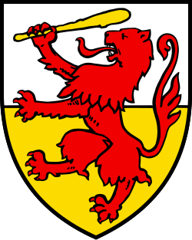
Coat of arms of Mollens
Per fess argent and Or, a lion gules overall holding a mace Or. The shield is divided horizontally, white at the top and yellow at the bottom. A red lion, set over both parts, holds a yellow mace. These were the arms of the nobles of Mollens, recorded in the 14th and 15th centuries. The municipality adopted them in 1922.[12][13][3]
Founding of Mollens
The territory of Mollens was frequented long before the village. The Mollendruz rock shelter, on the heights of the municipality, has yielded prehistoric occupations, with traces of reindeer hunters around 10 000 years before our era, at the end of the last glacial period. The sequence, from the Late Palaeolithic to the Neolithic, is said to be practically unique in Switzerland. Gallo-Roman remains, tile-kiln structures and bronze medals, were uncovered in 1846 between Mollens and the neighbouring village of Ballens, and traces of a Roman road are reported in the municipality. A cemetery from the 8th to the 12th century, uncovered in 2014 beneath the former communal forge, attests to a medieval occupation predating the first written mentions of the name. The church of Mollens came under the priory of Romainmôtier from 1139, and in 1167 the locality entered the Cluniac network as a small centre collecting land revenues for the abbey. A branch of the lords of Mont-la-Ville held the advocacy (avouerie) of the place, attested in 1272 and then in 1358. A jurisdictional dispute was settled in 1281 in favour of the priory.[1][3][4][5]
History of Mollens
around 10 000 BC. Successive prehistoric occupations at the Mollendruz rock shelter, with traces of reindeer and horse hunters at the end of the last glacial period. The sequence is described as practically unique in Switzerland, from the final Palaeolithic to the Neolithic.[5]
Roman era. Passage of a Roman road across the present-day territory of the municipality. Remains of a tile kiln and bronze medals discovered in 1846 between Mollens and Ballens.[3][4][5]
8th to 12th century. Occupation of a medieval burial site, uncovered in 2014 beneath the former communal forge, predating the first written mentions of the village's name.[5]
1111. First known written mention of the place name, in the personal name « Enguizo de Morlens ». The date is uncertain, 1111 (or 1139).[1]
1139. The church of Mollens is attached to the priory of Romainmôtier.[1]
1167. The village enters the Cluniac network, dependent on the priory of Romainmôtier, as a small centre for collecting land revenues.[4][5]
1228. First attestation of the current form of the name, « Mollens ».[3][4][5]
1257. A leper house is attested at Mollens.[1]
1272 and 1358. The advocacy (avouerie) of the place is held by a branch of the lords of Mont-la-Ville.[1]
1281. A jurisdictional dispute over Mollens is settled in favour of the priory of Romainmôtier.[3][5]
1416. The village has 46 hearths (households), one of the oldest known counts for the locality.[1]
1539-1798. Under the Bernese Ancien Régime, Mollens is part of the bailiwick of Morges. The municipality is governed by a council of ten members.[1]
1542. Under Bernese rule, a first Bernese lord of Mollens is mentioned, Jean Steiger, avoyer (chief magistrate) of Bern.[3][5]
1593. The parish of Mollens is attached to that of Bière.[1]
1761. A major fire strikes the village.[1]
1791. Construction, or possibly reconstruction, of the current château by Nicolas-Alexandre de Watteville.[1][3][4][5]
5 April 1798. A devastating fire destroys 48 houses as well as the church, where the communal archives were kept, entirely lost. The bells melt in the fire.[1][3][4][5]
1798-2007. Mollens is part of the district of Aubonne.
1833. The parish of Mollens is attached to that of Ballens.[1]
until 1912. A sawmill remains active in the village.[1]
1 January 2008. The new Vaud districts come into force: the district of Aubonne disappears and Mollens joins the district of Morges.
2014. Discovery of a medieval cemetery (8th-12th century) beneath the former communal forge.[5]
Today. Mollens remains an independent municipality of the canton of Vaud, district of Morges, with no known merger with a neighbouring municipality. The village as a whole is listed in the Federal Inventory of Swiss Heritage Sites (ISOS) and is part of the network of Cluniac Sites.[1][5]
Population of Mollens
Sources and references: [1][3][7]
| 1416 | 46 hearths (count in households, not individual inhabitants) |
| 1764 | 351 |
| 1850 | 530 |
| 1853 | 553 |
| 1900 | 481 |
| 1950 | 355 |
| 1980 | 216 (lowest point) |
| 2000 | 272 |
| 2023 | 322 |
Families of Mollens
Citizen families before 1800. Baudin, Cuvit and Mayor, with no precise date.[14]
In the 19th century. Coendoz, Favre and Morellon, as well as the Marmet family of Granges-près-Marnand, with no precise date. The Santschi family, from Sigriswil BE, was admitted in 1807.[14]
From 1901 to 1962. A single family, the Pittet, in 1952.[14]
Economy of Mollens, past and present
Fields and alpine pasture. Mollens lives from farming. In 2000 the municipality had 20 farms. South of the village, farmland amounts to nearly 500 hectares of crop rotation land. On the Pré de Mollens alpine pasture, a herdsman looks after the cattle of the village farms, and tomme cheeses are sold there on a few Saturdays in the summer season.[1][13]
The forest. To the north, the forest extends over more than 500 hectares and covers half of the municipal territory. The village no longer has a shop but keeps its municipal inn.[1][13]
Disasters and major events in Mollens
The fires of 1761 and 1798. Two fires devastated the village. The second, on 5 April 1798, destroyed 48 houses and the church. Some twenty head of cattle died in the flames.[1][3][5]
Historic sites in Mollens
The Château de Mollens. Nicolas-Alexandre de Watteville had it built in 1791. Its courtyard opens toward the garden, and six stone pillars carry its monumental gateway. The château remains one of the village's landmarks. It is privately owned.[1][3][5]
The church of Mollens. Of medieval origin, the church was linked from the 12th century to the Cluniac network and to the priory of Romainmôtier, on which it was administratively dependent until the early 14th century. Destroyed in the fire of 5 April 1798, which took the communal archives with it, it was subsequently rebuilt. The building is today listed in the Federal Inventory of Swiss Heritage Sites (ISOS).[1][4][6]
The historic village fabric. The whole village is listed in the ISOS. Its layout is described as « herringbone »: lanes branch off a central axis. Rural villages at the foot of the Jura vaudois that have kept their old structure often show this layout.[4][5]
The Mollendruz and Marchairuz passes. Mollens lies between these two passes of the Jura vaudois, routes historically used to link the Pied du Jura to the Vallée de Joux. The Mollendruz pass also gave its name to the prehistoric rock shelter discovered on its slopes.[4]
Remains in Mollens
The Mollendruz rock shelter. This archaeological site has yielded prehistoric occupations, with traces of reindeer hunters dated to around 10 000 years before our era. The sequence, from the end of the Palaeolithic to the Neolithic, is said to be practically unique in Switzerland, though this is uncertain.[5]
Gallo-Roman remains. In 1846, excavations between Mollens and Ballens uncovered structures interpreted as the remains of a Roman tile kiln, accompanied by bronze medals. Traces of a Roman road are also reported within the municipal territory. Its precise course is uncertain.[3][5]
The medieval cemetery at the old forge. In 2014, a cemetery dating from the 8th to the 12th century resurfaced beneath the former communal forge. This discovery points to an occupation of the site predating, or at the very least contemporary with, the very first written mentions of the village's name.[5]
Protected heritage in Mollens
Cultural property of regional significance (B objects)[11]
- Château avec deux maisons paysannes, deux portails et bassin
Traditions and festivals in Mollens
The New Year drums. At the turn of the year, the youth society of Mollens beats the drums. It also organises the village festival.[13]
L'Écho du Jura. The village brass band is called the Écho du Jura de Mollens. It gives an annual concert and holds a lotto.[13]
Sources
- Dictionnaire historique de la Suisse, article « Mollens (VD) »
- Site officiel de la commune de Mollens (VD), page d'accueil
- Site officiel de la commune de Mollens (VD), page Historique
- Site officiel de la commune de Mollens (VD), page Présentation
- L'Alpage de Mollens, présentation historique de la commune de Mollens VD
- Parc naturel régional Jura vaudois, fiche sur l'église de Mollens
- Localcities, fiche démographique de Mollens (VD)
- Gemeinde-commune-comune.ch, fiche de la commune de Mollens (VD)
- Feuille des avis officiels du canton de Vaud (FAOVD), alphabet des communes, Mollens
- État de Vaud, communiqué du 12.07.2007, « Organisation des préfectures et adaptation au nouveau découpage territorial »
- Federal Office for Civil Protection (FOCP), Swiss Inventory of Cultural Property (PCP), list for the canton of Vaud (as of 1.1.2026)
- IPI, Swissreg, emblems database: coat of arms of Mollens (no. 101400)
- Official Gazette of the Canton of Vaud (FAO), "Alphabet des communes vaudoises: Mollens"
- Register of Swiss Surnames, 3rd edition (1989), search Commune "Mollens", Canton VD
Published by Sébastien Jörg ·
Other villages near Mollens
Missing information, or do you have a source? Suggest a correction or addition. Every submission is checked before it's published.
Suggest a change