Boudry
The revolutionary Jean-Paul Marat (1743) and the chocolate maker Philippe Suchard (1797) were both born in this borough, a chartered town since 1343 below its castle on the Areuse.
Entry based on 19 sources · Our method · Reusable text (CC BY-SA)
Origin of the name Boudry
Boudry first appears in 1278, as « Baudri ». The name is said to be of Germanic origin, from the Merovingian personal name Balderich, Latinised as Baldricus. Another hypothesis links it to the Burgundian personal name Buderich. Neither has been confirmed.[1][4]
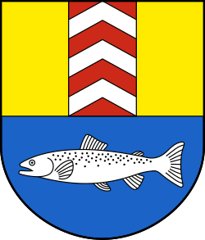
Coat of arms of Boudry
Per fess Or, a pale gules charged with three chevrons argent, and azure, a fish argent. The upper half is yellow with a vertical red band bearing three white chevrons, the lower half shows a white fish on blue.[14]
Founding of Boudry
Boudry has no known founder. Before the 14th century the territory had two hamlets: Pontareuse, near the bridge of the Roman road (Vy d'Etraz) over the Areuse, and Vermondins, on the plateau. The borough itself grew up at the foot of the castle, on a promontory overlooking the Areuse, and controlled the Yverdon-Neuchâtel road where it crossed the river. The castle belonged to Rodolphe IV of Neuchâtel, whose family had probably built it, and Rodolphe brought the surrounding lands under his authority. The liberties of Neuchâtel, granted with some restrictions by Count Louis, then made Boudry a town.[1][4]
History of Boudry
Neolithic to La Tène. Neolithic lakeside settlements on the shore . The Baume du Four cave is occupied from the Neolithic to the La Tène period. Hallstatt burial mounds in the Vallon de Vers and two Celtic villages at Les Buchilles.[1]
Early Middle Ages. A Burgundian cemetery is established at Bel-Air, near Areuse.[1]
1278. First mention of Boudry, as « Baudri », and of its castle . Sybille of Neuchâtel cedes the place to one of her daughters.[1][4]
1282. Pierre de Vaumarcus sells the rights of advocacy to Girard d'Estavayer.[1]
1313. Rollin d'Estavayer returns these rights to the Count of Neuchâtel, who had obtained the advocacy of Areuse in 1311.[1]
1343. On 12 September Count Louis grants the town of Boudry the liberties of Neuchâtel, with some restrictions.[1][4]
1369. The community obtains the right to levy the ohmgeld (wine tax) on Boudry and Cortaillod.[1]
1373-1413. Marguerite de Vufflens, widow of Count Louis, keeps the castellany in usufruct . Countess Isabelle takes it back in 1379, then from 1394 to 1413 it passes to Girard of Neuchâtel, lord of Vaumarcus. From 1413 it always belongs to the Counts of Neuchâtel.[1]
1510. The burghers build a town hall. In 1513 they take over the manorial mill in return for a rent.[1]
1534. The town remains Catholic at least until this date, through the action of the priest of Pontareuse, Claude Gauthier, while the rest of the parish adopts the Reformation.[1]
1540. Boudry obtains, among other privileges, the right to elect two « maîtres bourgeois » (burgher masters).[1]
1548. The burghers receive a tower under a perpetual lease, in which a clock is later installed.[1]
1585. A witch hunt reportedly ended with the conviction of four women.
1645-1647. Construction of a Reformed church in the centre of the old borough, reserved for the inhabitants of Boudry.[1]
1727. Opening of the Les Iles calico printing works (active until 1844) . Two others follow at Vauvilliers (before 1742 to 1874) and Grandchamp (1761-1841).[1]
1743. Birth in Boudry of Jean-Paul Marat, the future French revolutionary.[9]
1797. Birth in Boudry of the chocolate maker Philippe Suchard.
1813. Abolition of the « émine de la porte », a tax paid only by the inhabitants of Cortaillod for the upkeep of the walls, gates and bridge of Boudry.[1]
1828. Removal of the Château du Bas . The Tour Chaffaut is destroyed in 1835.[5]
1832. The jurisdictions of Rochefort, Bevaix and Cortaillod are abolished and joined to that of Boudry, which also receives the small territory of Areuse . The inhabitants of Areuse are admitted to the church of Boudry.[1][2]
1842. The old wooden bridge over the Areuse is replaced by a stone bridge.[5]
1848. Boudry becomes the capital of the district of Boudry.[1]
1870. Boudry merges with the small commune of Areuse.[1][2]
1883. Foundation of the Musée de l'Areuse.
1894. Opening at Perreux of the cantonal hospice for the incurable, later a psychiatric hospital.[1]
1931-1936. First retreat at the Grandchamp estate in 1931. Marguerite de Beaumont settles there in 1936. Community life, the origin of the Protestant community of Grandchamp, begins in 1940.[11]
1944. A battery factory replaces a watch factory . A machine tool company settles in 1958.[1]
1955-1957. Complete restoration of the castle, after the founding of the Compagnie des Vignolants in 1951.[5]
1980. Opening of a wine tasting cellar, followed in 1986 by a museum of vine and wine.[1]
1999. Boudry reportedly passed 5'000 inhabitants at the end of June.[5]
2014. A federal asylum centre reportedly opened at Perreux, where a cantonal first reception centre has existed since 2012.
2018. The Neuchâtel districts were reportedly abolished that year. The municipality of Boudry remains independent.
2023. On 26 November Boudry approves the « Basse-Areuse » merger project with Cortaillod and Milvignes, but the rejection by Milvignes makes the project fail.[7]
Population of Boudry
Sources and references: [1][3]
| 1750 | 638 |
| 1850 | 1'378 |
| 1900 | 2'190 (with Areuse) |
| 1950 | 2'625 |
| 1960 | 3'086 (unconfirmed) |
| 1970 | 4'372 (unconfirmed) |
| 1980 | 4'488 (unconfirmed) |
| 1990 | 5'163 (unconfirmed) |
| 2000 | 5'311 |
| 2025 | 6'339 |
Families of Boudry
Citizen families before 1800. Amiet, Barbier, Bindith, Bippus, Bonhôte, Borel, Bovet, Coste, Eifer, Erbeau, Favre, Gorgerat, Grellet, Gretillat, Maréchal, Martenet, Pernet, Perret, Pomey, Roy, Udriet, Vasserot, Verdonnet and Vust, with no precise date, as well as the d'Yvernois family from Môtiers NE.[15]
In the 19th century. Forty-five families, thirty-nine of them with no precise date. The cantons of Bern (13) and Vaud (9) provide the most. Dated registrations begin in 1892 with the Ortlieb family from Germany and end in 1899 with the Miquel family from France and the Reguin family from Chavornay VD.[15]
From 1901 to 1962. Seventy-two families, five of them with no precise date. Bernese (18) and Italian (13) families dominate, ahead of those from Vaud (8). The Buschini family from Italy is registered four times, in 1932, 1934, 1946 and 1951. Families from Poland (1949), the Soviet Union (1949) and Yugoslavia (1953) join the list. The last registration, in 1962, is the Albagli family from Egypt.[15]
Notable people of Boudry
Jean-Paul Marat (Boudry 1743 - Paris 1793). The son of a designer of printed calicoes, he leaves Boudry with his family for Neuchâtel in 1754. A physician and writer in London and then Paris, during the French Revolution he becomes editor of L'Ami du peuple and a Jacobin deputy in the Convention. Charlotte Corday assassinates him in 1793.[9]
Philippe Suchard (Boudry 1797 - Serrières 1884). The son of an innkeeper and a citizen of Boudry, he trains as a confectioner. He opens a confectionery in Neuchâtel in 1825 and in 1826 founds the chocolate factory at Serrières. From 1834 he also runs steamboats on the lake.[10]
Marguerite de Beaumont (1895-1986). She settles at the Grandchamp estate in 1936 to keep up a year-round presence of prayer, following the retreats held there since the early 1930s by women of the Reformed Church of French-speaking Switzerland. Geneviève Micheli (1883-1961), who arrives in 1944, becomes the community's first Mother. In 1952 the first sisters make their commitments and adopt the Rule of Taizé.[19]
Disasters and major events in Boudry
The flood of autumn 1750. The wooden bridge over the Areuse often had to be rebuilt. In autumn 1750 a flood of the river swept it away. Vehicles paid a toll to cross it. A stone bridge with three low arches replaced it in 1841-1842.[13][5]
The bridge subsidence, 18 February 1990. The stone bridge of 1842 subsided. It was then rebuilt. Today's concrete bridge has kept the parapets of 1842.[5][13]
Historic sites in Boudry
The borough of Boudry. Single-street borough on a promontory overlooking the Areuse, a chartered town since 1343. It keeps the Reformed church (1645-1647), the town hall, reportedly from 1834-1835, and the Fountain of Justice, whose statue is said to be dated 1610.[1]
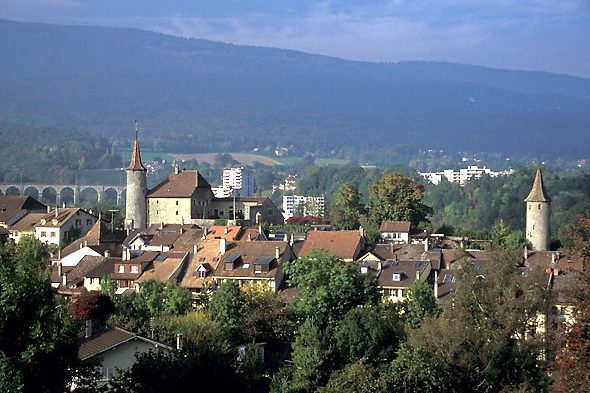
Boudry castle. Set on a natural acropolis between two watercourses, the castle dates back to the 12th century and is recorded in 1278. It was fully restored from 1955 to 1957. It reportedly houses the museum of vine and wine opened in 1986.[5]
The Tour de Pierre. Neo-medieval pavilion built in 1876, reportedly converted into a wine tasting cellar.
The Musée de l'Areuse. Regional museum founded in 1883, devoted to the natural and local history of the Areuse area.
The Areuse gorges and Champ-du-Moulin. The municipality extends to Champ-du-Moulin, in the Areuse gorges, where the burghers of Boudry acquired important rights.[1]
Grandchamp, Trois-Rods and Areuse. These districts keep the appearance of Neuchâtel villages of the 18th and 19th centuries. Grandchamp, former site of a calico printing works (1761-1841), is home to a Protestant monastic community.[1][5]
Perreux. Site of the cantonal hospice for the incurable opened in 1894, later a psychiatric hospital.[1]
Remains in Boudry
Prehistoric and protohistoric sites. The municipal territory includes Neolithic lakeside settlements, the Baume du Four cave (occupied from the Neolithic to La Tène), Hallstatt burial mounds in the Vallon de Vers, two Celtic villages at Les Buchilles and various Roman remains.[1]
Burgundian cemetery of Bel-Air. Early medieval cemetery discovered at Bel-Air, near Areuse.[1]
Pontareuse. In the Middle Ages the parish church stood at Pontareuse, a little north of Boudry . The parish reached the border of Franche-Comté. Remains of the church were still visible in 1815.[1]
Vanished fortifications. Of the borough's defences, the wall walk, the Château du Bas (removed in 1828) and the Tour Chaffaut (destroyed in 1835) have disappeared. The Tour Marfaux is said to be a remnant of the old fortifications.[5]
Protected heritage in Boudry
Cultural property of national significance (A objects in the PCP inventory)[12]
- La Baume du Four, abri néolithique - Age du Fer
Cultural property of regional significance (B objects)[12]
- Ancienne Indiennerie et son séchoir (actuelle chapelle)
- Archives communales
- Château
- Fontaine de la Justice
- Hôtel de la truite et sa salle des fêtes
- Musée de l'Areuse
- Musée de l'Areuse, Édifice
- Musée de la vigne et du vin au Château
- Porte des Vermondins
- Temple
- Tour de Pierre
- Tour Marfaux
Traditions and festivals in Boudry
The Compagnie des Vignolants. Representatives of the 19 wine-growing communes of the Littoral found it on 6 October 1951 in Boudry town hall, to promote and defend Neuchâtel wine. On 1 October 1957 the Compagnie takes possession of the castle: delegates of the wine-growing communes pour soil from their vineyards into a reconstructed well, and the Musée de la vigne et du vin opens. The Compagnie runs it until 1981. Its roughly 280 members wear a yellow and red robe.[17][16]
Boudrysia. Over a weekend, from Friday to Sunday, Boudrysia fills the streets of the town centre with stands. The festival has two themed processions, concerts and activities for young people, and each edition welcomes a different guest region.[18]
Sources
- Dictionnaire historique de la Suisse, « Boudry » (Germain Hausmann)
- Dictionnaire historique de la Suisse, « Areuse (localité) » (Germain Hausmann)
- État de Neuchâtel, arrêté du 4 février 2026 homologuant le recensement cantonal de la population au 31 décembre 2025
- Site officiel de Boudry, page Histoire
- Site officiel de Boudry, page Patrimoine
- Site officiel de la commune de Boudry
- Littoral Région, 1er décembre 2023, résultats de la votation sur la fusion Basse-Areuse
- Site officiel de la commune de Milvignes
- Dictionnaire historique de la Suisse, « Marat, Jean-Paul » (René Sigrist)
- Dictionnaire historique de la Suisse, « Suchard, Philippe » (Vincent Callet-Molin)
- Dictionnaire historique de la Suisse, « Beaumont, Marguerite de » (Gottfried Hammann)
- Federal Office for Civil Protection (FOCP), Swiss Inventory of Cultural Property (PCP), list for the canton of Neuchâtel (as of 1.1.2026)
- Inventory of Historical Traffic Routes in Switzerland (IVS), NE 2.2.6, Boudry, Rue Louis-Favre and bridge over the Areuse
- IPI, Swissreg, emblems database: coat of arms of Boudry (no. 102932)
- Register of Swiss Surnames, 3rd edition (1989), search Commune "Boudry", Canton NE
- RTN, 16 June 2026, "Les Vignolants font santé pour leurs 75 ans"
- Château de Boudry, "L'origine du musée"
- Switzerland Tourism (MySwitzerland), "Boudrysia"
- Communauté de Grandchamp, "Community" (history of the community)
Published by Sébastien Jörg ·
Localities of the municipality with a page
Other villages near Boudry
Missing information, or do you have a source? Suggest a correction or addition. Every submission is checked before it's published.
Suggest a change