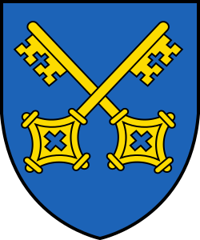
Bourg-Saint-Pierre
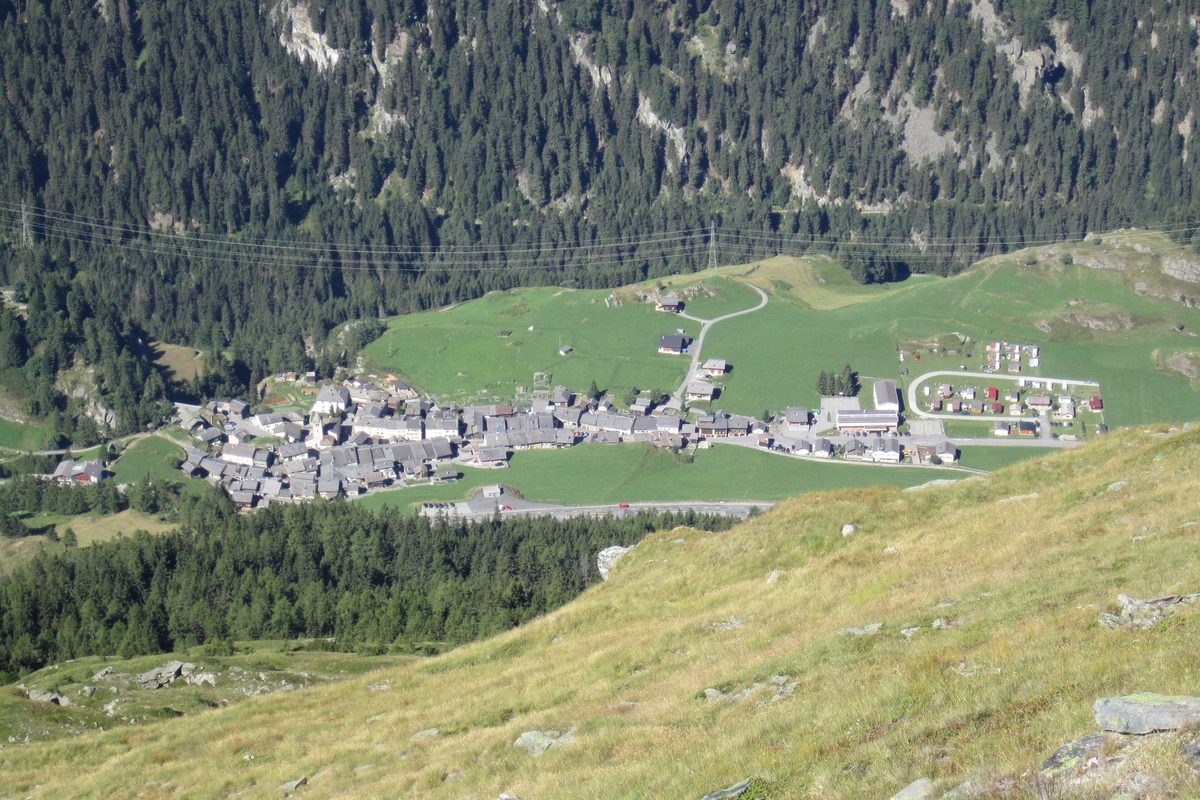
Origin of the name Bourg-Saint-Pierre
The place appears in 1125 in the Latin form « Burgus Sancti Petri ». Its old German name is « Sankt Petersburg ». The name links the borough to Saint Peter, patron of the old abbey of Saint-Pierre du Mont-Joux. No other explanation is known.[1]
Founding of Bourg-Saint-Pierre
Bourg-Saint-Pierre was born of the road. A compulsory stage on the Mont-Joux route, used since at least the 4th century BC, the site has probably been inhabited since Roman times. A monastery-hospice, the abbey of Saint-Pierre du Mont-Joux, is recorded there from 812/820. Ravaged several times, it lost importance after 1050 to the new hospice of the Great St Bernard. Around the middle of the 11th century the counts of Savoy brought the village under their rule: in return for opening and maintaining the path, they granted it franchises and privileges linked to transport over the pass. From the 13th century the village became a fortified borough. The municipality includes the borough, the Great St Bernard hospice and the hamlet of Allèves, depopulated at the end of the 19th century. The climate is harsh, the land mostly unproductive, and people live mainly from transit.[1]
History of Bourg-Saint-Pierre
4th century BC. The Mont-Joux route has been in use at least since this period. The site has probably been inhabited since Roman times.[1]
8th century. First sanctuary, perhaps from this period.[1][6]
812/820. First mention of the monastery-hospice, the abbey of Saint-Pierre du Mont-Joux.[1]
10th century. The Saracens destroy the first sanctuary, perhaps around 940 (or 972).[1][4][6]
around 1000. Hugues, Bishop of Geneva (around 993-1020), rebuilds the church.[1][6]
after 1050. The abbey loses importance to the new hospice of the Great St Bernard.[1]
11th century. Around the middle of the century the village comes under the rule of the counts of Savoy, who grant it franchises and transport privileges in return for maintaining the path.[1]
1125. Mentioned as « Burgus Sancti Petri ».[1]
13th century. The village becomes a fortified borough, defended by the castles of Quart and Allinges.[1][4]
1475. Conquest by the Upper Valaisans. The castles of Quart and Allinges are destroyed. The Bishop of Sion maintains the right of souste (staging right) and the monopoly of the « viérie », road maintenance.[1]
1475-1536. Bourg-Saint-Pierre belongs to the government of Lower Valais, then to that of Saint-Maurice from 1536 to 1798.[1]
1739. Construction of the present Baroque church, which keeps the old Romanesque bell tower.[1][6]
1800. From 15 to 21 May the troops of First Consul Bonaparte cross the Great St Bernard pass, before the victory of Marengo on 14 June. The village reportedly served as headquarters of the Reserve Army and Bonaparte reportedly stayed here on 20 May.[4]
1809. Loss of the « viérie » monopoly. The village nevertheless benefits from the growth in traffic due to freedom of trade.[1]
1906. The opening of the Simplon tunnel, then the modernisation of transport, cause gradual depopulation.[1]
1964. Opening of the Great St Bernard road tunnel, whose operation and transit tourism slow the exodus.[1]
1984. President François Mitterrand reportedly gives the municipality a medallion showing Napoleon's crossing of the pass.
Population of Bourg-Saint-Pierre
Sources and references: [1][2]
| 1850 | 305 |
| 1870 | 400 |
| 1900 | 355 |
| 1950 | 227 |
| 1960 | 524 |
| 2000 | 212 |
| 2025 | 242 |
Historic sites in Bourg-Saint-Pierre
Church of Saint-Pierre. Baroque church built in 1739 in place of the church rebuilt around 1000 by Bishop Hugues of Geneva. It keeps the old Romanesque bell tower.[1][5][6]
Great St Bernard Hospice. Located on the municipal territory, at the pass, the new hospice took over after 1050 from the old abbey of Saint-Pierre du Mont-Joux.[1][5]
Allèves. Hamlet of the municipality, depopulated at the end of the 19th century.[1]
Café Napoléon. The inn faces the choir of the church. Its name recalls that Bonaparte is said to have spent a night there in May 1800. The date of 20 May and the commemorative plaque are not confirmed.[4]
Remains in Bourg-Saint-Pierre
Roman milestone. This milestone column from the reign of Emperor Constantine was moved from the pass road and set next to the church of Saint-Pierre. It reportedly marked the 24th mile from Martigny on the Mont-Joux route.[4]
Romanesque bell tower. The old Romanesque bell tower was kept when the Baroque church was built in 1739.[1][6]
Fortified borough. From the 13th century the borough is fortified and defended by the castles of Quart and Allinges, destroyed in 1475.[1]
Sources
- Dictionnaire historique de la Suisse, « Bourg-Saint-Pierre » (Catherine Raemy-Berthod, version de 1997 remaniée le 14.10.2004)
- Office fédéral de la statistique (OFS), STATPOP, chiffres provisoires au 31.12.2025, via citypopulation.de
- geo.admin.ch, recherche de lieux (coordonnées)
- Office fédéral de la culture, ISOS (Inventaire fédéral des sites construits à protéger en Suisse), « Bourg-Saint-Pierre », n° 4831
- Office fédéral de la protection de la population (OFPP), Inventaire PBC, liste cantonale du Valais (objets A et B, état au 1.1.2026)
- Inventaire PBC (OFPP), fiche 6648 « Église St-Pierre avec tour romane », texte de la Société d'histoire de l'art en Suisse
Localities of the municipality with a page
Other villages near Bourg-Saint-Pierre
Missing information, or do you have a source? Suggest a correction or addition. Every submission is checked before it's published.
Suggest a change