Buix
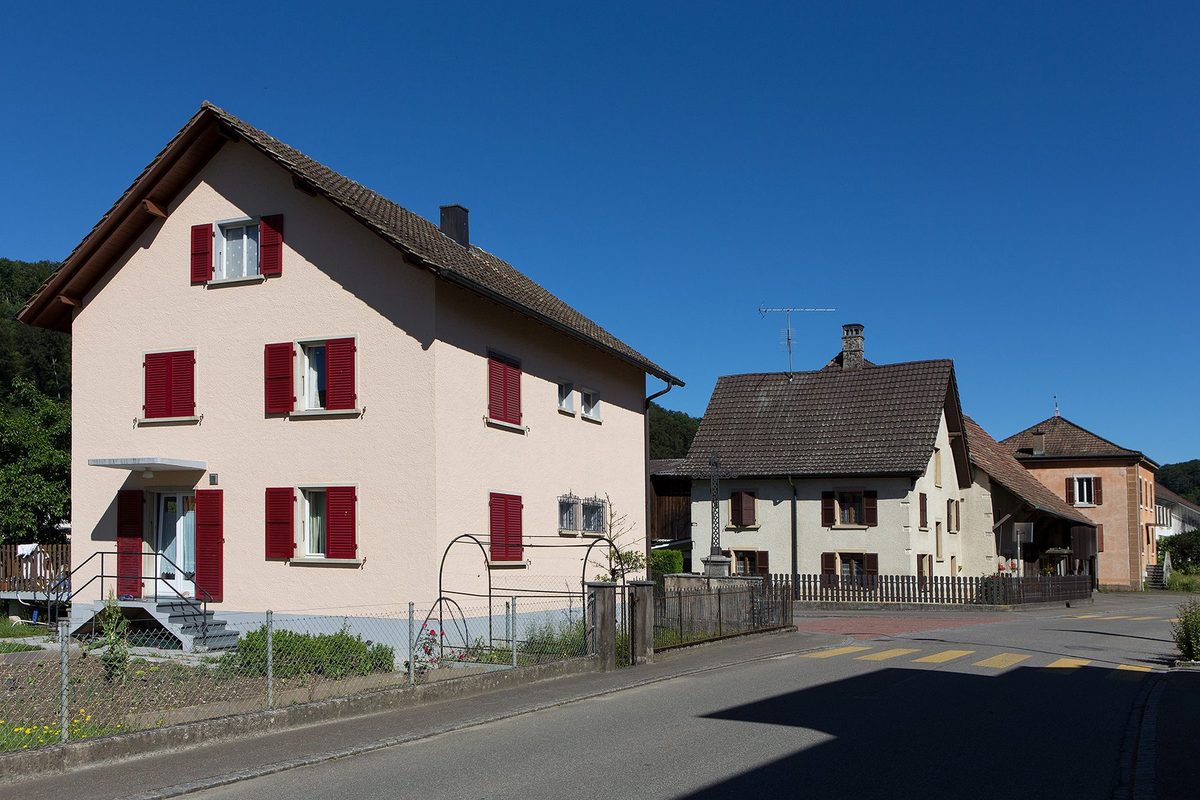
Origin of the name Buix
The village is first recorded in 1136 as « Bus ». The former German name was « Buchs ». What the name means is not yet known. The inhabitants are reportedly nicknamed the « Gravalons », meaning hornets in the Ajoie patois.[1]
Founding of Buix
The area was occupied in Roman times, as shown by a large rural estate (villa) discovered in the 19th century. In the Middle Ages, Buix belonged to the advocacy of Ajoie, which passed to the Prince-Bishopric of Basel at the end of the 13th century. A noble family « de Buix » is attested from 1170. Until the end of the Ancien Régime, the village belonged to the mairie of Bure. The former municipality comprised the village of Buix and the hamlet of Le Maira on the French border. It is today part of the municipality of Basse-Allaine (merger of 1 January 2009). It is not known who founded the village or when.[1]
History of Buix
Roman period. A large Roman rural estate (villa) occupies the area.[1]
1136. First mention: « Bus ».[1]
1157. Mention of the church of Saint-Maurice, which depends on the abbey of Baume-les-Messieurs in Franche-Comté.[1]
1170. First record of a noble family « de Buix ».[1]
1244. A donation to Bellelay Abbey is the oldest evidence of the French language in French-speaking Switzerland.[1]
late 13th century. The advocacy of Ajoie, which includes Buix, passes to the Prince-Bishopric of Basel.[1]
around 1392. Besides Bellelay, Lucelle Abbey and the chapter of Saint-Ursanne also own property in Buix.[1]
1779. The parish moves from the diocese of Besançon to that of Basel.[1]
1792-1815. Buix belongs to the French departments of Mont-Terrible, then Haut-Rhin.[1]
1815-1978. Buix belongs to the Bernese bailiwick, then district, of Porrentruy.[1]
19th century. Auguste Quiquerez discovers the Roman villa.[1]
1852. Buix adopts the status of a mixed municipality.[1]
1872. The station on the Porrentruy-Delle line opens.[1]
early 20th century. Manufacture of jewel bearings for the watch industry.[1]
1950. From this time, most of the working population work outside the municipality, mainly in Boncourt.[1]
1988. Buix becomes the first place in the canton of Jura where vines are planted again.[1]
1993. Excavation of the Roman villa, which also uncovers medieval masonry.[1]
2009. On 1 January, Buix merges with Courtemaîche and Montignez into the municipality of Basse-Allaine.[1]
Population of Buix
Sources and references: [1]
| 1770 | 207 |
| 1818 | 296 |
| 1850 | 453 |
| 1900 | 561 |
| 1950 | 628 |
| 2000 | 456 |
| 2008 | 458 |
Historic sites in Buix
Church of Saint-Maurice. Mentioned in 1157, it depended on the abbey of Baume-les-Messieurs in Franche-Comté. The parish belonged to the diocese of Besançon until 1779, then to that of Basel.[1]
Hamlet of Le Maira. Hamlet of the former municipality of Buix, on the French border.[1]
Buix vineyard. In 1988 Buix was the first place in the canton of Jura where vines were planted again.[1]
Remains in Buix
Roman villa. Large Roman rural estate discovered in the 19th century by Auguste Quiquerez. It was investigated in 1993. The excavations also uncovered medieval masonry.[1]
Sources
- Dictionnaire historique de la Suisse, « Buix » (Dominique Prongué), version du 28.05.2020 (version allemande consultée)
- geo.admin.ch (swisstopo), recherche de lieux « Buix »
Other villages near Buix
Missing information, or do you have a source? Suggest a correction or addition. Every submission is checked before it's published.
Suggest a change