Bullet
Destroyed by fire in 1744, this village at the foot of the Chasseron became a holiday resort around the turn of the 20th century, with the Les Rasses plateau and its Grand Hôtel.
Entry based on 10 sources · Our method · Reusable text (CC BY-SA)
Origin of the name Bullet
The village is first mentioned in 1323 as «Buleto». What «Bullet» means is still not known.[1]
Coat of arms of Bullet
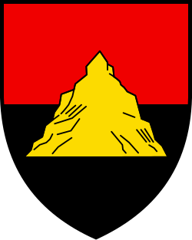
Per fess gules and sable, a mountain or overall. The shield is red above and black below. A yellow mountain rises over both colours: it stands for the Chasseron. The commune adopted these arms in 1922. It took up the colours of Bern, in memory of the inhabitants' attachment to Their Excellencies, who had helped the families ruined by the fire of 1744.[8][2]
Founding of Bullet
Bullet lies at 1'143 m above sea level, at the foot of the Chasseron, on remains of the terminal moraine of the former Rhône glacier. Who founded it, and how, is not known. It appears in the records at the beginning of the 14th century. In the Middle Ages, as in the Bernese period, it belonged to the lordship of Sainte-Croix. Besides Bullet, the municipality includes the hamlets of Les Rasses, Les Cluds, La Crochère, Les Crosats and La Frétaz.[1][2]
History of Bullet
1323. First mention of the village, as «Buleto».[1]
1536. Bernese conquest of Vaud: Bullet, which belongs to the lordship of Sainte-Croix, is attached to the bailiwick of Yverdon.[1]
1569. A chapel is built as a daughter church of Sainte-Croix.[1]
1663. The chapel becomes a parish church.[1]
1744. The village and the church are destroyed by fire. The Bernese authorities organise a general collection for the affected families.[1][2]
1745. The church is rebuilt.[1]
18th century. Watchmaking is added to livestock farming as a source of income.[1]
1798. End of the Bernese bailiwick of Yverdon, to which Bullet had belonged since 1536. The municipality is attached to the district of Grandson.[1]
19th century. Music box making develops, an activity that declines in the 20th century.[1]
1886. The church burns once again. It is rebuilt in 1887.[1]
1893. Opening of the Yverdon-Sainte-Croix railway, which, together with the postbus service, fosters the development of tourism.[1][2]
1898. Opening of the Grand Hôtel des Rasses and the Hôtel du Chasseron.[2][4]
1922. Adoption of the current coat of arms: the colours of Bern, with a gold mountain symbolising the Chasseron.[2]
after 1930. Tourism declines.[1]
around 1960. Tourism revives with holiday homes and cross-country skiing.[1]
2008. The new Vaud districts come into force (1 January): Bullet moves from the district of Grandson to that of Jura-Nord vaudois.[2][5]
2019. The Grand Hôtel des Rasses is named «Historic Hotel of the Year».[3][4]
Population of Bullet
Sources and references: [1][6]
| 1764 | 583 |
| 1850 | 719 |
| 1860 | 767 |
| 1900 | 631 |
| 1950 | 635 |
| 1980 | 436 |
| 2000 | 522 |
| 2025 | 687 |
Families of Bullet
Burgher families before 1800. Bonnet, Bugnon, Champod, Gaillard, Guiot, Hugonet, Lador, Lambert, Lassieur, Lassueur, Robellaz and Thévenaz, with no precise date.[9]
From 1901 to 1962. Twenty-four entries from many backgrounds. The Mébold opened the list in 1915, followed by the Guénat in 1923. Several families came from Germany (Focking in 1934, Petersen in 1939, Hessen in 1945) or from Italy (Rosa in 1940, Giorla in 1948, Benzi in 1951, Prévitali in 1957). Others arrived from Yugoslavia (Bumbowitch, 1953), France (Maillard, 1953, and Duffour, 1961), Belgium (Goethals, 1954), the Soviet Union (Karpenco, 1955) and Austria (Héring, 1958). The Malikova were registered in 1954. Swiss newcomers include the Gander of Saanen BE, the Hausammann of Seedorf BE, the Kohler of Burgistein BE and the Marguet of Ménières FR in 1957, the Fischer of Neuenegg BE and the Hiltbrunner of Wyssachen BE in 1958, then two Ticino families in 1959, the Bernardi of Medeglia and the Quadri of Meride. The last entry is that of the Duffour, in 1961.[9]
Notable people of Bullet
Edouard Baierlé and Edouard Junod-Jéquier. These two entrepreneurs were behind the Grand Hôtel des Rasses and the Hôtel du Chasseron, which opened in 1898 on Bullet's territory.[2]
Economy of Bullet, past and present
Cattle, watches and music boxes. Livestock farming is the base. Watchmaking was added in the 18th century, and music-box making took over in the 19th century before disappearing in the 20th. Farmers still work the commune's pastures, and the village has its own dairy. Local firms work mainly in joinery.[1][2]
Tourism at Les Rasses. At the end of the 19th century Les Rasses turned to tourism, helped by the Yverdon-Sainte-Croix railway and the postbuses between Sainte-Croix and Bullet. Tourism declined from 1930. In the 1950s downhill skiing became established on the slopes of the Chasseron. Around 1960 holiday homes and cross-country skiing revived the resort.[1][2]
Disasters and major events in Bullet
The fire of 1744. Fire destroyed the whole village and its church. Their Excellencies of Bern ordered a general collection for the families affected. The inhabitants remembered this with gratitude and remained strongly attached to Bern.[1][2]
Historic sites in Bullet
Bullet church. Chapel founded in 1569 as a daughter church of Sainte-Croix, which became a parish church in 1663. Burnt down with the village in 1744 and rebuilt in 1745, it burned again in 1886. The present building dates from 1887.[1]
Grand Hôtel des Rasses. Belle Époque hotel opened in 1898 on the Les Rasses plateau, at about 1'200 m above sea level, with a view of the Alps. It retains its «Belle Époque» restaurant, dating from 1897, and was named «Historic Hotel of the Year 2019».[2][3][4]
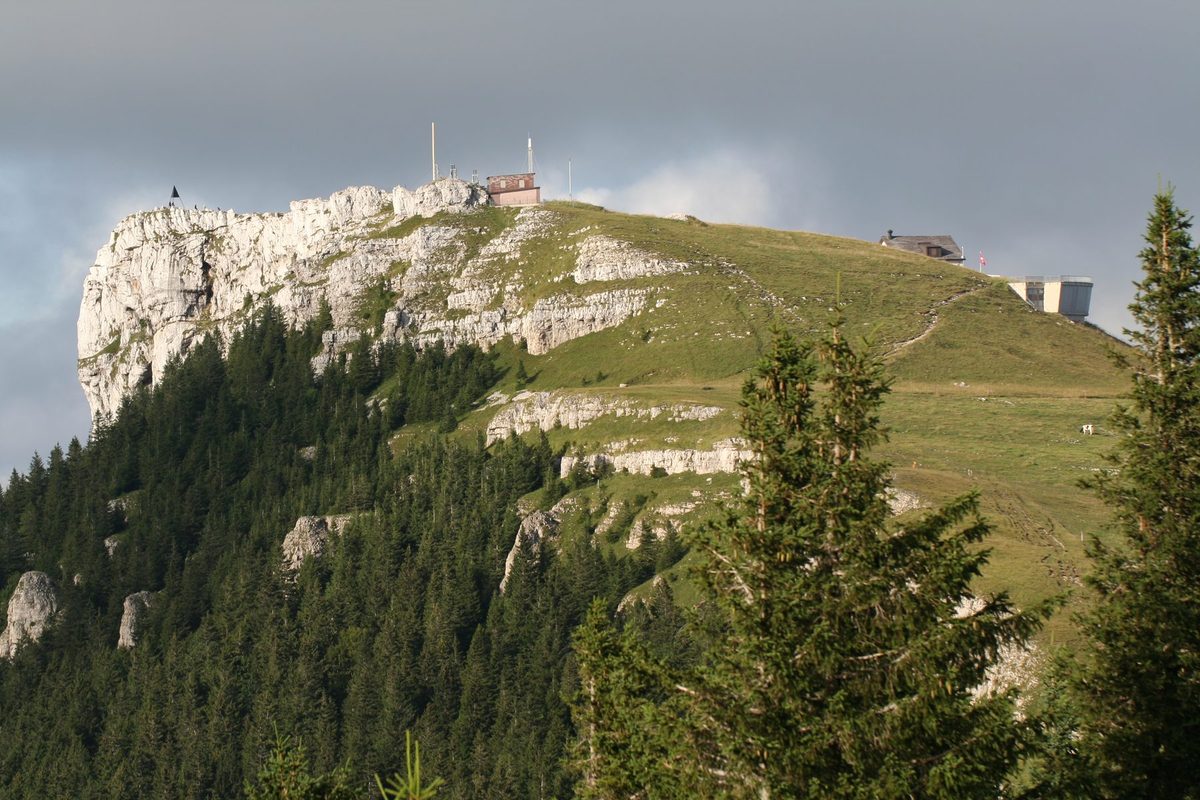
The Chasseron and the Les Rasses plateau. The Chasseron, whose outline has appeared on the municipal coat of arms since 1922, towers over the village. The Les Rasses plateau became a holiday spot after the railway reached Sainte-Croix in 1893, and later an area for skiing and cross-country skiing.[1][2]
Remains in Bullet
Terminal moraine of the Rhône glacier. The village stands on remains of the terminal moraine left by the former Rhône glacier during the ice ages, evidence that the ice reached the slopes of the Jura.[1]
Protected heritage in Bullet
Cultural property of regional significance (B objects)[7]
- Chasseron, sanctuaire romain
Traditions and festivals in Bullet
La Mara. The Les Rasses Nordic Centre hosts La Mara every year, an international cross-country ski race, usually on the first weekend of March.[2][10]
Sources
- Chantal Lafontant, « Bullet », Dictionnaire historique de la Suisse, version du 04.02.2003
- Feuille des avis officiels du canton de Vaud, « Alphabet des communes vaudoises : Bullet »
- Swiss Historic Hotels, « Grand Hôtel des Rasses »
- Commune de Bullet, « Grand Hôtel des Rasses »
- État de Vaud, communiqué « Organisation des préfectures et adaptation au nouveau découpage territorial », 12.07.2007
- Statistique Vaud, « Population résidante permanente au 31 décembre 2025 »
- Federal Office for Civil Protection (FOCP), Swiss Inventory of Cultural Property (PCP), list for the canton of Vaud (as of 1.1.2026)
- IPI, Swissreg, emblems database: coat of arms of Bullet (no. 101325)
- Register of Swiss Surnames, 3rd edition (1989), search Commune "Bullet", Canton VD
- Yverdon-les-Bains Région tourist office, "La Mara"
Published by Sébastien Jörg ·
Localities of the municipality with a page
Other villages near Bullet
Missing information, or do you have a source? Suggest a correction or addition. Every submission is checked before it's published.
Suggest a change