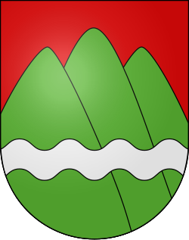
Buttes
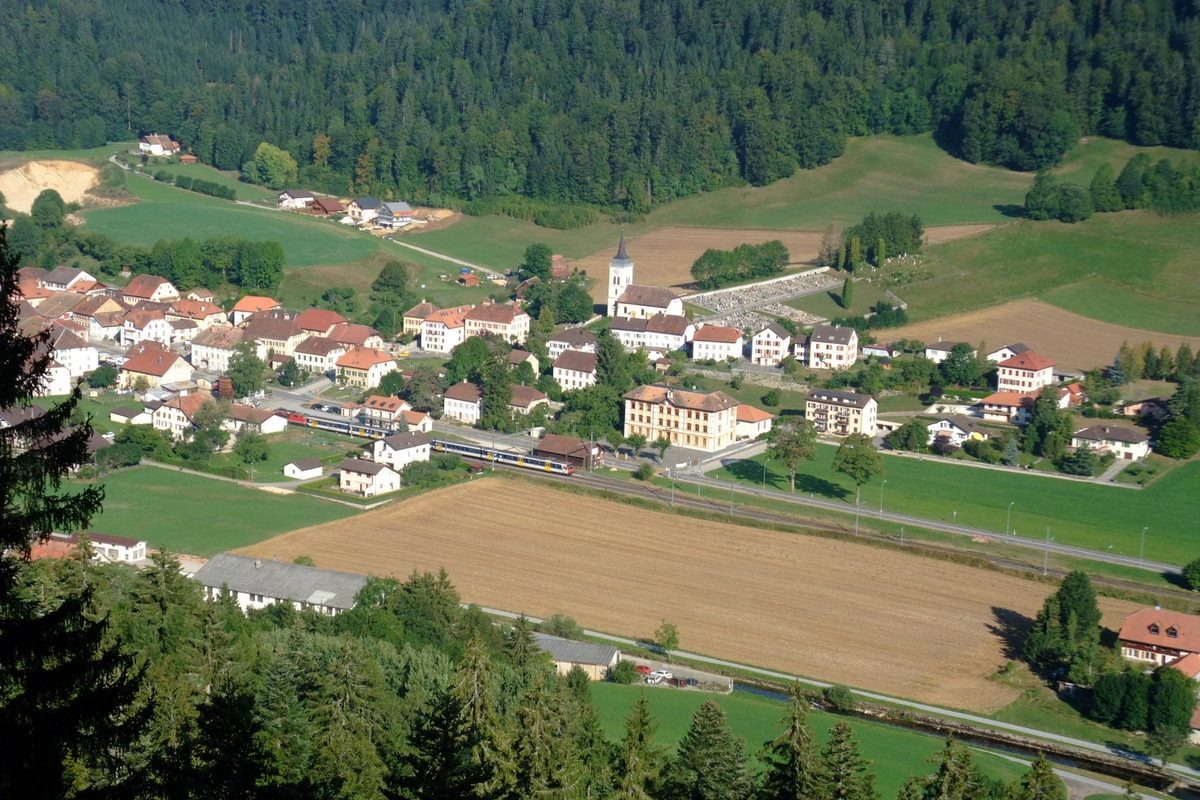
At the head of the Val-de-Travers, Buttes was a staging post on the Vy Saulnier, the salt road, and from the 15th to the 19th century a nursery of masons and carpenters.
Entry based on 7 sources · Our method · Reusable text (CC BY-SA)
Origin of the name Buttes
The first written mention, around 1300, gives the form « Boutes ». The territory is crossed by the Buttes river. The meaning of « Buttes » is not established.[1]
Founding of Buttes
Buttes depended spiritually (10th-16th century) and temporally (10th-14th century) on the priory of Saint-Pierre du Vautravers (Môtiers), then on the castellany of Val-de-Travers from the 14th century to 1848. The village developed as a staging post on the Vy Saulnier, the old Franco-Swiss salt road. The community was constituted in 1522 and belonged to the corporation of the Six Communes. Buttes is now part of the municipality of Val-de-Travers (merger of 1 January 2009). There is no known founder or founding act for Buttes.[1]
History of Buttes
10th-16th century. Buttes depends spiritually on the priory of Saint-Pierre du Vautravers, and temporally until the 14th century.[1]
around 1300. First written mention, in the form « Boutes ».[1]
14th century-1848. The village comes under the castellany of Val-de-Travers.[1]
15th-19th century. Buttes is a nursery of masons and carpenters.[1]
1522. The community of Buttes is constituted and joins the corporation of the Six Communes.[1]
1705. A Protestant church replaces the chapel dedicated to Saint Maurice.[1]
1714. Mention of an asphalt deposit.[1]
1779-1862. Tile works in operation.[1]
1835. End of the parish shared with Saint-Sulpice.[1]
before 1848. The village is a centre of liberal patriots.[1]
1843. Opening of a road to Sainte-Croix.[1]
1886. Station on the Val-de-Travers Regional railway (RVT).[1]
19th-20th century. Production of a medicinal herbal tea known as « Swiss tea ».[1]
1901-1991. A watch manufactory operates.[1]
1958. Opening of a home for the elderly.[1]
1967-1983. Land consolidation.[1]
1990. 15 % of the working population is still employed in the primary sector.[1]
2009. On 1 January, Buttes merges with Les Bayards, Boveresse, Couvet, Fleurier, Môtiers, Noiraigue, Saint-Sulpice and Travers to form the municipality of Val-de-Travers.[1]
Population of Buttes
Sources and references: [1]
| 1750 | 654 |
| 1850 | 1'182 |
| 1870 | 1'436 |
| 1900 | 1'393 |
| 1950 | 919 |
| 1990 | 594 |
| 2000 | 644 |
| 2008 | 601 (31 December, last census before the merger) |
Families of Buttes
Citizen families before 1800. Bourquin, Cathoud, Dubois, Dubois du Nilac, Grandjean, Juvet, Lebet, Leuba, Leuba-Bastillon, Leuba-dit-Galland, Leubaz and Thiébaud, with no precise date, as well as the Reuge family from France. Four of these names are branches of the Leuba family.[4]
In the 19th century. Blum, de Rougemont, Donnier and Donniez, with no precise date, like the Berger family from Wattenwil BE, the Blatty family from Boltigen BE, the Brusa-Perona family from Italy, the Locher family from Hasle bei Burgdorf BE, the Rouillier family from La Côte-aux-Fées NE and the Vaucher family from Fleurier NE. Registered in 1889 are the Jaccard family from Sainte-Croix VD, the Messerli family from Oberwil im Simmental BE and the Yersin family from Rougemont VD, and in 1891 the Gutknecht family from Agriswil FR, the Luthy family from Rüderswil BE and the Schenk family from Röthenbach im Emmental BE. The Kapp family from France follows in 1892, and the Gerber family from Röthenbach im Emmental BE in 1894.[4]
From 1901 to 1962. Forty-four registrations. France (14 families) and Italy (13) provide most of the new citizens, ahead of the canton of Bern (8). Others come from Belgium, Austria, Germany or Argentina. The last family registered, in 1962, is the Pesenti family from Italy.[4]
Economy of Buttes, past and present
Masons, carpenters and a staging post. From the 15th to the 19th century, Buttes supplied masons and carpenters. The village was also a staging post on the old salt road between France and Switzerland. A road to Sainte-Croix has existed since 1843.[1]
Asphalt, tiles and Swiss tea. An asphalt deposit is recorded from 1714. Tile works operated from 1779 to 1862. In the 19th and 20th centuries, Buttes also made a medicinal herbal tea called « thé suisse » (Swiss tea).[1]
Watchmaking. A watch factory ran from 1901 to 1991. In 1990, 15 % of the working population was still employed in the primary sector.[1]
Historic sites in Buttes
Buttes church. Built in 1705 on the site of an old chapel dedicated to Saint Maurice. The bell tower is said to have been added in 1854 and the stained glass installed in 1948-1949, dates that are not confirmed. Buttes formed a joint parish with Saint-Sulpice until 1835.[1]
The Vy Saulnier. Old Franco-Swiss salt road on which Buttes was a staging village. A road to Sainte-Croix was opened in 1843.[1]
Fête des Fontaines. Festival held on 12 September. The date is said to recall Neuchâtel joining the Confederation in 1814, and the festival is said to date back to the 19th century.[1]
Legends of Buttes
The serpent of the Chaîne. A tradition reported by an old author, quoted by the Inventory of Historic Traffic Routes, tells that a « serpent monstrueux » (monstrous serpent) had settled in the rocks of the Combe à la Vuivra, at the Chaîne pass in Saint-Sulpice, and laid waste to the surroundings, so that the main road to France had to be diverted through Buttes, along a path called the « Vie Saunier » or salt road.[3]
Traditions and festivals in Buttes
The Fête des Fontaines. On the afternoon of 12 September, the children of Buttes decorate the village fountains. A procession led by the Saint-Sulpice brass band moves from one neighbourhood to the next, then the crowd forms a large circle around the basin on the Place du 12-Septembre for the "Picoulet", a game in which all ages take part. The date recalls 12 September 1814, when the Federal Diet accepted Neuchâtel into the Confederation. The King of Prussia, still the country's sovereign, banned celebrations that day, so the people of the valley decorated the fountains instead.[5]
The medieval salt festival. On the first Saturday of September, an organising committee turns the streets of Buttes into a medieval market for the Fête du sel. Entry is free.[6][7]
Sources
- Dictionnaire historique de la Suisse, « Buttes »
- État de Neuchâtel, arrêté du 21 janvier 2009 portant homologation des résultats du recensement cantonal de la population du 31 décembre 2008
- Inventaire des voies de communication historiques de la Suisse (IVS), NE 1.0.12
- Register of Swiss Surnames, 3rd edition (1989), search Commune "Buttes", Canton NE
- Courrier du Val-de-Travers Hebdo, 18 September 2026, "Fête des fontaines. À Buttes, les traditions coulent de source"
- Switzerland Tourism (MySwitzerland), "Medieval salt festival", Buttes
- Fête du Sel de Buttes, official website
Published by Sébastien Jörg ·
Other villages near Buttes
Missing information, or do you have a source? Suggest a correction or addition. Every submission is checked before it's published.
Suggest a change