Caux
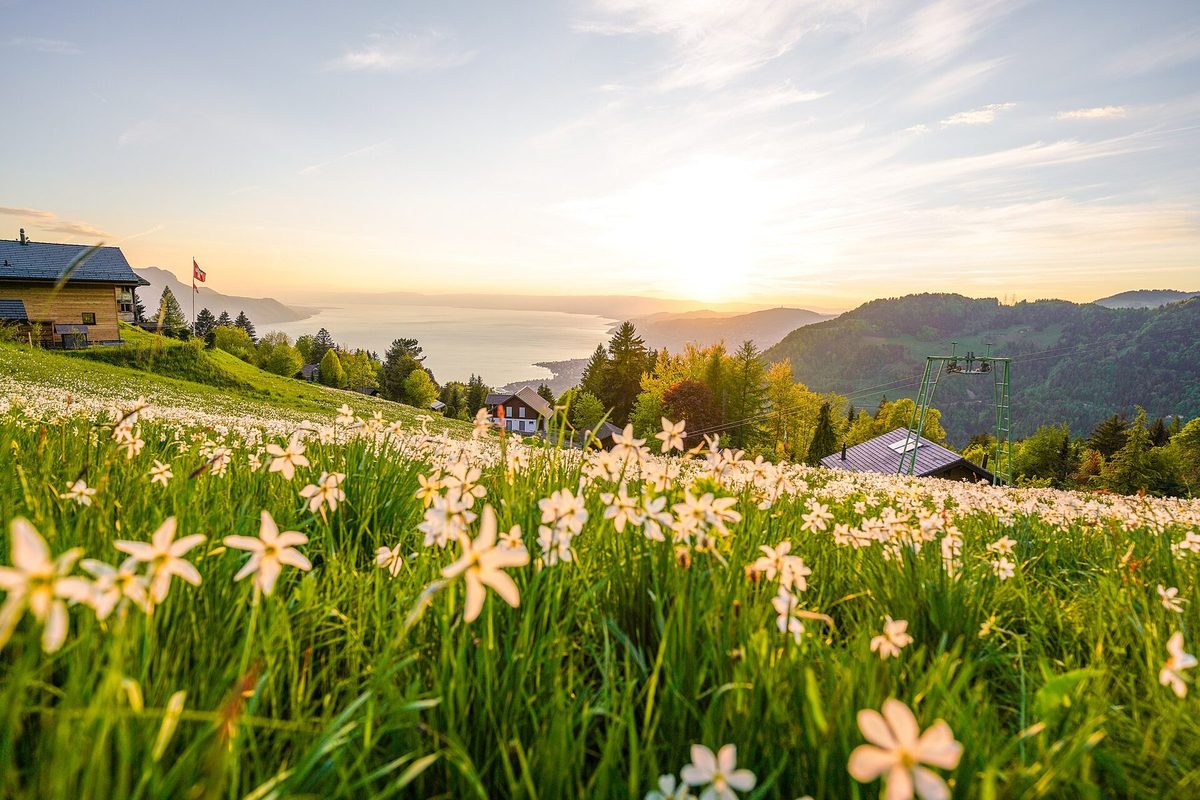
A former pasture above Montreux, Caux saw the Caux-Palace open in 1902, then the largest and most luxurious hotel in Switzerland.
Entry based on 5 sources · Our method · Reusable text (CC BY-SA)
Origin of the name Caux
Old documents refer to the place as « monts de Cau ». The name « Caux » still awaits an explanation.[1]
Founding of Caux
Caux has no known founding charter. The « monts de Cau » were part of the lower pastures cleared by the first settlers, at about 1'000 metres above Lake Geneva, at the foot of the Rochers de Naye. The resort itself was born of tourism. First a chalet turned into an inn welcomed walkers coming from Glion and Montreux, then the rack railway made it possible to build large hotels, including the Grand-Hôtel and the Caux-Palace. Caux is not a municipality: the locality belongs to Montreux, in the district of Riviera-Pays-d'Enhaut.[1][2]
History of Caux
17th century. With the improvement of the road network, Montreux spreads towards the lakeshore, then towards the heights of Caux and Les Avants.[2]
1875. A modest chalet is turned into an inn to welcome the growing number of walkers coming from Glion and Montreux.[1]
1883. Opening of the Territet-Glion funicular, the first stage of rail access to the heights.[1]
1890-1893. Construction of the Grand-Hôtel, designed by the architect Louis Maillard and presented at its opening as « le plus bel hôtel du monde ». It is raised by additional storeys in 1899.[1]
around 1892. Completion of a new carriage road coming from Glion.[1]
1892. Opening of the Glion-Rochers-de-Naye rack railway, with a station at Caux.[1]
1900-1902. Construction of the Caux-Palace by the architect Eugène Jost. With 300 to 350 rooms, at its inauguration it is the largest and most luxurious hotel in Switzerland.[1]
1905-1906. Construction of the Saint-Michel chapel, originally an Anglican chapel.[1]
1907-1908. Construction of the Catholic chapel of Saint-Joseph.[1]
1909. The rack railway is extended down to Montreux.[1]
1913. An inventory lists more than 500 beds in the resort, at the height of the Belle Époque (1893-1914).[1]
1930. Caux hosts the first bobsleigh world championship.[1]
1939. The outbreak of the Second World War destroys most of the resort's hotel economy. During the war the Caux-Palace and the Grand-Hôtel take in Jewish refugees, among them passengers of the Kasztner train who arrived in December 1944, cared for by the Swiss army.[1][3]
1946. The Moral Re-Armament movement buys the Caux-Palace, renamed Mountain House, to turn it into an international conference centre. It is now run by Initiatives of Change.[1]
1978. The former Grand-Hôtel, meanwhile renamed Hôtel Regina, is bought by the Lectorium Rosicrucianum, which turns it into a conference centre.[1]
2013. Second version of the record of the Federal Inventory of Swiss Heritage Sites (ISOS), which ranks Caux among the sites of national importance.[1]
Economy of Caux, past and present
The "monts de Cau". Before the resort, the land of Caux, known as the "monts de Cau", consists of pastures cleared by the first settlers of the Montreux area. The Jaman pass road runs through it. For a long time, it is the only direct route to Lake Geneva for the people of the Sarine and Simmental valleys. A farmhouse from the 18th and 19th centuries recalls this farming life.[1]
The hotels. In 1913, the Société immobilière de Caux offers 430 beds. With the 45 beds of the Pension Maria and the 30 of the Pavillon des Fougères, the resort has more than 500. Other houses take in guests, such as the Hôtel Les Rosiers, built in 1896, or Les Sorbiers, opened in the former house of Doctor Mercanton.[1]
Winter sports. By the end of the 19th century, Caux has a skating rink and a 700-metre toboggan run. In 1909, a bobsleigh run links the Crêt-d'y-Bau with Caux. A ski jump with a ski lift opens at the Hauts-de-Caux in 1936, and the Piste du Diable is inaugurated in 1939.[1]
From the wars to conferences. The golden age ends abruptly in the summer of 1914. During the First World War, the hotels stay almost empty, and the interwar years are hard for them. After the Caux-Palace, Moral Re-Armament buys the Hôtel Regina and the Pension Maria in 1947, then the Hôtel Alpina, the former Pavillon des Fougères, in 1949. In 2013 an international hotel school rents the palace for the nine months of the school year.[1]
Historic sites in Caux
Caux-Palace (Mountain House). Hotel built from 1900 to 1902 by the architect Eugène Jost, the largest and most luxurious in Switzerland at its inauguration. Bought in 1946 by Moral Re-Armament, it became an international conference centre (Initiatives of Change) and also houses a hotel management school.[1][3]
Former Grand-Hôtel. The resort's first large hotel, built from 1890 to 1893 by the architect Louis Maillard and raised in 1899. Renamed Hôtel Regina, it was bought in 1978 by the Lectorium Rosicrucianum.[1]
Saint-Michel and Saint-Joseph chapels. Two chapels from the early 20th century: Saint-Michel (1905-1906), originally Anglican, and the Catholic chapel of Saint-Joseph (1907-1908).[1]
Caux station. Station of the Glion-Rochers-de-Naye rack railway, opened in 1892 and extended to Montreux in 1909.[1]
Sources
- Inventaire fédéral des sites construits d'importance nationale (ISOS), « Caux », fiche 4760, 2e version, octobre 2013
- Evelyne Lüthi-Graf, « Montreux », Dictionnaire historique de la Suisse (DHS), version du 15.06.2017
- Andrew Stallybrass, « 2019: Marc Isserles, We must save the children », Caux Initiatives of Change, 21.12.2021
- Statistique Vaud, « Population résidante permanente au 31 décembre 2025 »
- geo.admin.ch, recherche de lieux swisstopo (coordonnées)
Published by Sébastien Jörg ·
Other villages near Caux
Missing information, or do you have a source? Suggest a correction or addition. Every submission is checked before it's published.
Suggest a change