Montreux
Its name is thought to come from a "small monastery" that nobody has identified. The present commune only dates from 1962, born of the merger of Le Châtelard and Les Planches.
Entry based on 16 sources · Our method · Reusable text (CC BY-SA)
Origin of the name Montreux
The name is thought to come from the Latin "monasteriolum", diminutive of "monasterium" (small monastery). The oldest known mention, "Monasteriolo", reportedly dates from the 11th century, though this is uncertain; "Mustruel" follows in 1215. The old German name is "Muchtern". The monastery the name may refer to has not yet been identified.[1][6]
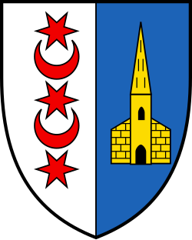
Coat of arms of Montreux
Per pale, first argent three mullets of six points gules in pale, separated by two crescents of the same, second azure a minster Or, open and masoned sable. The shield is divided vertically. On the left, on a white field, three red six-pointed stars alternate from top to bottom with two red crescents. On the right, on a blue field, stands a yellow church with black openings and joints. The left half partly reuses the arms of Le Châtelard: the stars and crescents come from the arms of the Oron and La Sarraz families, successive lords of Le Châtelard. The church is the parish temple that appeared on the arms of Les Planches. After the merger vote, the arms were chosen through a competition.[11][12][13]
Founding of Montreux
Montreux did not begin as a town. It was a parish grouping many villages and hamlets scattered across the slope, linked by a network of paths. In the Middle Ages, together with Veytaux, it formed a single church community in the orbit of Chillon Castle and Savoy, before Bernese rule. Politically, the territory was divided between the communes of Le Châtelard and Les Planches. The modern town grew out of the tourist boom of the 19th century and then out of the merger of these two communes, in which Veytaux declined to take part.[1][3]
History of Montreux
11th century. Oldest known mention, in the form "Monasteriolo", of uncertain date.
1215. The name appears in the form "Mustruel".[1][6]
1416. The territory has about 200 hearths (households).[1]
1536. The region comes under Bernese rule with the conquest of Vaud.[1]
1751. Construction of the lakeside road.[3]
1761. Jean-Jacques Rousseau sets his novel "Julie, or the New Heloise" in Clarens, which makes the place famous.[2][3]
1764. The territory has 2'103 inhabitants.[1]
1816. Lord Byron visits the area, further increasing the fame of Clarens and the Montreux shore.[2]
1835. Opening of the first real hotels (the Visinand and Verte Rive guesthouses).[3]
1861. Opening of the Lausanne-Villeneuve railway line, which triggers unprecedented urban growth.[2][3][4]
1850-1900. Hotel boom: the number of hotels and guesthouses rises from 8 in 1850 to about 70 in 1900.[1]
1883. Opening of the Territet-Glion funicular.[3]
1887. Opening of the Grand Hôtel de Territet.[3]
1888. An electric tramway linking Vevey, Montreux and Chillon goes into service, one of the first in Switzerland.[1][2][3][4][6]
1900. The territory has 14'144 inhabitants.[1]
16 December 1901. Opening of the Montreux-Oberland Bernois railway (MOB) as far as Les Avants, extended to Zweisimmen in 1905.[4]
1906. Opening of the Montreux Palace.[3]
1909. Opening of the Montreux-Glion line.[3]
1946. Creation of the Septembre musical.[1]
1961. Creation of the Rose d'Or television festival. Vote on merging the communes of the parish, accepted by Le Châtelard and Les Planches, rejected by Veytaux.[1]
1962. The merger of Le Châtelard and Les Planches comes into force, creating the commune of Montreux.[1][3]
1967. Claude Nobs founds the Montreux Jazz Festival.[1][6][7]
1971. The casino (Kursaal) burns down during a Frank Zappa concert. The event inspires Deep Purple's song "Smoke on the Water".[1][6]
1996. Unveiling of the statue of Freddie Mercury, singer of Queen, whose band worked at the Mountain Studios in Montreux from 1978 to 1995.[8]
2000. The commune has 22'454 inhabitants.[1]
Population of Montreux
Sources and references: [1][5]
| 1416 | 200 hearths (households) in the three communes of the parish |
| 1764 | 2'103 |
| 1900 | 14'144 |
| 1990 | 22'917 |
| 2000 | 22'454 |
| 2025 | 27'166 |
Families of Montreux
Citizen families before 1800. Forty-seven families, all with no precise date, except the Montandon, from Travers NE, admitted in 1738.[14]
In the 19th century. Burren, Moret, Parisod, Pittet and Roux, along with the Perrod from Ormont-Dessous VD, with no precise date. Dated registrations begin in 1875 with the Buenzod from Moudon VD and the Volkhardt from Germany. They are followed mostly by families from Germany (Reiss 1881, Jaeger 1885, Nuss, Schlageter and Steuer 1893, Degenmann 1894, Dequis and Held 1895, Riechelmann 1896, Mann 1898, Schieb 1899), from France (Lacroix 1886, Bartholmess 1893, Gaimard 1896, Polack 1897, Moinat 1899, Charrière 1900 and 1902) and from Italy (Bottelli, Guenzi and Vago 1894, Giovanna 1895, Minola 1900). The Flesch were registered in 1899.[14]
From 1901 to 1962. With 308 registrations, this century dominates the list. The canton of Bern supplies seventy-one families, Italy fifty-two, Fribourg twenty-eight, France twenty-one and Germany nineteen. Others come from Russia (1911), Hungary, Greece, the Netherlands, Czechoslovakia, Portugal, Great Britain, Poland or the Soviet Union (1961). The last registrations, in 1962, concern six families, including the Taroni from Italy.[14]
Notable people of Montreux
Girard d'Oron. In 1295 the Bishop of Sion sold him the parish of Montreux. As lord of Le Châtelard, he made Clarens a mayoralty at the end of the 13th century.[1][2]
Nicolas Céard. In 1794 he began the embankment of the Baye de Clarens torrent.[2]
Eugène Rambert (1830-1886). Born on 6 April 1830 at Sâles, near Clarens. A historian, storyteller and poet, he taught French literature at the Academy of Lausanne, then at the Federal Polytechnic in Zurich, before returning to Lausanne in 1881. In 1863 he was one of the founders of the Swiss Alpine Club.[15]
Elisée Reclus. He lived in Clarens from 1879 to 1890.[2]
Paul Kruger. The former president of the Transvaal spent his exile in one of the Dubochet villas in Clarens, his last residence.[2]
Claude Nobs. A trained chef, he was working at the Montreux tourist office when he launched the Montreux Jazz Festival in 1967.[7]
Economy of Montreux, past and present
Vines, fields and market. Montreux first lived from vines, crops and livestock. In 1757 the village of Les Planches obtained market rights.[6]
Tourism. Bernese road works from 1746 to 1751 made Montreux a stop on the Grand Tour. Its mild winter drew patients with respiratory illnesses for cures. In 1902, 31'473 guests stayed in its hotels, and 76'578 in 1910. Thomas Cook opened a travel agency there in 1892. An association set up in 1893 to promote the town launched the Narcissus Festival.[6]
Crises and revival. In 1915 the First World War caused the hotel trade to collapse. Hotels then housed internees, gas casualties and refugees. The Bank of Montreux, opened in 1868, went bankrupt in 1932. After the Second World War, festivals helped revive tourism. In the 1990s the economic crisis and unemployment above the cantonal average weighed on the town.[6]
Little industry. Apart from trades linked to the hotels, the area has little industry. The Société romande d'électricité runs the Taulan power station there. Montreux receives more than a million visitors a year and has the only category A casino in French-speaking Switzerland. About 1'300 pupils attend its private schools, mostly hotel schools.[6][13]
Disasters and major events in Montreux
The fire at the church of Saint-Vincent in 1476. The church of Saint-Vincent in Les Planches burned down in 1476. Once rebuilt, it was consecrated in 1525.[6]
Historic sites in Montreux
Quays and the Belle Époque. The flower-lined quays and grand hotels such as the Montreux Palace (1906) and the Grand Hôtel de Territet (1887) show the golden age of tourism in the late 19th and early 20th centuries.[3]
Clarens. Former village of Le Châtelard, mentioned from 1280, made famous by Rousseau's "New Heloise" (1761). It keeps the Villas Dubochet (1874-1876) and the Château des Crêtes (1864).[2]
Montreux Jazz Festival. Founded in 1967 by Claude Nobs, it has become one of the best-known music festivals in the world and takes place every July.[1][6][7]
Freddie Mercury statue. Erected in 1996 on the quays in tribute to the Queen singer, who recorded in Montreux, notably at Mountain Studios.[8]
Mountain railways. The Territet-Glion funicular (1883), the MOB (1901-1905) and the line to the Rochers-de-Naye link the town to the heights and illustrate the tourist boom.[3][4]
Protected heritage in Montreux
Cultural property of national significance (A objects in the PCP inventory)[10]
- Archives communales de Montreux (Clarens)
- Caux, Palace-Hôtel
- Château des Crêtes avec soubassement, terrasses et serre
- Château du Châtelard et fontaine
- Gare CFF
- Hôtel Montreux-Palace, annexe et pavillon des sports
- Ile et villa Salagnon
- Marché couvert
- Territet, ensemble ancien Grand-Hôtel, Hôtel des Alpes
- Villa Karma
Cultural property of regional significance (B objects)[10]
- Chamby, Grand Hôtel des Narcisses
- Chemin de fer-musée Blonay-Chamby y compris gare de Blonay (cf. aussi Blonay- Saint-Légier)
- Clarens, quartier des villas du Dubochet (21 villas)
- Clarens, villa Ormond
- Clarens, villa Toscane
- Eglise catholique du Sacré-Cœur
- Eglise réformée Saint-Vincent et ancien ossuaire
- Ensemble résidentiel de Bon-Port, trois villas locatives
- Funiculaire des Avants, y compris gares des Avants et de Sonloup
- Funiculaire Territet – Glion, y compris gares de Territet et de Glion
Show the other 14
- Funiculaire Territet – Mont-Fleury, y compris gares de Territet et de Mont-Fleury
- Glion, Clinique de Valmont
- Glion, Hôtel du Righi vaudois et parc
- Glion, Hôtel Victoria
- Hôtel Eden
- Hôtel Excelsior avec extensions au centre, au sud et à l'ouest
- Hôtel National avec terrasses et arcades
- Hôtel Suisse et Majestic
- Musée du chemin de fer du Blonay-Chamby
- Musée historique de Montreux et de sa région
- Territet, Institut Monte-Rosa
- Territet, villas Germaine et Châtelaine
- Territet, église anglicane St. John's
- Villa Florentine avec pavillon, gloriette néogothique et jardin
Legends of Montreux
The lady of Saleuscex. Near the ruins of a tower on the Cubli, a veiled woman is said to appear at midnight, sighing. She would be Éléonore, daughter of the cruel Archibald d'Aigremont: sheltering with him in the tower, she loved her cousin Berthold de Blonay, but promised her dying father to enter a convent to save his soul.[9]
Traditions and festivals in Montreux
The Brent fair. The Brent fair has been held since 1486.[1]
The Abbaye des Echarpes blanches. The Abbaye des Echarpes blanches was founded in 1626.[1]
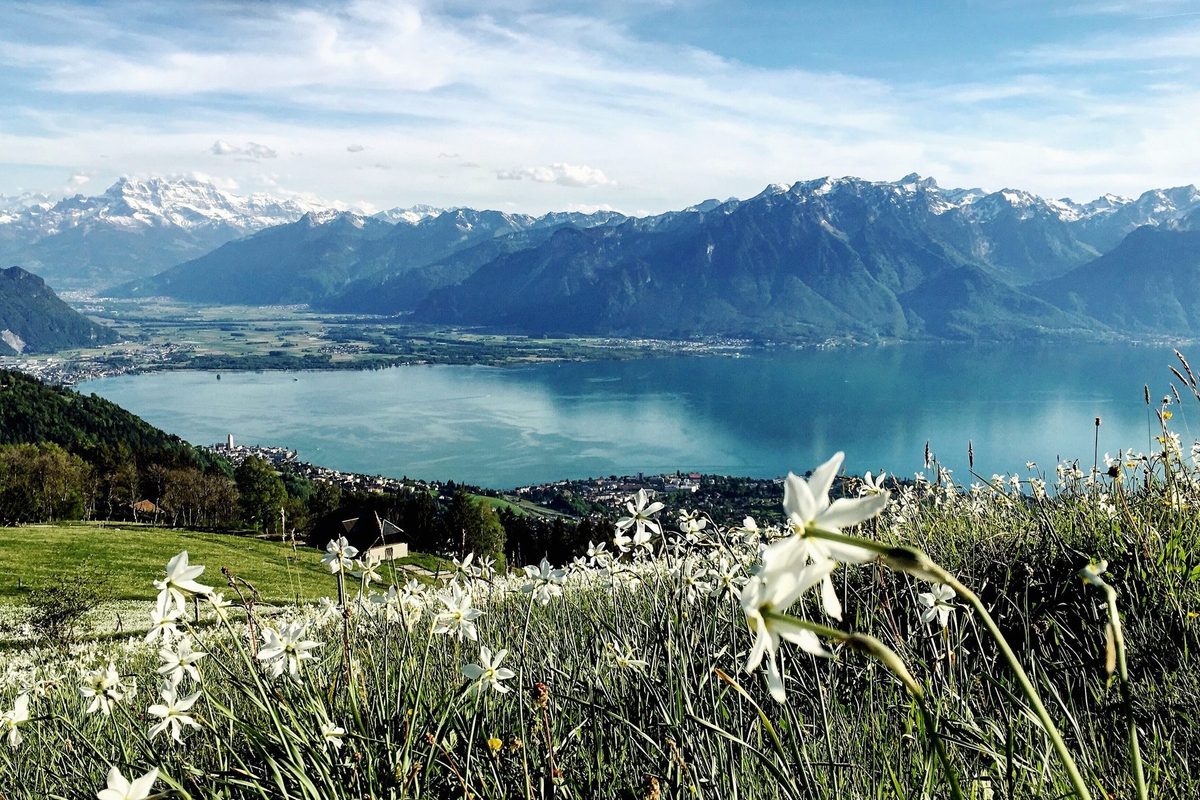
The Narcissus Festival. From 1897 to 1957 Montreux held the Narcissus Festival, with a parade of flower-decked floats and shows. A « narcissus train » linked Basel with Les Avants, and the sale of bouquets gave farmers an income.[1][16]
Sources
- Dictionnaire historique de la Suisse, « Montreux »
- Dictionnaire historique de la Suisse, « Clarens »
- Commune de Montreux, « Un héritage à redécouvrir » (plan directeur communal)
- Archives de Montreux, « Inauguration d'une voie de chemin de fer moderne et emblématique » (MOB)
- Statistique Vaud, « Population résidante permanente au 31 décembre 2025 »
- Dictionnaire historique de la Suisse, « Montreux » (version allemande, Evelyne Lüthi-Graf, version du 15.06.2017)
- swissinfo.ch, « Artists pay tribute to Claude Nobs in Montreux », 9 février 2013
- Suisse Tourisme (MySwitzerland), « Freddie Mercury »
- Alfred Cérésole, Légendes des Alpes vaudoises, ill. Eugène Burnand, Lausanne, 1885, p. 225-227
- Federal Office for Civil Protection (FOCP), Swiss Inventory of Cultural Property (PCP), list for the canton of Vaud (as of 1.1.2026)
- IPI, Swissreg, emblems database: coat of arms of Montreux (no. 102126)
- Archives de Montreux, "Les armoiries montreusiennes" (after D. L. Galbreath's Armorial vaudois)
- Official Gazette of the Canton of Vaud (FAO), "Alphabet des communes vaudoises: Montreux"
- Register of Swiss Surnames, 3rd edition (1989), search Commune "Montreux", Canton VD
- Cantonal and University Library of Lausanne, Patrinum, record « Eugène Rambert »
- State of Vaud, inventory of intangible heritage, « Narcisses »
Published by Sébastien Jörg ·
Localities of the municipality with a page
- Brent
- Caux
- Chailly-Montreux
- Chamby
- Chernex
- Clarens
- Glion
- Le Châtelard
- Les Avants
- Les Planches
- Territet
- Villard-sur-Chamby
Other villages near Montreux
Missing information, or do you have a source? Suggest a correction or addition. Every submission is checked before it's published.
Suggest a change