Clarens
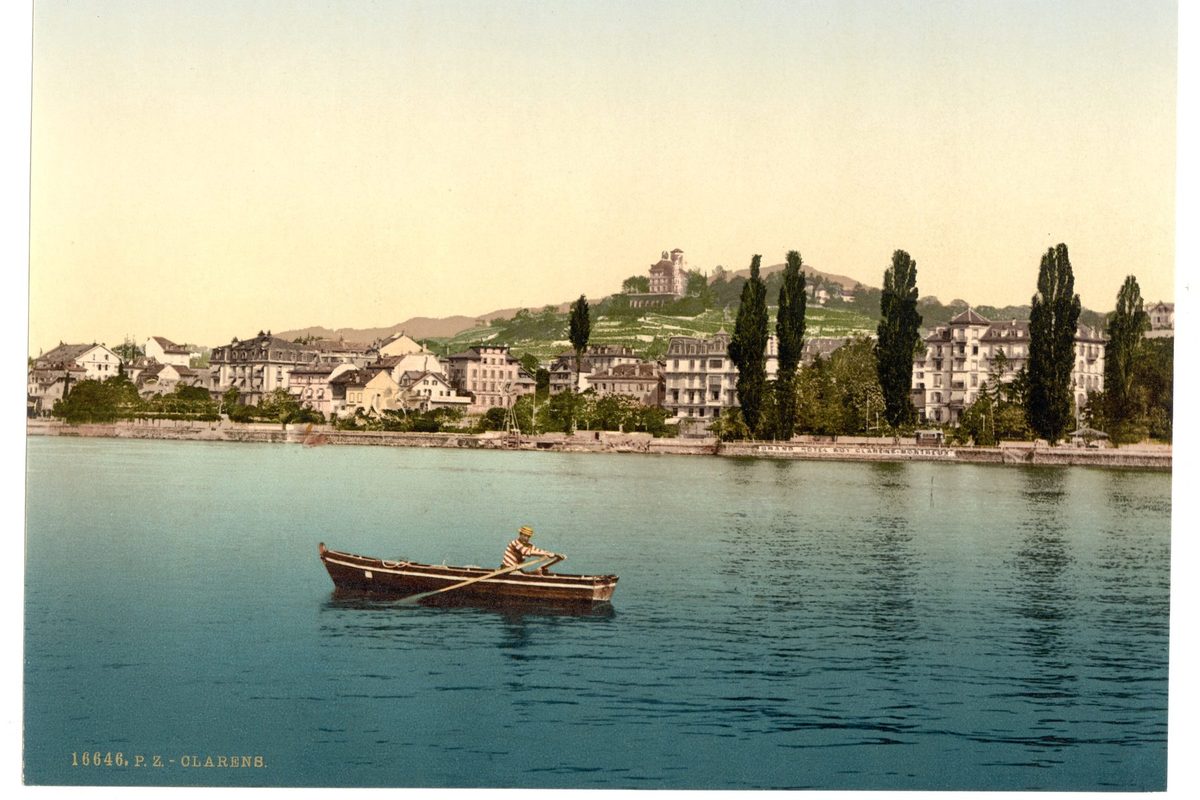
Rousseau set « La Nouvelle Héloïse » here and Byron passed through in 1816: Clarens, on Lake Geneva, grew from 200 inhabitants in 1798 to 2'513 in 1900.
Entry based on 10 sources · Our method · Reusable text (CC BY-SA)
Origin of the name Clarens
The name, formerly « Clareyns », is said to come from a Germanic personal name derived from the Latin clarus, « clear ». The form « Clarens » appears in the first known written mention, in 1280.[1]
Founding of Clarens
The origins of the village, on the shore of Lake Geneva in a wine-growing area, are unknown. In the late 13th century, Girard d'Oron, lord of Le Châtelard, made it a mayoralty (mayorie). Clarens then formed a métralie with Tavel and Planchamp. It was one of the seventeen villages and hamlets of the municipality of Le Châtelard and always belonged to the parish of Montreux. The small village of 1798 became a major tourist centre in the 19th century, thanks to the fame given to it by Rousseau and Byron, and then to the arrival of the railway. Clarens now belongs to the municipality of Montreux (Riviera-Pays-d'Enhaut district).[1][2][5]
History of Clarens
1280. First known written mention of Clarens.[1]
late 13th century. Girard d'Oron, lord of Le Châtelard, makes Clarens a mayoralty (mayorie). The village forms a métralie with Tavel and Planchamp.[1]
1746. Road improvements begin.[1]
18th century. Jean-Jacques Rousseau sets his novel « Julie ou la Nouvelle Héloïse » in Clarens, making the village famous.[1]
1798. Clarens has 200 inhabitants.[1]
1816. Visit of Lord Byron, after which Clarens becomes a major tourist destination.[1]
1817. The Clarens cemetery is laid out. It is enlarged from 1868 to 1886.[2]
1861. Clarens railway station opens.[1]
1864. The Château des Crêtes is built.[1]
1874-1876. The 21 « Villas Dubochet » are built.[1]
1878. Pyotr Ilyich Tchaikovsky reportedly composes his Violin Concerto in D major, op. 35, in Clarens in March and April.
1879-1890. The geographer Elisée Reclus lives in Clarens.[1]
1888. Inauguration of the electric tramway line through Clarens, the first in Switzerland. It is replaced by a trolleybus in 1957.[1]
1900. Clarens has 2'513 inhabitants.[1]
1914. Clarens has 27 guesthouses and hotels.[1]
1937. The Reformed church of Clarens is consecrated.[1]
1959-1962. The architect Pierre Dumas builds the Catholic church of Sainte-Thérèse; this information is uncertain.
1962. The merger of Le Châtelard and Les Planches creates the municipality of Montreux, to which Clarens now belongs.[2]
Population of Clarens
Sources and references: [1]
| 1798 | 200 inhabitants |
| 1900 | 2'513 inhabitants |
Notable people of Clarens
Leo Tolstoy. An admirer of "La Nouvelle Héloïse", the Russian writer comes to Clarens in Rousseau's footsteps. He arrives on 21 April 1857 and stays more than a month at the Pension Perret, then returns twice in June, first to the Pension Ketterer at Le Basset. Since 12 October 2018 a plaque in the Verte-Rive park has recalled his visits.[9]
Pyotr Ilyich Tchaikovsky. The composer stays in Clarens three times, partly at the Villa Richelieu. In autumn 1877 he finishes orchestrating the first act of "Eugene Onegin" there. In spring 1878, after his friend Iosif Kotek arrives, he writes his Violin Concerto, complete and fully orchestrated in April, and he returns from January to February 1879 to work on "The Maid of Orleans".[10]
Economy of Clarens, past and present
Vines and hotels. Clarens lies in a winegrowing region. After Byron's visit in 1816, the village becomes a sought-after place to stay. In 1914, its 27 guesthouses and hotels welcome many celebrities.[1]
Historic sites in Clarens
Château des Crêtes. Residence built in 1864 for Emmanuel-Vincent Dubochet, cultural property of national significance (PCP), with base, terraces and greenhouse.[1][4]
Villas Dubochet. Group of 21 villas built from 1874 to 1876 by the architect Louis Henri Maillard, cultural property of regional significance (PCP). Paul Kruger, President of the Transvaal in exile, had his last residence here.[1][4]
Clarens cemetery. Laid out in 1817 and enlarged from 1868 to 1886. It reportedly holds among others the graves of the writer Henri-Frédéric Amiel, the theologian Alexandre Vinet, the writer Eugène Rambert, the economist Léon Walras, the painter Oskar Kokoschka, the writer Vladimir Nabokov and the soprano Joan Sutherland; this list is uncertain.[2]
Sainte-Thérèse church. Catholic church on the avenue Alexandre Vinet, reportedly built from 1959 to 1962 by the architect Pierre Dumas.
Île de Salagnon. Located opposite the port of Le Basset, it is one of the five islands of Lake Geneva. It bears a Florentine-style villa and a small harbour. The island and villa are cultural property of national significance (PCP).[3][4]
Château du Châtelard. Centre of the former lordship of Le Châtelard, whose lord Girard d'Oron made Clarens a mayoralty, it is one of the monuments of Clarens (see the Le Châtelard entry). The castle and its fountain are cultural property of national significance (PCP).[4]
Protected heritage in Clarens
Cultural property of national significance (A objects in the PCP inventory)[7]
- Archives communales de Montreux
- Château des Crêtes avec soubassement, terrasses et serre
Cultural property of regional significance (B objects)[7]
- Clarens, quartier des villas du Dubochet (21 villas)
Traditions and festivals in Clarens
The Noble Abbaye des Echarpes Blanches. People of Montreux found this shooting society in 1627 to encourage shooting, friendship and fellowship. It is the oldest society in Montreux, with its seat at the Maison Cochard in Clarens. Its members, about 205 men in 2019, shoot at 300 metres every year, and every two years the shoot is followed by a day of celebration. In 2019 the society deposits its founding charter, a parchment from 1627, in the Montreux Archives.[8]
Sources
- Dictionnaire historique de la Suisse, « Clarens » (Evelyne Lüthi-Graf, version du 13.01.2020)
- Dictionnaire historique de la Suisse, « Châtelard, Le (VD) » (Evelyne Lüthi-Graf, version du 08.09.2005)
- Commune de Montreux, « Clarens »
- Office fédéral de la protection de la population, Inventaire suisse des biens culturels d'importance nationale et régionale, liste du canton de Vaud (état au 1.1.2026)
- Canton de Vaud, Loi sur le découpage territorial (LDecTer, RSV 132.15) du 30 mai 2006
- Statistique Vaud, « Population résidante permanente au 31 décembre 2025 »
- Federal Office for Civil Protection (FOCP), Swiss Inventory of Cultural Property (PCP), list for the canton of Vaud (as of 1.1.2026)
- Municipality of Montreux, press release of 12 July 2019, founding charter of the Noble Abbaye des Echarpes Blanches deposited in the Montreux Archives
- Municipality of Montreux, press release of 12 October 2018, memorial plaque for Leo Tolstoy in Clarens
- Tchaikovsky Research, page "Clarens"
Published by Sébastien Jörg ·
Other villages near Clarens
Missing information, or do you have a source? Suggest a correction or addition. Every submission is checked before it's published.
Suggest a change