Champagne
Mentioned as early as 885, Champagne lost the right to put its own name on its wines as a result of the bilateral agreements between Switzerland and the European Union.
Entry based on 10 sources · Our method · Reusable text (CC BY-SA)
Origin of the name Champagne
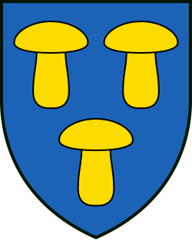
The village appears in 885 as «Campania». A form «Champanes», dated 1228, is also cited, without certainty. No etymology is known for «Champagne». The municipal coat of arms, three gold mushrooms on a blue field, is a canting arms playing on this name.[1][4]
Coat of arms of Champagne
Azure, three mushrooms Or. Three yellow mushrooms stand out on a blue field. They reproduce the imprint of the seal engraved in 1788, whose matrix the bailiff of Grandson had destroyed. The municipality adopts these arms in 1918.[9][4]
Founding of Champagne
Nobody knows who founded Champagne. Yet the area was inhabited in Roman times, with a Gallo-Roman villa in the hamlet of Saint-Maurice, and in the early Middle Ages, as Burgundian graves show. Emperor Charles the Fat handed the villa of Champagne to a certain Vodelgise, who ceded it to the bishop of Lausanne. The village then belonged to the lordships of Grandson and Montagny-le-Corbe, and under Bernese rule to the common bailiwick of Grandson. Champagne and Saint-Maurice were originally two separate villages that grew together over time, perhaps because they depended on different lordships before the Burgundian Wars. The municipality also includes the hamlets of Les Pasquières and Sous le Closel, and stretches from Lake Neuchâtel to the first slopes of the Jura. The inhabitants' nicknames are «Lè z'Aragne» (the spiders) and «Les Champagnoux» (the mushrooms).[1][3]
History of Champagne
Roman period. Roman presence attested by coins, remains at La Râpe and a Gallo-Roman villa at Saint-Maurice.[1][2][3]
early Middle Ages. Burgundian graves containing iron belt plates inlaid with silver.[1][3]
885. First mention, «Campania».[1]
888. Vodelgise, who had received the villa from Emperor Charles the Fat, cedes it to the bishop of Lausanne.[1]
12th century. A parish church dedicated to Mary is attested.[1]
1228. Mention of the church of Saint-Maurice («Sanctus Mauricius»). The prior of Saint-Jean in Grandson presents the priest.[2]
15th century. Construction of the porch of the church of Saint-Maurice.[2]
1476. After the Burgundian Wars, Champagne belongs to the common bailiwick of Grandson, administered by Bern and Fribourg until 1798.[2]
1532. Adoption of the Reformation: Saint-Maurice becomes one of the four Reformed parishes of the bailiwick and the seat of a consistory, with Champagne, Romairon and Fontanezier.[2]
1561. Construction of a new parsonage, around 1561.
1697-1699. The church of Saint-Maurice is partly rebuilt, at dates that are still uncertain.
1788. Inhabitants create a seal with the three mushrooms without permission. The authorities ask the bailiff of Grandson to destroy it, but an impression is preserved.[4]
1792. The botanist Augustin Pyramus de Candolle settles in Champagne for four years and plants a cedar there.[3]
1798. Champagne belongs to the district of Grandson.
1871. An old mill with a sawmill is converted into a small factory for watchmaking tools, which later became «La Nationale».[1]
1910. The parish of Saint-Maurice takes the name parish of Champagne.[2]
1918. Official adoption of the coat of arms with the three gold mushrooms.[4]
1962. Founding of an industrial biscuit factory (flûtes).[1]
2002. With the bilateral agreements between Switzerland and the European Union, the winegrowers lose the right to use the name «Champagne» on their wines. The date of the ban is uncertain: 2002 or 2004.[1][6][7]
2008. After the abolition of the district of Grandson, Champagne belongs to the district of Jura-Nord vaudois.[4][5][8]
Population of Champagne
Sources and references: [1][5]
| 1798 | 351 |
| 1850 | 410 |
| 1900 | 619 |
| 1950 | 496 |
| 1960 | 449 |
| 2000 | 653 |
| 2025 | 1'087 |
Families of Champagne
Citizen families before 1800. Banderet, Cochand, Duvoisin, Giroud, Guilloud, Perdrix, Tharin, Vautravers, Verraires and Verreyres, without a precise date.[10]
From 1901 to 1962. 17 registrations. Several families come from abroad: from Italy (Bessero in 1934 and 1941, Montangero in 1936, Fornara in 1944, Casetta in 1953, Zigliani in 1960 and Roncalli in 1962) and from Germany (Ruhlmann in 1910). From Switzerland come the Faure family from Le Locle NE (1941), the Sorg family from Rüthi SG (1955), the von Siebenthal family from Saanen BE (1955), the Lanz family from Gondiswil BE (1956), the Schmidli family from Thalheim AG (1956), the Schärz family from Adelboden BE (1956), the Millet family from Vaumarcus NE (1957), the Neuenschwander family from Langnau im Emmental BE (1957 and 1960), the Ryser family from Dürrenroth BE (1959) and the Miserez family from Lajoux JU (1961). The last family registered, in 1962, is the Roncalli family.[10]
Economy of Champagne, past and present
Vineyards. Champagne has remained a farming and above all a winegrowing village. In 2026, its vineyard covers 9.6 hectares according to the FAO. The bilateral agreements between Switzerland and the European Union forbid the use of the name Champagne for its white wines. In 2003, the winegrowers' appeal before the European Court of First Instance is still pending.[1][4]
From watchmaking tools to flûtes. In 1871, old mills and sawmills on the banks of the Arnon become a small factory for watchmaking tools. As La Nationale, the firm makes machine tools in 2005. An industrial biscuit factory making flûtes opens in 1962. According to the FAO, the municipality's businesses provide more than 400 jobs in 2026, notably in the food and technical industries.[1][4]
Historic sites in Champagne
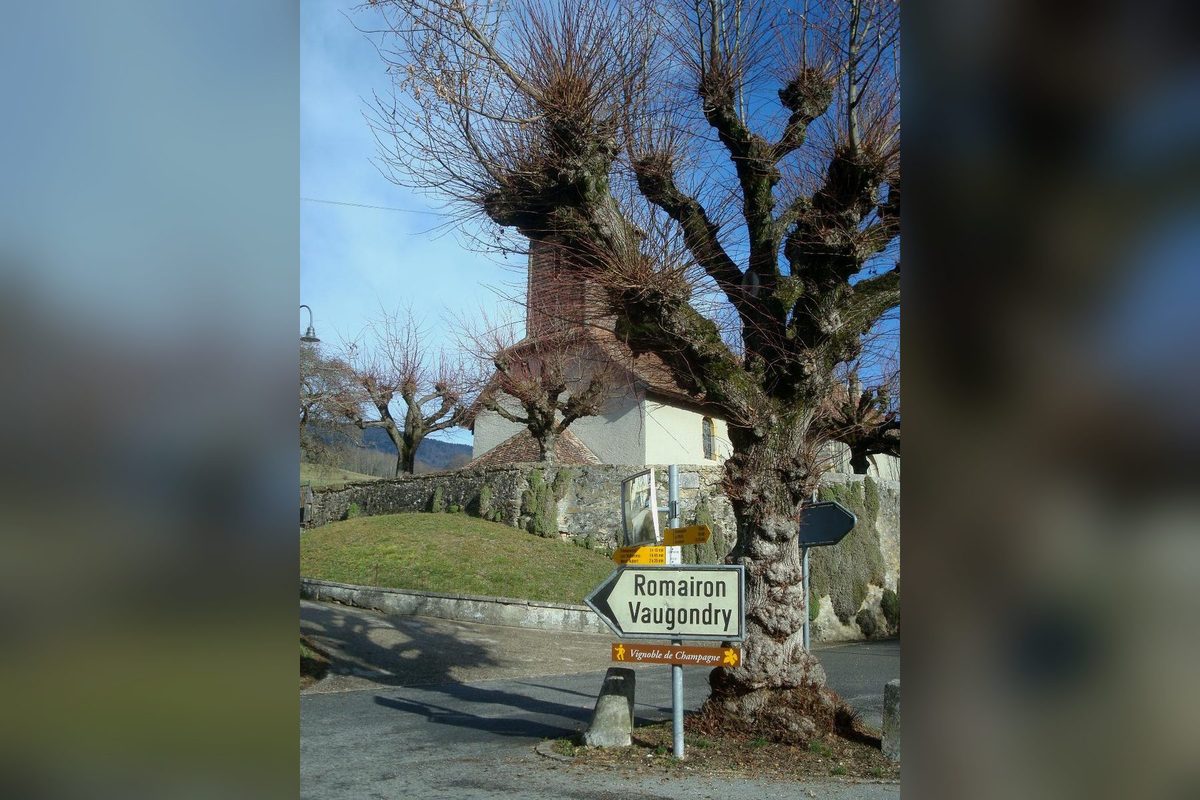
Church of Saint-Maurice. Parish church of the hamlet of Saint-Maurice, mentioned from 1228, with a 15th-century porch. In 1532 it became the seat of one of the four Reformed parishes of the bailiwick of Grandson. It was partly rebuilt in 1697-1699, a date still to be confirmed, and restored in 1904. The parish has borne the name of Champagne since 1910.[2]
Parsonage. Parsonage built around 1561.
Old village centre. The well-preserved heart of the village, with its restored old farmhouses and period houses, is listed in the Federal Inventory of Swiss Heritage Sites of national importance (ISOS).[4]
Candolle's cedar. Cedar planted by the botanist Augustin Pyramus de Candolle during his stay in Champagne from 1792. Its girth grew from 4.6 m to 6.7 m between 1910 and 1991.[3]
La Nationale. Watchmaking tools company founded in 1871 in an old mill with a sawmill, still in operation.[1]
Remains in Champagne
Roman remains. Roman coins and remains at the place called La Râpe. Remains of a Gallo-Roman villa in the hamlet of Saint-Maurice.[1][2][3]
Burgundian graves. Early medieval burials, notably at the place called Tombez, which yielded iron belt plates inlaid with silver.[1][3]
Traditions and festivals in Champagne
The Abbaye des mousquetaires. Champagne has its Abbaye des mousquetaires, which holds its festival every two years.[4]
The grape harvest festival. The wine village also celebrates the harvest with a festival held every two years.[4]
Sources
- Philippe Heubi, « Champagne (VD) », Dictionnaire historique de la Suisse (version du 24.05.2005)
- Philippe Heubi, « Saint-Maurice (VD) », Dictionnaire historique de la Suisse (version du 27.11.2009)
- Commune de Champagne, « Portrait »
- Feuille des avis officiels du canton de Vaud, « Alphabet des communes vaudoises : Champagne » (FAO n° 81, 09.10.2026)
- Statistique Vaud, « Population résidante permanente au 31 décembre 2025 »
- swissinfo.ch, « Swiss 'champagne' faces extinction under EU accords », 16.05.2002
- swissinfo.ch, « Row fizzes over use of champagne name », 20.07.2005
- État de Vaud, communiqué du 12.07.2007, « Organisation des préfectures et adaptation au nouveau découpage territorial »
- IPI, Swissreg, emblems database: coat of arms of Champagne (no. 101903)
- Register of Swiss Surnames, 3rd edition (1989), search Commune "Champagne", Canton VD
Published by Sébastien Jörg ·
Localities of the municipality with a page
Other villages near Champagne
Missing information, or do you have a source? Suggest a correction or addition. Every submission is checked before it's published.
Suggest a change