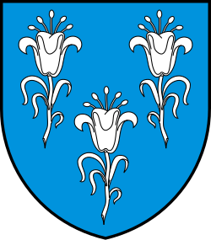
Chancy
Origin of the name Chancy
The name appears in 1260 as « Chancie ». It may come from a certain Cantius, who is said to have built his villa here in the 1st century.[1][3]
Founding of Chancy
Nobody knows who founded Chancy. The place was occupied in Roman times, as the many remains found in the village and around it show, including a tile works with its kiln and the ruins of a castrum at Montagny. Chancy owes its importance to the Rhône. The village was reportedly already an important crossing of the river in the time of Julius Caesar. Later, on the road from Genève to Lyon via the Fort-l'Écluse, this is where travellers reached the right bank. In the Middle Ages the counts of Genève exercised the seigneurial rights here, before leaving their enjoyment to the priory of Saint-Victor and keeping only high justice. After the emancipation of Genève and the abolition of the ecclesiastical lordships, the procurators of Chancy and Avully recognised themselves as subjects of Genève. The municipality comprises the villages of Chancy and Passeiry and the hamlet of Le Cannelet.[1][3]
History of Chancy
Roman times. Numerous structures are built at Chancy and in its surroundings, whose remains include a tile works with its kiln and a castrum at the place called Montagny.[1]
2nd-3rd century. At the end of the 2nd or the beginning of the 3rd century, a tile workshop settles in the ruins of a Gallo-Roman temple, in the woods of Chancy.[4]
Early Middle Ages. A wooden post-built structure is erected on the tile works site.[4]
1260. Count Amadeus II of Genève grants the priory of Saint-Victor the enjoyment of the seigneurial rights over Chancy (« Chancie »), reserving only high justice.[1]
1424. A bridge replaces the ferry across the Rhône.[1]
1536. The procurators of Chancy and Avully recognise themselves as subjects of Genève. The village adopts the Reformation and forms a parish with Cartigny and Valleiry.[1]
16th century. The village is burned and plundered several times, notably by Savoy.[3]
1589. The bridge is finally demolished. For nearly three centuries a ferry once again provides the crossing.[1][3]
1749. By the Treaty of Paris, Genève obtains Chancy and Avully. End of the period in which Chancy shares the fate of the lands of Saint-Victor.[1][2]
1770-1773. Jean Senebier is pastor of Chancy.[5]
1816. The western border of Switzerland is fixed. Boundary stones dated 1816 and a boundary stone no. 1 mark it, with an installation record of 1819.[3][4]
1840-1842. Construction of a neoclassical Protestant temple.[1]
1858. A bridge replaces the ferry. Pougny-Chancy station opens on the Genève-Lyon line.[1][3]
1874. A new bridge is built on the present site.[1]
1890. The tramway is extended from Bernex to Chancy. The Genève-Chancy line reportedly operates until 1938.[3]
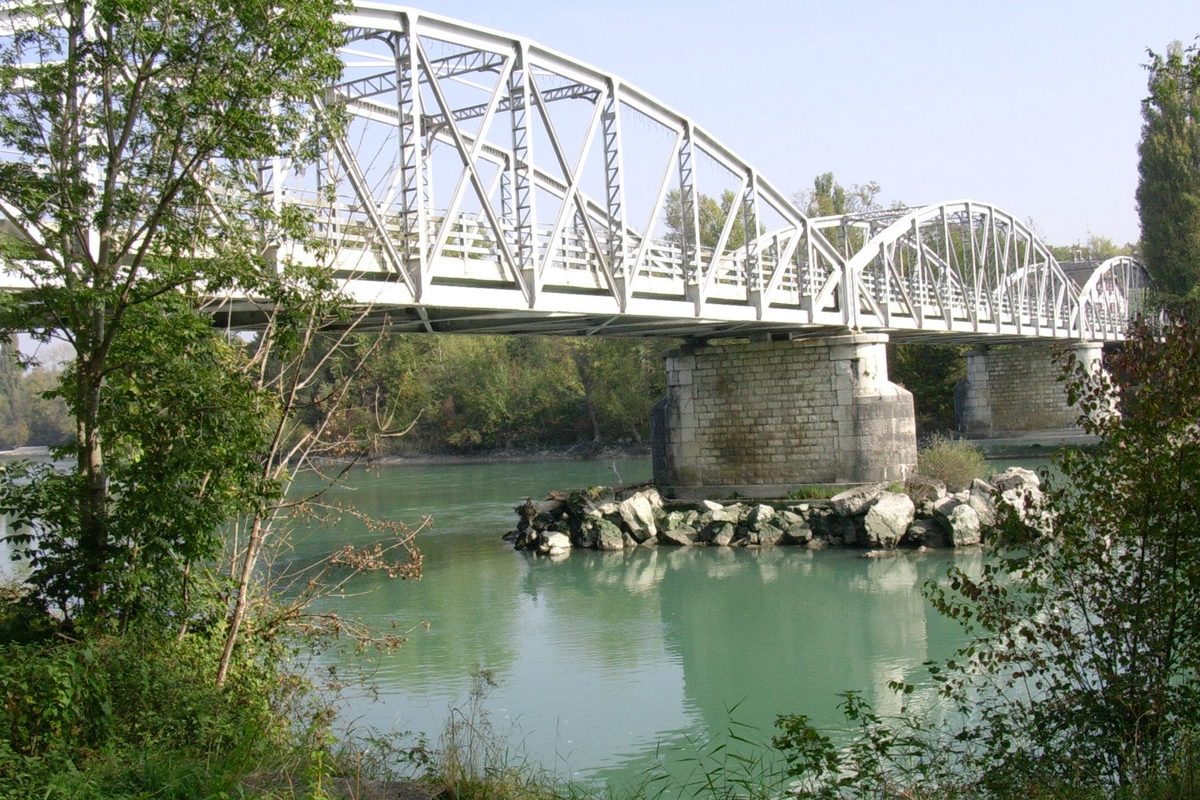
1902-1907. Construction of the present metal bridge, which marks the border with France. Dates vary between 1902 and 1907.[1][3][8][9]
1905. The medieval church of Saint-Genis gives way to a town hall.[1]
1945. The 1905 town hall is abandoned in favour of a new town hall with a municipal hall, designed by the architect Maurice Braillard.[1]
1993. On 4 September, Swiss and French representatives meet at boundary stone no. 1, which marks the western border of Switzerland.[4]
Population of Chancy
Sources and references: [1][6]
| 1850 | 346 |
| 1900 | 331 |
| 1950 | 296 |
| 1987 | 640 |
| 2000 | 913 |
| 2025 | 1'644 |
Historic sites in Chancy
Bridge over the Rhône. Historic crossing to the right bank of the Rhône. Before the present metal bridge, which marks the border and dates from the early 20th century, several wooden bridges followed one another. A first bridge replaced the ferry in 1424. Demolished in 1589, it gave way to a ferry for nearly three centuries, until the bridge of 1858, replaced in 1874.[1][3]
Temple. Neoclassical Protestant temple built in 1840-1842.[1]
Town hall by Maurice Braillard. Town hall with a municipal hall opened in 1945, the work of the architect Maurice Braillard. It replaces the town hall set up in 1905 on the site of the medieval church of Saint-Genis.[1]
Boundary stone no. 1. Boundary stone marking the western border of Switzerland with France. The border dates from 1816. The boundary stones bear an « S » for the Kingdom of Piedmont-Sardinia or a « G » for Genève, some decorated with Sardinian eagles or Genevan coats of arms.[3][4]
Chancy woods. Bois des Bouchets and Bois de Fargout, the latter in the Longet valley, with Roman ruins and old boundary stones near the Rhône.[4]
Passeiry and Le Cannelet. Village and hamlet of the municipality.[1][3]
Remains in Chancy
Roman tile works of the Chancy woods. Tile workshop of the late 2nd or early 3rd century, set up in the ruins of a Gallo-Roman temple. One firing took about two weeks. In the early Middle Ages a wooden post-built structure was erected there.[4]
Castrum of Montagny. Ruins of a Roman castrum at the place called Montagny.[1]
Sources
- Dictionnaire historique de la Suisse, « Chancy » (Catherine Santschi), version du 11.11.2003
- Dictionnaire historique de la Suisse, « Avusy » (Catherine Santschi), version du 08.09.2009
- Commune de Chancy, « Histoire »
- Commune de Chancy, « Curiosités »
- Dictionnaire historique de la Suisse, « Senebier, Jean » (Toni Cetta), version du 25.09.2014
- Office cantonal de la statistique (OCSTAT), Mémento statistique du canton de Genève 2026, tableau Population résidante par commune, en 2025
- geo.admin.ch, service de recherche de swisstopo (coordonnées)
- Grand Conseil de Genève, Mémorial, séance du 29.05.1997, PL 7652 (crédit pour la stabilisation du lit et des berges du Rhône à Chancy), exposé des motifs du Conseil d'État
- Structurae, « Pont de Chancy » (fiche de l'ouvrage)
Localities of the municipality with a page
Other villages near Chancy
Missing information, or do you have a source? Suggest a correction or addition. Every submission is checked before it's published.
Suggest a change