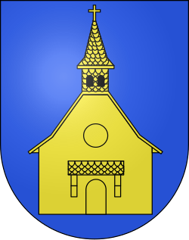
Chapelle-sur-Moudon
The church of Chapelle-sur-Moudon keeps a late 15th-century stained-glass window, one of the few in the canton to have escaped destruction at the Reformation.
Entry based on 8 sources · Our method · Reusable text (CC BY-SA)
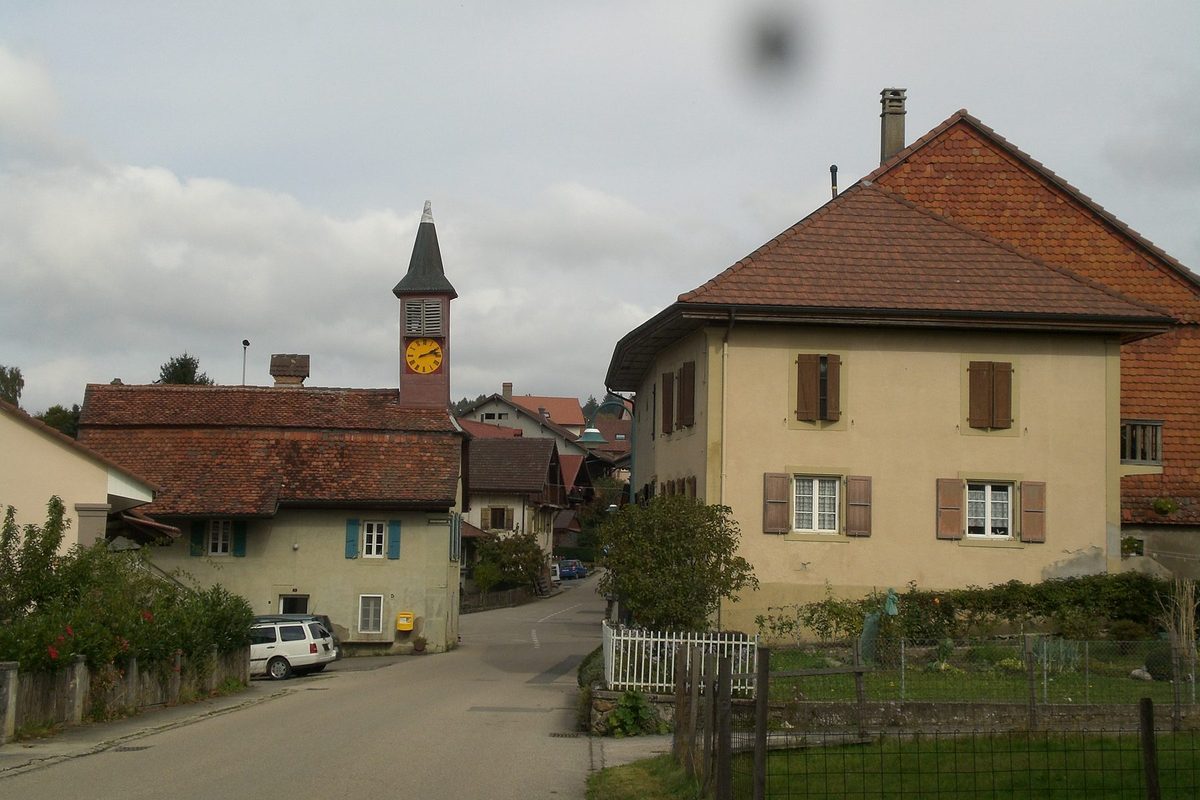
Origin of the name Chapelle-sur-Moudon
The name comes from the chapel («Capela») that a notable named Waldo had built in the 10th century, hence the form «Capela Waldana». The place is mentioned in 1177 («Capellam») and in 1228 («Cappella Vualdana»). Under the Ancien Régime it was called Chapelle-Vaudanne. The village was called Chapelle until 1953, when it took the name Chapelle-sur-Moudon. The municipality considered restoring the suffix «Vaudanne» but gave up the idea.[1][2]
Founding of Chapelle-sur-Moudon
It all begins with a chapel that a notable named Waldo had built in the 10th century. It gave the place its name, and the present church, from the 13th century, stands on its remains. From the 12th century a family bearing the village's name appears, the lords and knights of Chapelle. Later the counts of Savoy held most of the village and sold a large estate there to a burgher of Moudon. The lordship passed to the d'Illens, the first to bear the title, then to the Praroman family, who kept it until the end of the 18th century and bought the remaining rights, including high justice, from Bern.[1][2]
History of Chapelle-sur-Moudon
10th century. A notable named Waldo has a first chapel built, whose remains lie beneath the present church.[2]
12th century. A family bearing the name of the place, the lords and knights of Chapelle, appears.[1][2]
1177. First mention of the place, in the form «Capellam».[1]
1228. Mention in the form «Cappella Vualdana». The church is then a parish church.[1]
around 1338. The counts of Savoy, who hold most of the village, sell a large estate with seigneurial rights to a burgher of Moudon.[1]
1360. A fire partly destroys the village.[1]
1403. The d'Illens acquire the estate and are the first to bear the title of lords.[1]
1489. The lordship passes to the Praroman family, who keep it until the end of the 18th century.[1]
1536. Bernese conquest: the village belongs to the bailiwick of Moudon until 1798. The church becomes an annex of the parish of Saint-Cierges.[1]
1680. The Praroman buy the remaining seigneurial rights, including high justice, from Bern.[1]
1724. Construction of the church bell tower.[1]
1750. The present château was reportedly built that year for the Praroman family.
late 18th century. The lordship reportedly passed by inheritance to the Réal family.
1777. Construction of the building known as «Le Casino», with a meeting and games room upstairs and a communal oven on the ground floor.[2]
1795. Construction of a communal bread oven on rue du Château, still visible today.[2]
1798 to 1803. During the Helvetic period the village reportedly belonged to the canton of Léman, before joining the canton of Vaud in 1803.
1839. Opening of the village school.[1]
1888. A fire partly destroys the village.[1]
1930. The first floor of the Casino ceases to be used as a meeting and games room.[2]
1953. The village, until then called Chapelle, takes the name Chapelle-sur-Moudon.[1]
1956. The Casino's communal oven ceases to be used.[2]
1958. The Société vaudoise d'hydrocarbures drills for oil, without success.[1]
after 1984. The château reportedly underwent a major restoration.
2008. The new Vaud districts come into force: the municipality, in the district of Moudon since 1798, joins the district of Gros-de-Vaud.
2013. On 1 January Chapelle-sur-Moudon merges with Chanéaz, Correvon, Denezy, Martherenges, Neyruz-sur-Moudon, Peyres-Possens, Saint-Cierges and Thierrens to form the municipality of Montanaire.[1][5]
Population of Chapelle-sur-Moudon
Sources and references: [1][2]
| 1764 | 268 |
| 1850 | 368 |
| 1900 | 323 |
| 1950 | 302 |
| 1970 | 224 |
| 1980 | 240 |
| 2000 | 319 |
| 2021 (1 May, municipality) | 551 |
Families of Chapelle-sur-Moudon
Citizen families before 1800. Besson, Chapallaz, Cordey, Etendu, Jessevel, Martin, Mingard, Pache and Veyre, without a precise date.[8]
From 1901 to 1962. Several families come from abroad: from France (Créteau-Durussel in 1953) and from Italy (Motto-Bertolino in 1953). From Switzerland comes the Beyeler family from Wahlern BE (1947). They are joined by the Hermann family (1940), the Labiche family (1940), the Michaud family (1944) and the Déglise family (1949). The last registrations date from 1953 (Créteau-Durussel and Motto-Bertolino).[8]
Economy of Chapelle-sur-Moudon, past and present
A farming village. Chapelle-sur-Moudon is a farming place. In the early 20th century, the castle houses a boarding school. From 1980, several small villa districts are built. On the ground floor of the Casino, the former communal oven now serves as a butcher's cutting room.[1][2]
Historic sites in Chapelle-sur-Moudon
Church. 13th-century church built on the remains of a 10th-century chapel. It is reportedly dedicated to Saint Martin, but it is also listed as the Reformed church of Sainte-Marie-Madeleine. A parish church in 1228, it became an annex of the parish of Saint-Cierges at the Reformation. Its bell tower dates from 1724. Its choir, listed as a historic monument, was possibly designed around 1500 by the Geneva master mason François de Curtine; this is not certain. It keeps a late 15th-century stained-glass window, one of the few in the canton to have escaped destruction at the Reformation. Cultural property of regional importance (PBC inventory, category B).[1][2][3]
The Château. The château was reportedly built in 1750 for the Praroman family. In the early 20th century it housed a girls' boarding school. Apparently thoroughly restored after 1984, it is now private property.[2]
Le Casino (1777). The upper floor served as a meeting and games room until 1930. The ground floor housed a communal oven used until 1956 and is now a butcher's cutting room. The municipality offered passing vagrants a night's lodging and a soup there until after the Second World War.[2]
The bread oven (1795). Former communal bread oven on rue du Château, recently renovated and used for baking days and village festivities.[2]
The school (1839). The village school dates from 1839. One class was still open there around 2017. It has reportedly since been converted into flats.[1]
Remains in Chapelle-sur-Moudon
Remains of the original chapel (10th century). The present 13th-century church was built on the remains of the 10th-century chapel from which the village takes its name and origin.[2]
Protected heritage in Chapelle-sur-Moudon
Cultural property of regional significance (B objects)[7]
- Eglise réformée Sainte-Marie-Madeleine
Legends of Chapelle-sur-Moudon
The «Rôtisseurs de brebis» (sheep-roasters). The inhabitants' nickname is Rôtafayes, the «sheep-roasters». According to a legend, a young shepherd is said to have dried a rain-soaked ewe in an oven.[2]
Sources
- Valérie Favez, « Chapelle-sur-Moudon », Dictionnaire historique de la Suisse (version du 04.01.2017)
- Commune de Montanaire, « Les 9 villages qui forment Montanaire »
- Office fédéral de la protection de la population, Inventaire PBC, liste cantonale VD (état au 1.1.2026)
- Statistique Vaud, « Population résidante permanente au 31 décembre 2025 »
- État de Vaud, « Fusions de communes en chiffres (2025) »
- État de Vaud, communiqué du 12.07.2007, « Organisation des préfectures et adaptation au nouveau découpage territorial »
- Federal Office for Civil Protection (FOCP), Swiss Inventory of Cultural Property (PCP), list for the canton of Vaud (as of 1.1.2026)
- Register of Swiss Surnames, 3rd edition (1989), search Commune "Chapelle-sur-Moudon", Canton VD
Published by Sébastien Jörg ·
Other villages near Chapelle-sur-Moudon
Missing information, or do you have a source? Suggest a correction or addition. Every submission is checked before it's published.
Suggest a change