Boulens
A grange of the Cistercian monks of Montheron, whose property and jurisdiction passed to the City of Lausanne at the Reformation.
Entry based on 8 sources · Our method · Reusable text (CC BY-SA)
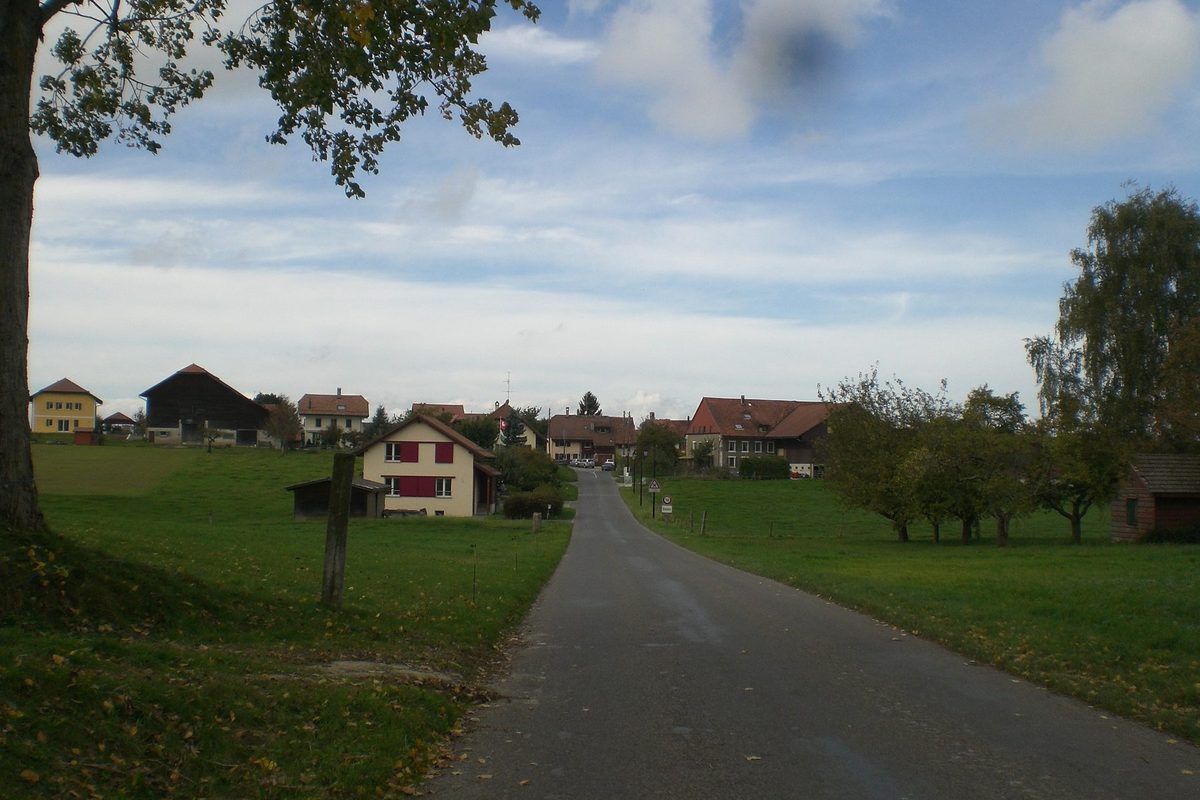
Origin of the name Boulens
The name appears in 1142 as «Bollens», then in 1177 as «Boslens». Where it comes from has not yet been explained.[1]
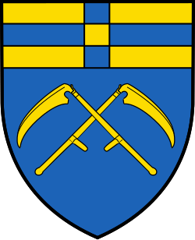
Coat of arms of Boulens
Azure, two scythes in saltire Or, a chief of five points Or equipollent to four azure. On a blue field, two yellow scythes cross in an X. The top of the shield forms a chequered band of nine squares, five yellow and four blue. The municipality adopted these arms in 1919, when it gave a commemorative medal to its mobilised soldiers. The scythes stand for work in the fields. The chequers take up the arms of the Counts of Geneva, who held large estates in Boulens in the 12th century.[6][7]
Founding of Boulens
In the Middle Ages the village belongs to the Cistercian abbey of Montheron, which runs it as a grange, a farm estate. The lords of Chapelle-Vaudanne (today Chapelle-sur-Moudon) also hold certain rights there. At the Reformation, the City of Lausanne takes over the abbey's property in Boulens, together with its rights of jurisdiction (métralie). When and by whom Boulens was founded is unknown.[1]
History of Boulens
1142. First mention of the village as «Bollens».[1]
1177. The name appears as «Boslens».[1]
Middle Ages. Boulens is a property of Montheron Abbey. The lords of Chapelle-Vaudanne also hold certain rights there.[1]
14th century. The chapel of Saint Nicholas, a dependency of the parish of Saint-Cierges, is attested (possibly as early as the 12th century).[1]
1536. Bernese conquest and Reformation: the City of Lausanne inherits the property and the métralie of Montheron Abbey in Boulens. The village belongs to the Bernese bailiwick of Moudon until 1798. Communal affairs are managed by the assembly of burghers.[1]
1744. The church is entirely rebuilt.[1]
1764. The village has 141 inhabitants.[1]
1798. End of Bernese rule; Boulens is attached to the district of Moudon, until 2007.[1]
1850. The municipality reaches 247 inhabitants.[1]
1970. The population falls to 134. Isolated and poorly served by public transport, Boulens remains a small farming village.[1]
2008. Boulens joins the district of Gros-de-Vaud, created by the new territorial organisation of Vaud.[3][4]
2025. The municipality has 371 inhabitants on 31 December.[2]
Population of Boulens
Sources and references: [1][2]
| 1764 | 141 |
| 1798 | 145 |
| 1850 | 247 |
| 1900 | 218 |
| 1950 | 170 |
| 1970 | 134 |
| 2000 | 211 |
| 2025 | 371 |
Families of Boulens
Citizen families before 1800. Guex, Hennard, Jordan and Vulliens, with no precise date.[8]
From 1901 to 1962. Three registrations, none in the 19th century: the Syrvet in 1955, the Mottier of Massongex VS in 1960 and the Roy, from France, in 1962.[8]
Economy of Boulens, past and present
Milk and cattle. Farms on the edge of the village deliver their milk for making Gruyère, and cattle graze in the meadows. A Nestlé factory in Bercher once provided many jobs in the region. Most inhabitants now work outside the municipality.[7]
Craftsmen and small businesses. The village has a few businesses: plastering and painting, tinsmithing and roofing, plumbing, a garage, car hire and a travel agency. A café-restaurant completes the picture.[7]
Historic sites in Boulens
Boulens church. Former chapel dedicated to Saint Nicholas, a dependency of the parish of Saint-Cierges, attested in the 14th century, possibly even the 12th century. The present building was entirely rebuilt in 1744.[1]
Remains in Boulens
Former mill on the Oulaire. A mill reportedly once operated on the Oulaire stream.
Protected heritage in Boulens
Cultural property of regional significance (B objects)[5]
- Grenier
Legends of Boulens
The nickname «the Greens». The inhabitants are nicknamed the Greens («lè Vè» in Vaud patois). According to a traditional, unverified story, a dyer asked a farmer whether a piece of cloth should be dyed black. The farmer reportedly answered yes («vâi»), but the dyer understood «vé» (green).
Traditions and festivals in Boulens
The Jeunesse La Paire. Its earliest traces date from 1917. Since 1984 it has brought together the young people of Boulens and Peyres-Possens, organising among other things the Easter egg race and a Christmas fondue. In 2018 Boulens hosts the Broye giron with help from the youth society of Chapelle-Martherenges.[7]
Sources
- Dictionnaire historique de la Suisse, « Boulens »
- Statistique Vaud, « Population résidante permanente au 31 décembre 2025 »
- Canton de Vaud, Loi sur le découpage territorial (LDecTer, RSV 132.15) du 30 mai 2006
- État de Vaud, communiqué du 12.07.2007, « Les préfètes et les préfets sont attribués aux nouveaux districts »
- Federal Office for Civil Protection (FOCP), Swiss Inventory of Cultural Property (PCP), list for the canton of Vaud (as of 1.1.2026)
- IPI, Swissreg, emblems database: coat of arms of Boulens (no. 102047)
- Official Gazette of the Canton of Vaud (FAO), "Alphabet des communes vaudoises: Boulens"
- Register of Swiss Surnames, 3rd edition (1989), search Commune "Boulens", Canton VD
Published by Sébastien Jörg ·
Other villages near Boulens
Missing information, or do you have a source? Suggest a correction or addition. Every submission is checked before it's published.
Suggest a change