Chessel
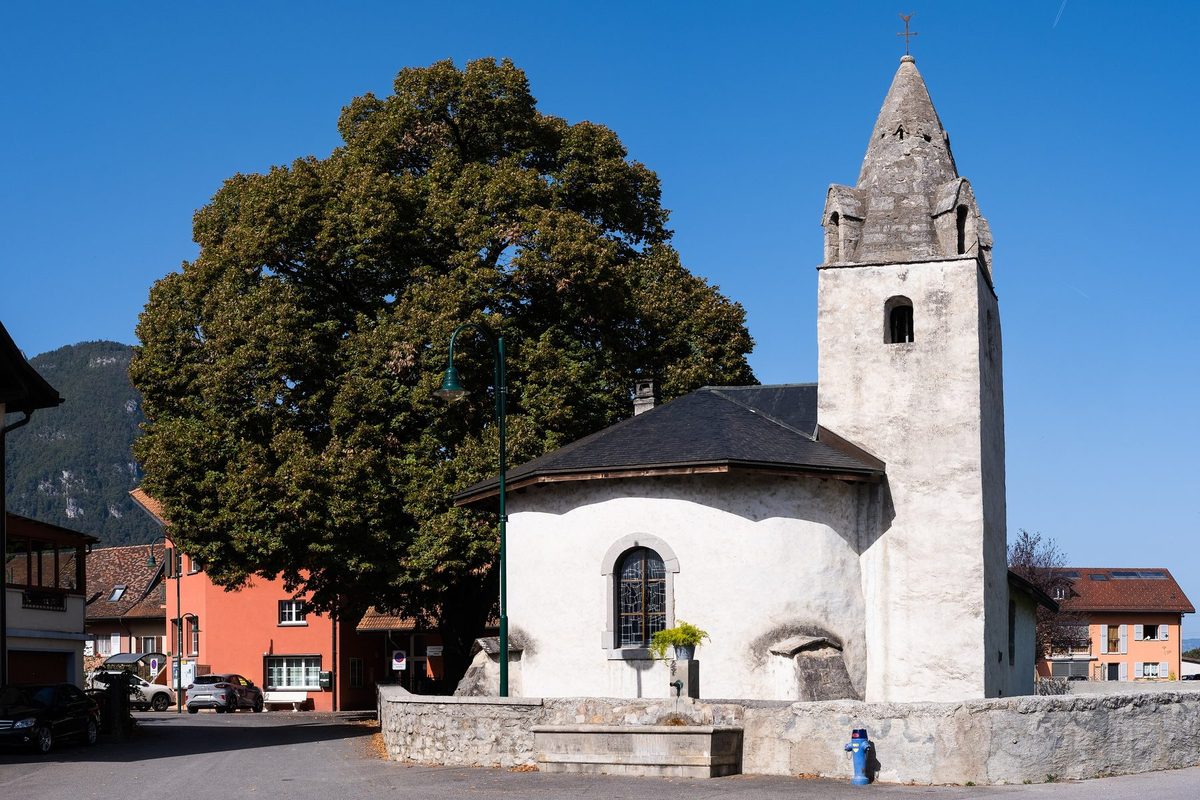
On the right bank of the Rhône, a Romanesque church on 10th-century foundations, with traces of Roman or early medieval settlement beneath it.
Entry based on 7 sources · Our method · Reusable text (CC BY-SA)
Origin of the name Chessel
The village is attested as « Chessey » in 1364. The name reportedly comes from a personal name, « Cassus », followed by the Celtic suffix -acum: the « estate of Cassus ». The ending -el would be a late development.[1]
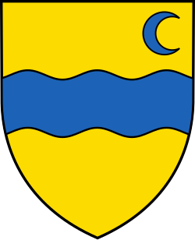
Coat of arms of Chessel
Or, a fess wavy azure, in sinister chief a crescent contourné of the second. On a yellow field, a wavy blue band crosses the shield horizontally. At the top right, a blue crescent faces to the right. Adopted in 1923, the wavy band stands for the plain crossed by the Rhône, along which the commune stretches. The crescent is added in 1926 and registered in 1929. It reportedly recalls the former Café de la Turquie. The communal authorities remove it in 1958, yet it still appears in the arms entered in the federal register.[5][6]
Founding of Chessel
The site was occupied well before the present village: traces from the Roman period or the early Middle Ages have been found beneath the church. In the Middle Ages Chessel belongs to the Savoyard castellany of Chillon, and the Pontverre and later the Châtillon families hold property there. Set on the right bank of the Rhône, the village long lived with the river: people crossed it by ferry, and dykes are mentioned from the 15th century. When and by whom Chessel was founded is unknown.[1]
History of Chessel
Roman period or early Middle Ages. Traces of settlement are found beneath the site of the church.[1]
10th century. Date of the oldest foundations of the church of Saint-Nicolas.[1]
1313. The village has 17 hearths.[1]
1364. The village is mentioned as « Chessey ».[1]
13th-14th century. The Romanesque church of Saint-Nicolas is built on the earlier foundations.[1]
15th century. The Rhône dykes are mentioned from this period.[1]
1475. After the Bernese conquest, Chessel is attached to the governorship of Aigle until 1798. It forms a métralie with a court of justice.[1]
1528. The Reformation is adopted; Chessel becomes an annex of the Reformed parish of Noville.[1]
1728. Chessel becomes an annex of the parish of Roche, until 1833.[1]
1798. Chessel joins the district of Aigle.[1]
1839. Construction of the Porte du Sex bridge, which replaces the ferry over the Rhône.[1]
1905. The Porte du Sex bridge is rebuilt.[1]
1960s. A camping and caravan site opens, attracting new residents.[1]
1975. A residential villa zone is created.[1]
Population of Chessel
Sources and references: [1][2]
| 1313 | 17 hearths (households) |
| 1338 | 24 hearths (households) |
| 1356 | 5 hearths (households), approximately |
| 1502 | 10 hearths (households) |
| 1764 | 99 |
| 1798 | 129 |
| 1850 | 132 |
| 1900 | 167 |
| 1910 | 141 |
| 1950 | 202 |
| 1980 | 191 |
| 2000 | 314 |
| 2025 | 525 |
Families of Chessel
Citizen families before 1800. Bertholet, Däppen, Däppen dit Tappet, Guillet, Métraux, Mettraux and Vernier, without a precise date.[7]
In the 19th century. The Clément family (from Cuarnens VD) and the Echenard family (from Ormont-Dessous VD), without a precise date. Then the Daucher family obtains citizenship in 1846, the Schütz family (from Germany) in 1857, the Strähl family (from Germany) in 1859, the Kues family (from the United States) in 1868, the Wagner family (from Germany) in 1886, the Müller family (from Germany) in 1888, the Schriever family (from Germany) in 1888, the Détraz family (from France) in 1889, the Orsinger family (from Germany) in 1891, the Gervaz family (from France) in 1892, the Maire family (from Italy) in 1893, the Gisler family (from Germany) in 1894, the Capra family (from Italy) in 1896, the Cerf family (from France) in 1898, the Germain family (from France) in 1899, the Monti family (from Italy) in 1900, the Neusel family (from Germany) in 1900 and the Wilkening family (from Germany) in 1900.[7]
From 1901 to 1962. 16 registrations. Several families come from abroad: from Italy (Giovanna in 1901, Guenzi in 1901, Tridondani in 1913, Pastori in 1914, Morandi in 1916 and Régis in 1918), from Germany (Hirschmann in 1906, Widmann in 1911, Riess in 1914 and Federneder in 1915) and from France (Clerc in 1906 and Charrière in 1914). From Switzerland come the Brügger family from St. Antoni FR (1956), the Noyer family from Vully-le-Bas FR (1957) and the Grob family from Bern BE (1961). They are joined by the Philippossian family (1937). The last family registered, in 1961, is the Grob family.[7]
Economy of Chessel, past and present
The alluvial land. Chessel was originally mostly agricultural. Eight market gardeners and farmers work the alluvial land left by the Rhône. Of the commune's 356 hectares, 253 are farmland and 64 forest, 52 of which belong to the commune. Most working residents are employed outside the village.[6]
The ferry and the dykes. Before the bridge, a ferry carries people across the Rhône. In 1618 the commune grants land to the ferrymen, who in return carry the inhabitants free of charge. In 1841 the dyke authority levies a tax on timber floating and on property. The Grand-Canal is dug in 1914 to drain the plain.[1][6]
Spring water. The commune has had its own drinking water spring since 1913. At the end of 2013 a turbine is installed in the spring's reservoir, earning the commune an income it considers significant.[6]
Disasters and major events in Chessel
The Rhône flood of 1902. A Rhône flood sweeps away the wooden bridge built near the castle of Porte-du-Scex. The present riveted metal bridge replaces it in 1903.[6]
Historic sites in Chessel
Church of Saint-Nicolas. Romanesque church built in the 13th and 14th centuries on 10th century foundations, with a masonry spire and a 15th century fresco fragment. In 1528 it became an annex of the Reformed parish of Noville. It is listed in the federal inventory of cultural property (PCP) as an object of regional significance.[1][3]
Porte du Sex bridge. Built in 1839 to replace the ferry used to cross the Rhône, then rebuilt in 1905.[1]
Remains in Chessel
Ancient traces beneath the church. Traces of settlement from the Roman period or the early Middle Ages have been found beneath the church of Saint-Nicolas, whose foundations date back to the 10th century.[1]
Protected heritage in Chessel
Cultural property of regional significance (B objects)[4]
- Eglise réformée Saint-Nicolas
Traditions and festivals in Chessel
The Turks. The people of Chessel go by the nickname "Turks" (Les Turcs).[6]
The Little New Year soup. The youth society brings together young people from the village and nearby. It serves a soup for the Little New Year.[6]
Sources
- Dictionnaire historique de la Suisse, « Chessel »
- Statistique Vaud, « Population résidante permanente au 31 décembre 2025 »
- Office fédéral de la protection de la population, Inventaire suisse des biens culturels d'importance nationale et régionale, liste du canton de Vaud (état au 1.1.2026)
- Federal Office for Civil Protection (FOCP), Swiss Inventory of Cultural Property (PCP), list for the canton of Vaud (as of 1.1.2026)
- IPI, Swissreg, emblems database: coat of arms of Chessel (no. 101714)
- Official Gazette of the Canton of Vaud (FAO), "Alphabet des communes vaudoises: Chessel"
- Register of Swiss Surnames, 3rd edition (1989), search Commune "Chessel", Canton VD
Published by Sébastien Jörg ·
Other villages near Chessel
Missing information, or do you have a source? Suggest a correction or addition. Every submission is checked before it's published.
Suggest a change