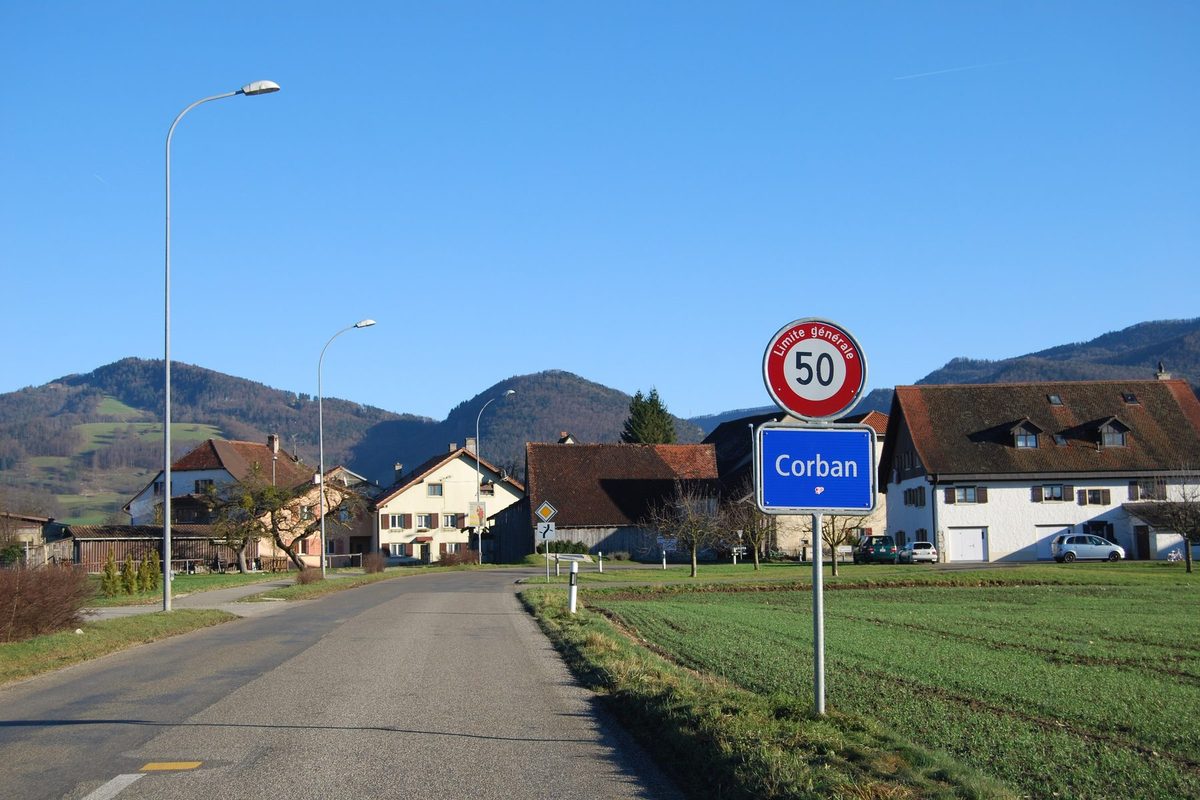
Corban
In the eastern part of the Val Terbi, the village where a hoard of 104 Roman denarii was found in 1892, and which chose the canton of Jura in 1975.
Entry based on 6 sources · Our method · Reusable text (CC BY-SA)
Origin of the name Corban
Two very different names refer to the village in the Middle Ages: « Bathendorf » in 1184, then « Corpaon » in 1240. In 1461 it is written « Courban ». The origin of these names is still debated.[1][3]
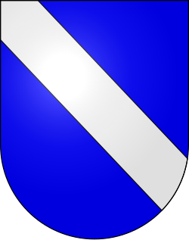
Coat of arms of Corban
Azure a bend argent. The shield is blue, crossed diagonally by a white band from the upper left to the lower right corner. These are the arms of the former municipality, approved by the Bernese government on 9 January 1947.[5]
Founding of Corban
People were already passing through here in Roman times: 104 Roman denarii of the 1st and 2nd centuries were found here in 1892. Until 1797 Corban was one of the mairies of the provostship of Moutier-Grandval, attached to the great mairie of Courrendlin, known as Sous-les-Roches, which remained Catholic. It is now part of the municipality of Val Terbi (merger of 2018).[1]
History of Corban
1st-2nd centuries AD. Date of the 104 Roman denarii buried on the territory of Corban.[1]
1184. First record: « Bathendorf ».[1]
Until the early 17th century. Corban belongs to the parish of Vermes.[1]
1683. The parish church of Saint-Blaise is built.[1]
Until 1797. Corban is one of the mayoralties of the provostry of Moutier-Grandval, attached to the great mayoralty of Courrendlin, known as Sous-les-Roches.[1]
1797-1800. Corban belongs to the French department of Mont-Terrible, then Haut-Rhin.[1]
1815. Corban passes to the canton of Bern, in the bailiwick and later the district of Moutier.[1]
1853. The burgher community is created.[1]
1892. A hoard of 104 Roman denarii is discovered.[1]
Early 20th century. The economy still relies largely on farming and livestock breeding.[1]
Around 1900. The village, called Battendorf by German speakers, has 73 houses and 397 Catholic inhabitants. It has a post office, a telephone and the Delémont-Montsevelier coach, a mill and a cheese dairy.[3]
1975. After the Jura plebiscites of June 1974 and March 1975, Corban, which had become a border municipality, chose on 7 September to join the canton of Jura.[1]
1979. Corban, assigned to the district of Moutier in 1976, passes to the district of Delémont.[1]
2018. Corban merges into the municipality of Val Terbi.[1]
Population of Corban
Sources and references: [1]
| 1818 | 314 |
| 1850 | 392 |
| 1900 | 389 |
| 1910 | 375 |
| 1950 | 457 |
| 1980 | 402 |
| 2000 | 452 |
| 2010 | 466 |
| 2017 | 481 |
Families of Corban
Citizen families before 1800. The list is that of the former municipality of Corban, merged into Val Terbi in 2018. Barth, Bron, Maitin, Rottet, Schaller, Steullet and Wendler are long-standing citizens there, with no exact date.[6]
From 1901 to 1962. The Ricca join in 1922, the Nusbaumer in 1944 and the Péclet, from France, in 1946. Two more families are admitted in 1958: the Molteni, from Italy, and the Schlüchter.[6]
Economy of Corban, past and present
Cheese and milk. The Corban cheese society is founded on 2 October 1895 and struck off in 1920. A dairy society is set up on 4 October 1912, and a new dairy opens in 1981. From 2001 to 2010 a land consolidation brings together Courchapoix, Corban and Montsevelier. The canton contributes 1,121,000 francs to it in 2010.[5]
Silk, mill and pinions. Silk weaving runs into difficulties in 1880, and weaving stops in 1881. Moulins de Corban SA is founded on 21 April 1960. In 1967 the municipality sells the old school to Pignons Réunis SA, of Grenchen.[5]
Disasters and major events in Corban
The ravages of 1499. During the Swabian War, Austrians angered that Bern has seized the provostship of Moutier-Grandval lay waste to Corban, along with Champoz, Courrendlin and Mervelier.[5]
The flood of May 1837. On 15 and 16 May 1837 the Scheulte bursts its banks and sweeps away the Pont-de-Cran bridge.[5]
Historic sites in Corban
Church of Saint-Blaise. Parish church built in 1683, which has kept late Gothic elements despite several alterations.[1]
Remains in Corban
Hoard of Roman denarii. Hoard of 104 Roman denarii from the 1st and 2nd centuries AD, discovered in 1892 on the territory of Corban.[1]
Protected heritage in Corban
Cultural property of regional significance (B objects)[4]
- Eglise paroissiale St-Blaise
Sources
- Dictionnaire historique de la Suisse, « Corban » (François Kohler)
- geo.admin.ch (swisstopo), recherche de lieux « Corban »
- Geographisches Lexikon der Schweiz, Band I (Neuenburg, Attinger, 1902)
- Federal Office for Civil Protection (FOCP), Swiss Inventory of Cultural Property (PCP), list for the canton of Jura (as of 1.1.2026)
- Chronologie jurassienne (Denis Moine), « Corban »
- Register of Swiss Surnames, 3rd edition (1989), search Commune "Corban", Canton JU
Published by Sébastien Jörg ·
Other villages near Corban
Missing information, or do you have a source? Suggest a correction or addition. Every submission is checked before it's published.
Suggest a change