Couvet
A staging post on the old road to France, Couvet was the birthplace of the watchmaker Ferdinand Berthoud and, in 1867, of the Dubied knitting machine factory.
Entry based on 10 sources · Our method · Reusable text (CC BY-SA)
Origin of the name Couvet
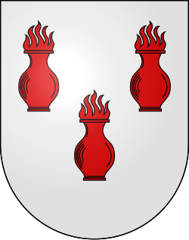
The name appears in 1300 as « Covés ». A tradition links it to the « couvets », pots used as foot warmers made by the potters settled here since the Middle Ages. The borrowing may, however, have gone the other way, with the village giving its name to the foot warmers. The question is not settled. Pottery and stove making are well attested in Couvet from the 16th to the early 20th century, and the municipal coat of arms of 1890 reportedly shows three vessels from which a flame rises, in memory of the « couvets ». A mention as early as 1291, linked to the settlement of the Dubied, Coulin, Andrié and Favre families, is sometimes put forward, but it is not confirmed.[1]
Founding of Couvet
Who founded Couvet is not known. The village took shape at the confluence of the Areuse and the Sucre, on the old road to France, where it became an important staging post with several inns. External burghers of Neuchâtel lived there from the 13th century. Couvet belonged to the castellany of Vautravers until 1848 and, from the 14th century, to the corporation of the Six Communes of the Val-de-Travers. The commune took shape in the 16th century, when it received the common pastures, the communal oven, land and woods on lease. Besides the village, its territory included the hamlet of Plancemont and scattered settlements. Couvet is now part of the municipality of Val-de-Travers.[1]
History of Couvet
Middle Palaeolithic. The Grotte des Plaints is occupied in the Mousterian, between 50'000 and 40'000 BC.[1]
13th century. External burghers of Neuchâtel are mentioned in Couvet.[1]
1300. First mention of the village, in the form « Covés ».[1]
14th century. Couvet is a member of the corporation of the Six Communes of the Val-de-Travers. It belongs to the castellany of Vautravers until 1848. Around the middle of the century the village has 62 hearths (households).[1]
1522-1523. The commune takes shape: leasing of the common pastures (1522), then of the communal oven (1523), land and woods.[1]
1554. The village has 97 hearths (households), about 500 inhabitants.[1]
1574. The pediment of the Porte du Milieu, bearing the Petitpierre arms, reportedly carries this date. The doorway is an example of the Neuchâtel Renaissance style.
1658. Couvet has its church. Construction reportedly began in 1657, under the direction of Jonas Favre.[1]
1706. The Protestant parish of Couvet is separated from that of Môtiers.[1]
1711. Couvet henceforth holds two annual fairs.[1]
1750-1772. The Borel, Bosset and Guyenet calico printing works is in operation. From the mid-18th century many workshops make watchmaking tools and clocks. Ferdinand Berthoud (1727-1807), born in Couvet, invents and perfects techniques for determining longitude with marine clocks. He is sometimes credited with inventing the marine chronometer.[1][3]
1765-1766. The masters Jean-Jacques and Jacob Rosselet reportedly build the church's ashlar tower.
1777. Improvement of the road to Môtiers.[1]
late 18th century. Beginning of the absinthe distilleries (Pernod, Duval, Berger, etc.), active until 1910.[1]
1860. Construction of the Franco-Suisse railway station and foundation of the district's first hospital.[1]
1867. Foundation of the Ed. Dubied knitting machine factory, which operates until 1987.[1]
1883. Opening of the station of the Régional du Val-de-Travers (RVT) railway.[1]
1890. The forester Henri Biolley applies his selection-forest and forest-control method in the communal forests.[1]
1894. Opening of a school of mechanics, which exists until 1998.[1]
1943. Construction of a Catholic chapel.[1]
2009. On 1 January Couvet merges with Les Bayards, Boveresse, Buttes, Fleurier, Môtiers, Noiraigue, Saint-Sulpice and Travers to form the municipality of Val-de-Travers.[1]
Population of Couvet
Sources and references: [1]
| mid-14th century | 62 hearths (households), about 300 inhabitants |
| 1554 | 97 hearths (households), about 500 inhabitants |
| 1750 | 1'004 |
| 1800 | 1'463 |
| 1850 | 1'711 |
| 1900 | 2'430 |
| 1950 | 2'897 |
| 1990 | 2'919 |
| 2000 | 2'703 |
| 2008 | 2'783 |
Families of Couvet
Dubied. Recorded in the Val-de-Travers from the mid-14th century, the Dubied were originally called Dumont. The name Dubied appears around 1462, and one branch holds rights in the commune of Couvet from the late 15th century. Major Daniel-Henri Dubied (1758-1841) trades there in stockings and lace. Henri Edouard Dubied (1823-1878), a mechanical engineer trained in Paris, starts making knitting machines in 1867. The business is then run by Paul Edouard (1855-1911) from 1879 and later by Pierre Edouard (1887-1955), who moves its head office to Neuchâtel in 1920.[7]
Citizen families before 1800. Andrié, Berthoud, Besancet, Borel, Borel-Jaquet, Borel-Petitjean, Borel-Saladin, Bove-Righini, Henriod, Jeanjaquet, Petitpierre, Petitpierre-chez-Jean and Tissot, as well as the Perrenod-dit-Pernod (from Les Ponts-de-Martel NE), with no precise date. The Montvert, from Neuchâtel NE, are registered in 1797.[6]
In the 19th century. Forty-four families, thirty of them with no precise date. These include the Coulin, the Guyenet and the Quadri (from Sala Capriasca TI). The dated entries run from 1814 to 1900. They include the Dubied in 1853 and the Duval in 1871, as well as three families from France, two from Germany and one from Poland.[6]
Show more families (1)
From 1901 to 1962. Ninety-three families. Those from Bern and from Italy are the most numerous, with nineteen families each, ahead of those from Germany (twelve), Vaud and France (nine each). Three further Petitpierre families are registered, from Cheseaux-Noréaz VD in 1932, Murten FR in 1934 and Genève GE in 1935. The last entries, in 1961, concern three families from Hungary, Sweden and Möhlin AG.[6]
Notable people of Couvet
Ferdinand Berthoud (Plancemont 1727 - Groslay 1807). Born in the hamlet of Plancemont, he learns the trade from his brother Jean-Henri, a pendulum-clock maker, and in 1745 leaves for Paris to work for the watchmaker Julien Leroy. In 1770 he becomes clockmaker and mechanic to the king and the navy. A member of the Institut de France and of the Royal Society of London, he is made a knight of the Legion of Honour in 1804.[3]
Henri Biolley (1858-1939). Forest district inspector in Couvet from 1880 to 1917, he then serves as chief forest inspector of the canton until 1927. He sets out his control method in a book published in Neuchâtel in 1921.[8]
Economy of Couvet, past and present
Potters and masons. Until the 16th century Couvet lived almost entirely from the land. Potters and stove makers then worked here from the 16th to the early 20th century. Up to the 19th century the village also supplied many well-known masons and architects.[1]
Cloth, lace and watchmaking. Besides the calico printing works of 1750-1772, Couvet made bobbin lace from the 18th century to the first half of the 19th. S. Duval wove stockings on the loom in the second half of the 18th century. From the middle of that century many workshops produced watchmaking tools and clocks.[1]
Absinthe, machines and small factories. The absinthe distilleries, among them Pernod, Duval and Berger, ran until 1910, and the Dubied knitting machine factory from 1867 to 1987. Many other firms worked alongside them. The 18th century had the Griesser printing works and the Petitpierre card makers, followed by the Borle-Borel foundry from 1800 to 1845 and the Quadri tile and brick works from 1834 to the First World War. The La Presta asphalt mine was worked from 1840, the Borel-Martin tannery from 1865 to 1902. The Moebus hydrotherapy establishment received guests from 1888 to 1909, and from 1897 the Bourquin firm made paillons, then corrugated cardboard.[1]
Inns, fairs and services. A staging post on the old road to France, Couvet had several inns. Its two annual fairs date back to 1711. In 2000 more than a third of the working population was employed in industry and over half in services.[1]
Historic sites in Couvet
The church. The church is attested from 1658. Its construction reportedly began in 1657 under the direction of Jonas Favre, and its ashlar tower was reportedly built in 1765-1766 by the masters Jean-Jacques and Jacob Rosselet. The parish was separated from Môtiers in 1706.[1]
The Porte du Milieu. An example of the Neuchâtel Renaissance style, the doorway is topped by a pediment bearing the Petitpierre arms, reportedly dated 1574.
The parsonage and the old school. The neoclassical parsonage of 1854 was reportedly built to plans by Hans Rychner, and the old primary school, also neoclassical, in 1846-1850 by the architect Louis Châtelain.
The hospital. The district's first hospital, founded in 1860.[1]
Plancemont. This hamlet of the former municipality was the birthplace of the watchmaker Ferdinand Berthoud (1727-1807), who invented and perfected techniques for determining longitude with marine clocks. He is sometimes credited with inventing the marine chronometer.[1][3]
The Dubied site. From 1867 to 1987 Couvet was the seat of the Ed. Dubied knitting machine factory, founded by Édouard Dubied (1823-1878), the village's main industry.[1]
Remains in Couvet
The Grotte des Plaints. Cave occupied in the Mousterian (Middle Palaeolithic, 50'000-40'000 BC), the oldest evidence of human presence on the territory of Couvet.[1]
Protected heritage in Couvet
Cultural property of regional significance (B objects)[5]
- Ancienne manufacture d'indiennes Borel de Bitche
- Archives communales de Val-de-Travers
- Collection Léon Perrin
- Ecu de France
- Hôtel de l'Aigle
- Les Plaints, grotte paléolithique
- Maison de campagne Le Marais
- Temple (tour)
Traditions and festivals in Couvet
The absinthe tradition. Absinthe appears in Couvet in the mid-18th century. In 1797 Major Daniel-Henri Dubied acquires the recipe and, with his son-in-law Henri-Louis Pernod, founds the first absinthe distillery, Dubied Père et Fils. Pernod opens his own in Pontarlier in 1805. From 1910 to 2005 absinthe is made only in secret, and in 2023 the absinthe culture of the Val-de-Travers joins the list of living traditions in Switzerland.[9][10]
The Société d'émulation. Couvet has its own Société d'émulation, active since 1859.[1]
Sources
- Dictionnaire historique de la Suisse, « Couvet »
- État de Neuchâtel, arrêté du 21 janvier 2009 portant homologation des résultats du recensement cantonal de la population du 31 décembre 2008
- Dictionnaire historique de la Suisse, « Berthoud, Ferdinand » (Eric-André Klauser), version du 20.02.2017
- Dictionnaire historique de la Suisse, « Dubied, Edouard » (Anne Jeanneret-de Rougemont)
- Federal Office for Civil Protection (FOCP), Swiss Inventory of Cultural Property (PCP), list for the canton of Neuchâtel (as of 1.1.2026)
- Register of Swiss Surnames, 3rd edition (1989), search Commune "Couvet", Canton NE
- Société neuchâteloise de généalogie, bulletin 16 (2001), Eric-André Klauser, "Famille Dubied"
- Archives of Rural History, entry "Biolley, Henri (1858-1939)"
- Federal Office of Culture, Living Traditions in Switzerland, "Culture de l'absinthe dans le Val-de-Travers" (2024)
- Canton of Neuchâtel, press release of 22 August 2023, "Une reconnaissance nationale pour deux traditions vivantes neuchâteloises"
Published by Sébastien Jörg ·
Other villages near Couvet
Missing information, or do you have a source? Suggest a correction or addition. Every submission is checked before it's published.
Suggest a change