Mines d'asphalte de La Presta
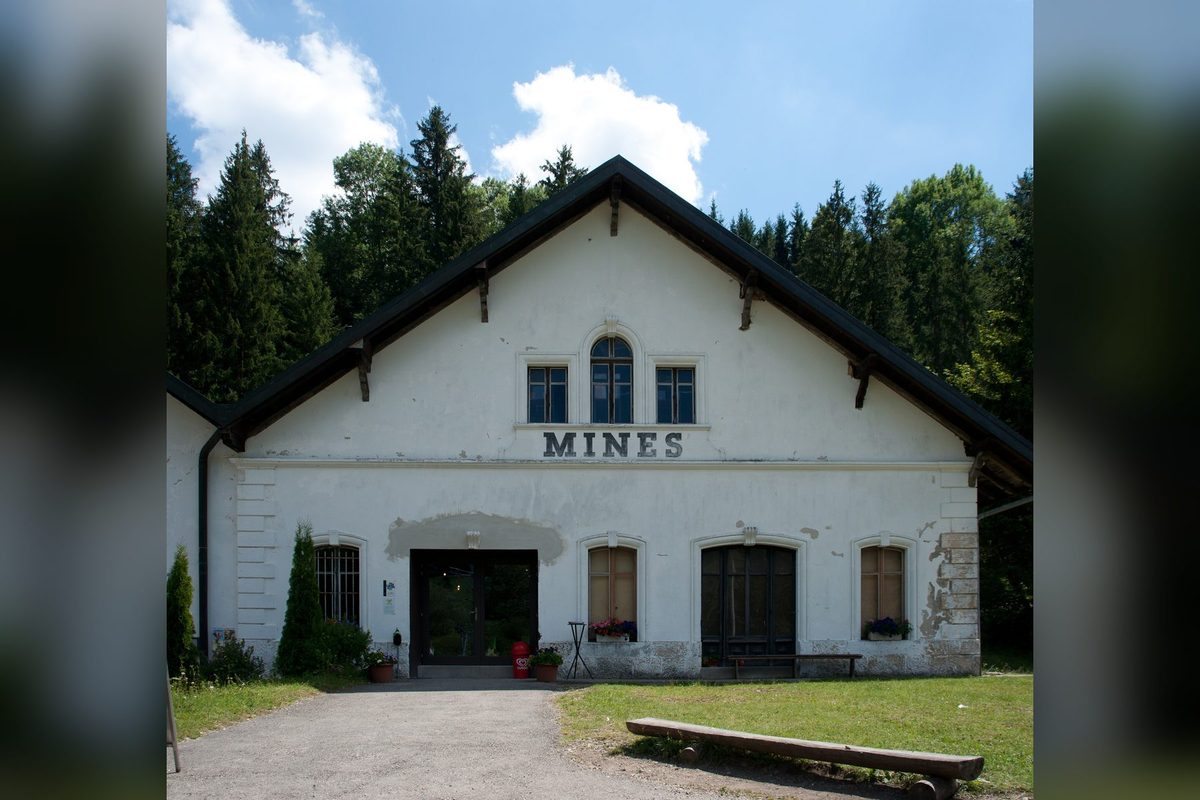
Asphalt mine in the Val-de-Travers worked from 1712 to 1986, with galleries totalling about 100 km. Part of it has been open to visitors since 1987.
Entry based on 7 sources · Our method · Reusable text (CC BY-SA)
Origin of the name Mines d'asphalte de La Presta
The site bears the name of the locality La Presta, near Travers. The origin of this place name has not yet been explained.
Founding of Mines d'asphalte de La Presta
The mine began with a discovery: in 1711 Eirini d'Eirinis, a Greek scholar, found a limestone soaked with asphalt in the Val-de-Travers. Extraction began in 1712, reportedly first as an open pit on the left bank of the Areuse, though this is uncertain. A concession is said to have been obtained in 1717. In the 18th century the asphalt was used almost only for medicinal purposes. Its use for roads began around 1812. The site lies at La Presta, about 1.5 km from Travers towards Couvet, in the former municipality of Travers, which became part of Val-de-Travers on 1 January 2009.[1][2][3]
History of Mines d'asphalte de La Presta
1711. Eirini d'Eirinis, a Greek scholar, discovers in the Val-de-Travers a limestone soaked with asphalt.[1][2][3]
1712. Extraction begins, reportedly first as an open pit on the left bank of the Areuse (uncertain).[1][5]
1717. A mining concession is said to have been obtained.
around 1812. Asphalt, until then used almost only for medicinal purposes, begins to be used for road building.[2]
1840. Mining begins at the La Presta mine (or 1830; date uncertain).[4]
1841-1848. Philippe Suchard reportedly owns the mines and helps promote the material.
1869. Workers are said to have begun digging underground galleries.
1873. The British firm Neuchâtel Asphalte Company Ltd. (NACO) takes over the operation, which then grows to a large scale.[1][2]
1960. NACO becomes a subsidiary of Tarmac, a major European road construction company.[1]
1986. Mining ends, having become unprofitable.[1][2][5]
1987. The site opens to the public as a show mine.[1]
2011. The Association culturelle des mines d'asphalte de La Presta (ACMAP) is founded.[1]
Notable people of Mines d'asphalte de La Presta
Eirini d'Eirinis. A Greek prospector from Bessarabia, he starts asphalt extraction in the Val-de-Travers around 1714. The first workings are on the left bank of the Areuse, at Bois de Croix in Travers. La Presta, on the right bank, is only mined from 1830.[7]
Economy of Mines d'asphalte de La Presta, past and present
Exported asphalt. Under NACO, large quantities of this waterproof material were shipped all over the world. The galleries and chambers run to more than 100 kilometres. Horses and electric railways hauled the asphalt to the surface. The last horse was retired in 1975.[1][2]
The show mine. The Café des Mines opened in 1991. In 1996 the museum was moved and the restaurant enlarged. The guided tour follows about one kilometre of gallery. It drew about 22'000 visitors in 2019. The miners once cooked a ham in asphalt once a year, on 4 December, Saint Barbara's Day. The custom was revived in the 1970s and the dish is served at the Café des Mines.[1][2]
Historic sites in Mines d'asphalte de La Presta
The show mine. About 1 km of galleries can be visited with a guide, who explains the mining techniques, the use of explosives and the drainage of water. Transport was first by horses, later by electric railway.[1][2]
Ham cooked in asphalt. A speciality linked to the mine: ham cooked in hot asphalt, originally prepared on 4 December, Saint Barbara's day, and revived in the 1970s.[1]
Remains in Mines d'asphalte de La Presta
The galleries. The galleries and chambers dug in the deposit reach a total length of about 100 km. Part of these mining remains can be visited today.[1][2]
Protected heritage in Mines d'asphalte de La Presta
Cultural property of national significance (A objects in the PCP inventory)[6]
- Mines d'asphalte de la Presta avec ses bâtiments adjacents
Sources
- Showcaves.com, « Mines d'Asphalte Site de la Presta à Travers »
- European Route of Industrial Heritage (ERIH), « Asphalt mines »
- Dictionnaire historique de la Suisse, « Travers » (version allemande)
- Dictionnaire historique de la Suisse, « Couvet »
- Suisse Tourisme (MySwitzerland), « Mines d'asphalte » (La Presta, Travers)
- Federal Office for Civil Protection (FOCP), Swiss Inventory of Cultural Property (PCP), list for the canton of Neuchâtel (as of 1.1.2026)
- Historical Dictionary of Switzerland (HDS), article "Asphalte" (Marc Weidmann), version of 21.11.2016 (French version)
Published by Sébastien Jörg ·
Other villages near Mines d'asphalte de La Presta
Missing information, or do you have a source? Suggest a correction or addition. Every submission is checked before it's published.
Suggest a change