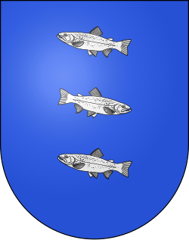
Travers
From 1712 to 1986 La Presta yielded asphalt from a deposit described as the largest in Europe. In 1850 Travers became the first Neuchâtel municipality to set up a republican-style council.
Entry based on 7 sources · Our method · Reusable text (CC BY-SA)
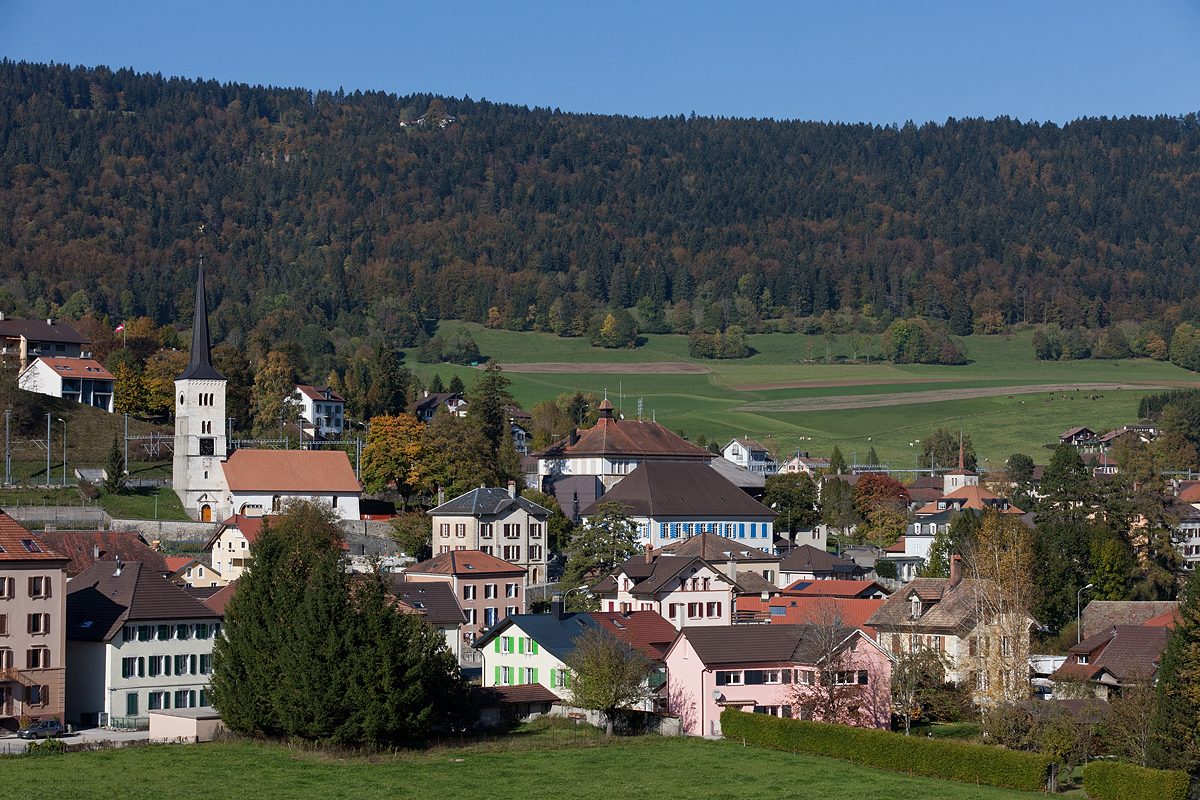
Origin of the name Travers
The village is mentioned in 1202 in the Latin form « Transversum », then in 1229 in the form « Travers ». What « Travers » means is still not known. The Latin « transversum » reportedly means « set crosswise ».[1]
Founding of Travers
Travers has no known founder or founding act. Travers grew up on both banks of the Areuse, with numerous hamlets. It appears in the records in 1202, and its church of Saint-Côme is attested shortly afterwards. The village belonged to the counts of Neuchâtel from the 13th century. Count Conrad of Freiburg later made it a lordship, added Noiraigue and Rosières to it and granted it in fief to Jean de Neuchâtel-Vaumarcus. Long agricultural, Travers industrialised around the middle of the 19th century.[1][2]
History of Travers
1202. First mention of the village, in the form « Transversum ».[1]
1228. The church of Saint-Côme is attested.[1]
1229. Mention in the form « Travers ».[1]
13th century. Travers is owned by the counts of Neuchâtel.[1]
1413. Count Conrad of Freiburg makes Travers a lordship and adds Noiraigue and Rosières to it. The lordship is granted in fief to Jean de Neuchâtel-Vaumarcus.[1][2]
1569. The church of Saint-Côme is converted into a Reformed church.[1]
1587. The lordship passes to the von Bonstetten family.[1]
1627-1643. François and Rodolphe von Bonstetten share the administration of the lordship, distinguishing the title of lord of Travers from that of lord of Rosières.[2]
1711. Identification of the large La Presta asphalt deposit.[1][4]
1712. Asphalt extraction begins at La Presta.[4]
1761. The lordship of Travers passes to the Sandoz.[1][2]
1827. The Sandoz cede the seigneurial rights to the prince of Neuchâtel.[1][2]
1848. Travers takes part in the overthrow of the Ancien Régime.[1]
1850. Travers is the first Neuchâtel municipality to adopt a municipal council of republican inspiration. Around the middle of the century the agricultural tradition gives way to watchmaking factories and the systematic mining of asphalt.[1]
1860. Opening of the Neuchâtel-Pontarlier railway line.[1]
1865. A fire destroys 101 houses.[1]
1883. The Régional du Val-de-Travers railway enters service.[1]
1939. Construction of the Catholic church of Saint-Joseph.[1]
1975. Start of industrial decline: Travers gradually loses most of its firms and becomes a residential village.[1]
1986. Closure of the La Presta asphalt mine.[4]
2009. On 1 January Travers merges with Les Bayards, Boveresse, Buttes, Couvet, Fleurier, Môtiers, Noiraigue and Saint-Sulpice to form the municipality of Val-de-Travers.[1]
Population of Travers
Sources and references: [1]
| 1850 | 1'471 |
| 1900 | 2'093 |
| 1950 | 1'653 |
| 2000 | 1'180 |
| 2008 | 1'238 |
Families of Travers
Citizen families before 1800. Thirty-one families, with no precise date: Bertholet, Blanc, Boiteux, Bonzon, de Rougemont (from Saint-Aubin), Delachaux, Dubois, Dubois-Dunilach, Erbeau, Favre, Frey, Greset, Greset-dit-Grisel, Grezet, Grisel, Jeanneret, Jeannet, Jeanrenaud, Joly, Jornod, Junod, Kopp, Lambercier, Montandon, Pellaton, Perregaux, Perrinjaquet, Py, Robbesaul, Robert and Westphale.[7]
In the 19th century. Six families with no precise date: the Bachmann from Langnau im Emmental BE, the Bornand from Sainte-Croix VD, another Frey family, from Germany, the Paillard, the Schenck and the Treuthardt from Zweisimmen BE. The Simon from Mauborget VD opened the dated registrations in 1804. From 1865 onwards they multiplied: Miéville from Pomy VD (1865), Peck from France (1866), Weber (1868), Coste from France (1873), Mayer from Germany (1874), Greiner from Germany and Romang from Gsteig BE (1879), Kübler from Germany (1881), Charlet from France and Stein from Germany (1884), Créange from Germany (1887), Schopfer from Lauenen BE (1889). The year 1890 saw five: Cossavella, Demarchi and Giachino from Italy, Huber from Jonen AG and Steudler from Krattigen BE. Then came the Bugni from Italy (1893), the Baudin from Ursins VD, the Bolens from Provence VD and the May from Germany (1894), the Stauffer from Bern (1895), the Bey from France (1896), the Nydegger from Guggisberg BE (1898) and the Arbore from Italy (1900).[7]
From 1901 to 1962. Seventy-two families. Italy provided the largest number, 24, from the Diana and the Ricca in 1917 to the Bacuzzi in 1961. Next came the canton of Bern (12), France (11), the canton of Vaud (6) and Germany (5). Two Vautravers families, one from Champagne VD, the other from Romairon VD, were registered in 1906 and 1907. Also of note are the Yakobson, who came from the Soviet Union in 1926, and the Netuschill, from Hungary, registered in 1955 and 1961. They and the Bacuzzi were the last registrations, in 1961.[7]
Economy of Travers, past and present
Asphalt from La Presta. The large asphalt deposit of La Presta, identified in 1711, was only mined systematically from the mid-19th century. In 1873 the British Neuchâtel Asphalte Company bought the mine, which later passed to the English firm Tarmac. The asphalt was exported all over the world. Its galleries total over 100 kilometres. The mine closed in 1986 because it no longer paid.[1][4]
Printed cotton, lace and watches. A printed cotton (indienne) works operated in Travers from 1750 to 1772. Lacemaking grew at the same time, then watchmaking, first at home and later in workshops. Founded in 1842, the Jaccottet movement-blank factory employed some 300 people at its peak. It closed in 1907. A furniture factory, founded in 1872, had 80 staff at the end of the 19th century.[6]
From railway to commuter village. The link to the international rail network in 1860 spurred industry. After 1975 Travers lost most of its firms and its residents now work elsewhere. The scattered farms still keep up significant farming.[6][1]
Disasters and major events in Travers
The fire of September 1865. In September 1865 fire struck 101 of the village's 124 houses and destroyed nearly all of them. The château, the church except for its bell tower, and the movement-blank factory were spared. In 1866 the cantonal engineer Charles Knab drew up an alignment plan. It kept the old paths and plot boundaries and only partly straightened the main road. Rebuilding strengthened Travers's industrial character.[6][1]
Historic sites in Travers
The church (former church of Saint-Côme). Church attested in 1228, converted into a Reformed church in 1569.[1]
The bridge over the Areuse. Bridge listed as a Swiss cultural property of national importance.[5]
The Catholic church of Saint-Joseph. Church built in 1939.[1]
Remains in Travers
The La Presta asphalt mine. Deposit identified in 1711, mined from 1712 and systematically from the middle of the 19th century. It is reportedly the largest asphalt deposit in Europe. It was worked until the mine closed in 1986.[1][4]
Protected heritage in Travers
Cultural property of national significance (A objects in the PCP inventory)[5]
- Mines d'asphalte de la Presta avec ses bâtiments adjacents
- Pont sur l'Areuse
Cultural property of regional significance (B objects)[5]
- Temple
Sources
- Dictionnaire historique de la Suisse, « Travers »
- Dictionnaire historique de la Suisse, « Rosières »
- État de Neuchâtel, arrêté du 21 janvier 2009 portant homologation des résultats du recensement cantonal de la population du 31 décembre 2008
- Showcaves.com, « Mines d'Asphalte Site de la Presta à Travers »
- Office fédéral de la protection de la population, Inventaire PBC des biens culturels d'importance nationale et régionale, liste du canton de Neuchâtel (état au 1.1.2026)
- Federal ISOS inventory, « Travers » (2nd version, March 2008)
- Register of Swiss Surnames, 3rd edition (1989), search Commune "Travers", Canton NE
Published by Sébastien Jörg ·
Other villages near Travers
Missing information, or do you have a source? Suggest a correction or addition. Every submission is checked before it's published.
Suggest a change