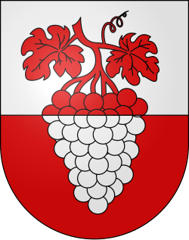
Cully
In 967 the king of Burgundy gave Cully, then « Cusliacum », to the cathedral church of Besançon, which remained its lord until 1246.
Entry based on 12 sources · Our method · Reusable text (CC BY-SA)
Origin of the name Cully
Cully first appears in 967 in the Latin form « Cusliacum ». Old documents then give « Cusliaco » (12th century), « Custiacum » (1154, doubtful spelling), « Culiacum » (1179), « Cullie » (1223), « Cullye » (1275) and « Culye » (1383). It is probably a Gallo-Roman estate name, formed from a family name (« Cussilius » or « Cunsilius ») and the suffix -acum denoting ownership. This hypothesis is not established with certainty.[1][8]
Founding of Cully
Cully has no single, dated foundation: the site has been occupied since the Neolithic, then crossed in Roman times by the road linking Lausanne to the Grand-Saint-Bernard. The village as we know it develops in the early Middle Ages within the vast parish of Villette, which stretched from Lake Léman to the Jorat with no single dominant centre, organized into «quarts» (corporate divisions acting as local communities). The first written mention of the place, in 967, indicates that it was given by the king of Burgundy to the cathedral church of Besançon, which remained its lord until 1246, the year the place passed to the bishop of Lausanne following territorial conflicts. The development of the village owes much to the vine: in the 12th century several abbeys, the priory of Lutry and the hospice of the Grand-Saint-Bernard received land in the Lavaux, among others from the bishop of Lausanne, and the Cistercians were the first to clear the steep slopes. The present-day terraces («charmus») began to be built in the 14th century and multiplied especially between 1750 and 1830.[1][3][4][6]
History of Cully
Neolithic. First traces of human occupation attested at the site of Cully.[1]
Roman period. The road linking Lausanne to the Great St Bernard crosses the area. Remains (coins, statues, building foundations) attest a Roman presence.[1]
997. First mention of vines in the Lavaux region, at Lutry, marking the documented beginnings of local viticulture.
967. First written mention of Cully («Cusliacum»): the place is given by the king of Burgundy to the cathedral church of Besançon.[1][8]
1079. Lausanne appropriates Lutry, Chexbres and Corsier, laying the territorial foundations of ecclesiastical Lavaux.
12th century. The bishop of Lausanne gives land to the abbey of Hauterive. The abbeys of Hautcrêt, Montheron and Humilimont, the priory of Lutry and the hospice of the Grand-Saint-Bernard also receive land in the Lavaux, and the Cistercians are the first to clear the steep slopes.[3]
1154. The place is mentioned under the form «Custiacum» in documents of the time.[8]
1223. Mention of the place under the form «Cullie».[8]
1246. Cully passes from the lordship of the bishop of Besançon to that of the bishop of Lausanne.[1]
1275. Mention of the place under the form «Cullye».[8]
1359. The inhabitants obtain a right to a weekly market and a right of fortification. They enjoy the same franchises as those of Villette. The town is administered by an assembly of burgesses.[1]
14th-15th century. In the 14th century the town takes on a circular plan, with the houses clustered around the church, then in the 15th century it extends towards the lake and takes a rectangular shape.[1][7]
14th century. Beginning of the construction of the vine terraces («charmus») in the Lavaux.
1365. A chapel dedicated to Saint Stephen has existed in Cully since this date, perhaps since around 1355 (date uncertain).[1]
1383. Mention of the place under the form «Culye».[8]
1524. Construction of the temple's tufa bell tower. It is said to be the work of the mason Pierre Soppaz, with work reportedly begun in 1521.[7]
1536. Bernese conquest of the Pays de Vaud: Cully comes under Bernese administration and falls under the bailiwick of Lausanne.[1][3]
1598. Cully becomes the seat of the châtellenie of Villette.[1][7]
1641. Construction of the Maison Jaune, a patrician residence with an old wine press.[7]
1643. Construction of the Fountain of Justice, topped by a statue of Justice.[7]
1706. Berne creates the «Chambre des vins» (Wine Chamber), giving the wines of the Lavaux, including those of Cully, reference status for export to Italy, Holland and Germany.
1750-1830. Intensification of the construction of vine terraces in the most prestigious sectors of the Lavaux.
1766. Cully is raised to a parish.[1]
1798. Fall of the Bernese Ancien Régime. Under the Helvetic Republic, Cully becomes the chief town of the district of Lavaux owing to its central position.[1]
1824-1826. In 1824 the Vaud Grand Council decrees the division of the former general parish of Villette into separate communes, including Cully-Chenaux, which becomes an independent commune. The final deed of partition is dated 11 August 1826, and the new authorities of Cully are sworn in on 12 December 1826.[1][3][4]
1841. A marble obelisk is erected on the place d'Armes in memory of Major Jean Daniel Abraham Davel, the Vaud officer executed in 1723 for advocating the independence of Vaud. The same year the neoclassical building of the Maison de Ville and the Hôtel du Raisin is built.[7]
1861. Construction of the Simplon railway line, which serves Cully.[1][7]
1865-1866. Works give the Reformed church, standing on the site of the former Saint-Étienne chapel, its neo-Gothic style. They are said to be by the architect David Braillard.[7]
1942. Construction of the Lavaux infirmary-hospital in Cully.[1][3][7]
1964. Construction of the Catholic church of Notre-Dame, above the town.[7]
2005. A first merger project of the Lavaux municipalities is rejected in a popular vote, on 25 February 2005.[4]
2007. The Lavaux terraced vineyard, including the territory of Cully, is inscribed on the UNESCO World Heritage List.[4][6]
2008. The Fountain of Justice is reportedly restored.
2009. A new merger project is approved by popular vote in May 2009, on 17 May or, according to the commune, on 7 May (date uncertain).[4]
2011. On 1 July 2011, Cully merges with Épesses, Grandvaux, Riex and Villette to form the new municipality of Bourg-en-Lavaux, of which Cully becomes the chief town and administrative centre.[1][4]
Population of Cully
Sources and references: [1]
| 1568 | 62 hearths (households) |
| 1764 | 483 inhabitants |
| 1798 | 615 inhabitants |
| 1850 | 880 inhabitants |
| 1900 | 1'101 inhabitants |
| 1950 | 1'296 inhabitants |
| 2000 | 1'798 inhabitants |
Families of Cully
Citizen families before 1800. Béboux, Bidaux, Blanche, Blanchet, Borel, Bovard, Bovet, Burnier, Chambaz, Champrenaud, Crot, Cuénoud, Daccord, Davel, Décastel, Delavaux, Delessert, Duboux, Dumur, Forel, Forestier, Jaques, Joly, Joran, Lavanchy, Léderrey, Marguerat, Mennet, Noverraz, Ponnaz, Porta, Ruffy, Testuz and Vallon, as well as the Bersier family (from Villarzel VD), without a precise date.[12]
In the 19th century. The Lambelet family obtains citizenship in 1824. In 1826, 5 families obtain citizenship at the same time: the Chappuis, Gorjat and Mercanton families (from Lutry VD) and the Corboz and Fonjallaz families (from Epesses VD). Then the Hosslé family (from Herznach AG) obtains citizenship in 1866.[12]
From 1901 to 1962. 23 registrations. Several families come from abroad: from Germany (Spiess in 1916, Wickersheim in 1919 and Schwab in 1933), from Italy (Treboud in 1937 and Zanotti in 1956), from Luxembourg (Berchem in 1926), from France (Pachoud in 1926) and from Greece (Keramidas in 1958). From Switzerland come the Carroz family from Arbaz VS, the Friedli family from Marbach LU, the Weber family from Guggisberg BE and the Zwahlen family from Saanen BE (1956), the Ramseyer family from Schlosswil BE (1957), the Flütsch family from Schiers GR and the Strauss family from Grindelwald BE (1958), the Estermann family from Eschenbach LU, the Frigeri family from Lamone TI, the Reichenbach family from Lauenen BE and the Wacker family from Bern BE (1960) and the Vouillamoz family from Isérables VS (1961). They are joined by the Madl family (1930), the Ravessoud family (1943) and the Courvoisier family (1952). The last family registered, in 1961, is the Vouillamoz family.[12]
Economy of Cully, past and present
The vineyards. For centuries Cully lived almost entirely from its vines. The natural harbour served the wine trade. In 1555 the building of booths on the Place d'Armes was ordered for fair days. In the first third of the 20th century, several vine diseases brought the wine estate into difficulty. The Union vinicole de Cully, a cooperative winery, was founded in 1937.[1][7]
Harbour and railway. Its natural harbour made Cully a stop for transport on the lake. In the 1820s and 1830s the town had a landing stage, as did Lutry and Rivaz. The Simplon line, opened in 1861, put an end to lake transport. New roads then brought the upper parts of Lavaux closer to Lausanne and Vevey, to Cully's disadvantage.[1][7]
Craftsmen, gravel pit and industry. In the 17th and 18th centuries many craftsmen worked in the town: shoemakers, blacksmiths, bakers, tailors, apothecaries. An industrial school opened briefly in the second half of the 19th century. From 1877 a gravel pit was worked near the station. It gave rise to the industrial area of that district, where wine businesses also settled.[1][7]
Tourism and commuters. Tourism remains an important source of activity. Founded in 1983, the Cully Jazz Festival is one of the largest festivals of its kind in Switzerland. A tourism and leisure zone lies by the harbour. Most residents have become commuters working in the service sector in Lausanne or Vevey.[1][7]
Disasters and major events in Cully
The Salle Davel fire of 1995. In 1995 fire ravaged the Salle Davel, home of the Cully Jazz Festival. The building was then rebuilt.[7]
Historic sites in Cully
The temple (former Saint-Étienne church). A chapel dedicated to Saint Stephen has stood here since at least 1365, perhaps since around 1355. The church dates partly from the 12th and 13th centuries. Its square tufa bell tower dates from 1524 and is said to be the work of the mason Pierre Soppaz. In 1865-1866 works attributed, though not with certainty, to the architect David Braillard gave it its neo-Gothic style.[1][7]
La Maison Jaune. Patrician residence dated 1641, with an old wine press.[7]
The Maison de Ville and the Hôtel du Raisin. The Maison de Ville and the Hôtel du Raisin form an L-shaped neoclassical building built in 1841.[7]
The Fountain of Justice. Fountain with an octagonal basin of 1643, given two goats in 1718 and topped by a copy of the polychrome statue of Justice, whose original has disappeared. It is a cultural property of regional importance. It was reportedly restored in 2008.[7][9]
The monument to Major Davel. Marble obelisk erected in 1841 on the place d'Armes, by the lake, in tribute to Major Jean Daniel Abraham Davel (1670-1723), the Vaud officer executed for trying to raise the Pays de Vaud against Bernese rule.[7]
The former castellans' house (known as the Muriset house). Cully was the seat of the castellany of Villette from 1598, under the Bernese Ancien Régime. The Muriset house is said to be the former castellans' house, though this identification is not certain.[1][7]
The Port of Cully. A natural harbour on the shore of Lake Léman, it long served the transport of wine and goods and today remains a port of call for the boats of the Compagnie Générale de Navigation (CGN).[1][7]
The Catholic church of Notre-Dame. Concrete Catholic church on a square plan with a pyramid roof, built in 1964 above the town near the cemetery. It forms a landmark in the landscape.[7]
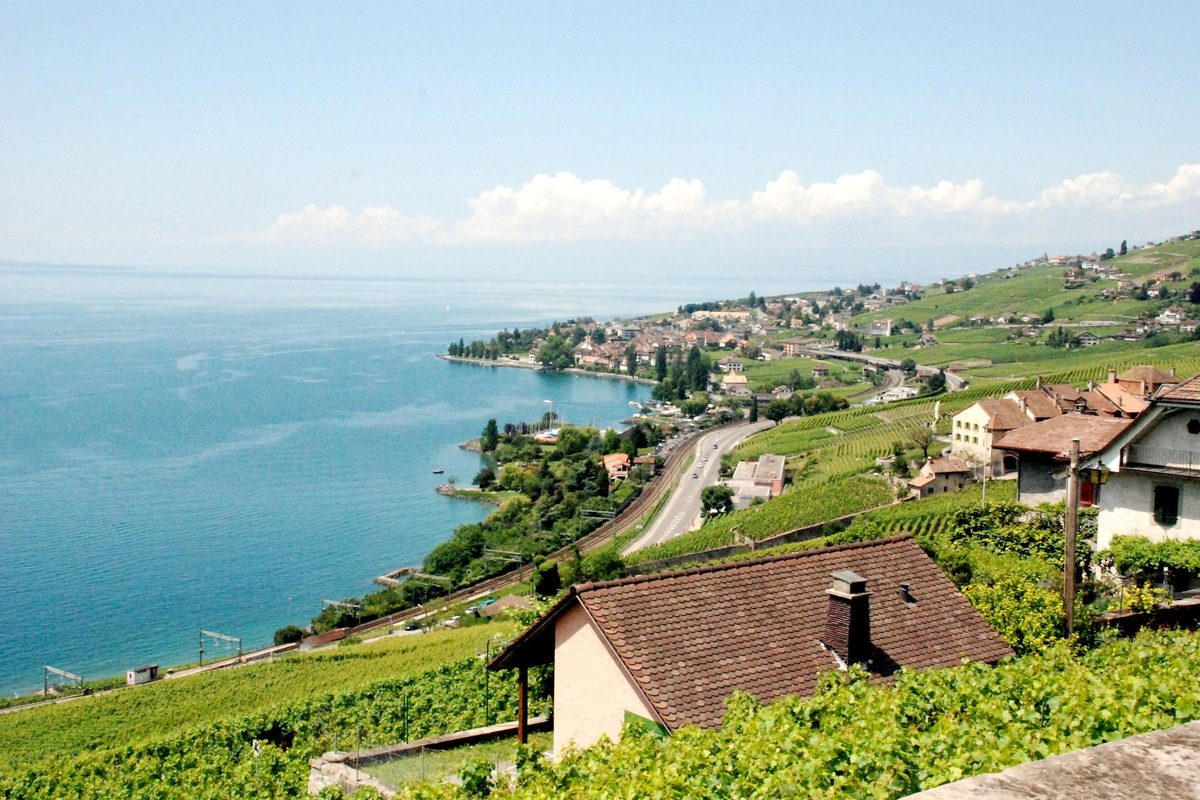
The Lavaux terraced vineyard (UNESCO). The vineyard slopes above Cully are part of the site « Lavaux, Vineyard Terraces », inscribed on the UNESCO World Heritage List in 2007. Vines have been grown here since at least the 12th century, notably at the initiative of Cistercian monks. The terraces (« charmus ») are attested from 1331, and their construction intensified between 1750 and 1830.[3][6]
Remains in Cully
Prehistoric remains. Two Neolithic lakeside settlements are known in Cully, one of them at Moratel.[1]
Roman remains. Roman remains (coins, statues, building foundations) have been found in Cully, on the Great St Bernard road.[1]
Early medieval cemeteries. Two early medieval cemeteries are attested in Cully.[1]
Protected heritage in Cully
Cultural property of national significance (A objects in the PCP inventory)[10]
- Cercle de l'Ermitage
Cultural property of regional significance (B objects)[10]
- Chapelle de l'Ancien Hôpital
- Fontaine de la Justice
- Maison
- Maison avec restes de l'ancien rempart
- Maison Blondel
Traditions and festivals in Cully
The Cully Jazz Festival. In 1983 three enthusiasts launched a jazz weekend with a local programme. The festival grew to four days in 1985 and invited its first foreign musicians. Since 1986 its OFF has filled the village cafés and wine cellars. A marquee has stood by the lake since 1995, and the temple has hosted acoustic concerts since 2005.[11]
The Fondation Lavaux-Cully-Jazz. Set up in 1987, the foundation covers the festival's deficit risk. It remains independent of the organising committee. For its 30th anniversary in 2012, the festival ran for nine days and drew about 45'000 visitors.[11]
Sources
- Germain Hausmann, « Cully », Dictionnaire historique de la Suisse (DHS), version du 04.05.2017
- « Bourg-en-Lavaux », Dictionnaire historique de la Suisse (DHS), version du 28.09.2016
- « Lavaux », Dictionnaire historique de la Suisse (DHS), version du 23.12.2010
- Commune de Bourg-en-Lavaux, « Un peu d'histoire »
- Lavaux Patrimoine mondial, « From 1000 AD to 1798 AD »
- UNESCO, Liste du patrimoine mondial, « Lavaux, Vineyard Terraces »
- Inventaire fédéral des sites construits d'importance nationale à protéger en Suisse (ISOS), « Cully » (octobre 2012)
- Henry Suter, « Noms de lieux de Suisse romande, Savoie et environs », glossaire, entrée « Cully »
- Office fédéral de la protection de la population, Inventaire PBC, liste cantonale VD (état au 1.1.2026)
- Federal Office for Civil Protection (FOCP), Swiss Inventory of Cultural Property (PCP), list for the canton of Vaud (as of 1.1.2026)
- State of Vaud, intangible heritage inventory, "Cully Jazz Festival"
- Register of Swiss Surnames, 3rd edition (1989), search Commune "Cully", Canton VD
Published by Sébastien Jörg ·
Other villages near Cully
Missing information, or do you have a source? Suggest a correction or addition. Every submission is checked before it's published.
Suggest a change