Curtilles
In the 9th century two synods were held at Curtilles, one of the oldest possessions of the bishops of Lausanne. On 1 January 2027 the village becomes a locality of Lucens.
Entry based on 11 sources · Our method · Reusable text (CC BY-SA)
Origin of the name Curtilles
The name appears between 852 and 875 as «Curtilia». No one has yet explained the name «Curtilles».[1]
Coat of arms of Curtilles
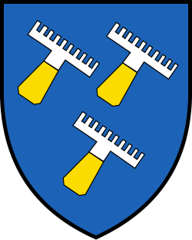
Azure, three curry-combs argent handled Or, bendwise sinister, 2 and 1. On a blue field, three curry-combs, the metal brushes used to groom horses, are white with yellow handles. They are set at a slant, two above and one below.[9][10]
Founding of Curtilles
Who founded Curtilles remains unknown. Yet the site has been inhabited since the Bronze Age. A milestone and a Roman villa are attested, then a Burgundian cemetery at the foot of the present castle. Curtilles is one of the oldest temporal possessions of the bishop of Lausanne, who held two synods there in the 9th century. A castle was built there around 1170, probably by Bishop Landri de Durnes. The small town then gave way to Lucens, protected by the castle of Bishop Roger de Vico Pisano.[1]
History of Curtilles
Bronze Age. A settlement is attested in the area.[1]
Roman period. A milestone and a Roman villa are attested.[1]
Early Middle Ages. A Burgundian cemetery occupies the site, at the foot of the present castle.[1]
852-875. First mention, «Curtilia», on the occasion of a synod held there.[1]
867-868. A second synod is held at Curtilles, a temporal possession of the bishop of Lausanne.[1]
1050. Foundation of the parish church of Saint-Pierre.[1]
around 1170. Construction of a castle, probably by Bishop Landri de Durnes.[1]
late 12th century. The small town loses importance to Lucens, protected by the castle of Bishop Roger de Vico Pisano (date uncertain).
1491. Date of the oldest of the stained-glass windows preserved in the church; another dates from 1517.[1]
1536-1798. Under Bernese rule, Curtilles belongs to the bailiwick of Moudon and depends on the castellany of Lucens.
16th century. Major repairs to the church of Saint-Pierre.[1]
1711-1718. The parsonage is moved to Lucens, but Curtilles remains a parish.[1]
1798. Curtilles belongs to the district of Moudon, until 2007.[1]
1840. Construction of the school, closed since 1968.[1]
19th century. Further major repairs to the church.[1]
1950s. Agriculture gradually gives way to crafts and small trades.[1]
2008. Curtilles becomes part of the new district of Broye-Vully.[4][7]
2025. On 18 May voters approve the merger with Lucens (in Curtilles 106 yes, 31 no and 5 blank; in Lucens 727 yes and 87 no).[2][3]
2027. On 1 January Curtilles is merged into Lucens. Its name ceases to be that of a municipality and becomes that of a locality of the new municipality of Lucens.[2][3]
Population of Curtilles
Sources and references: [1][4]
| 1764 | 149 |
| 1850 | 428 |
| 1900 | 386 |
| 1950 | 283 |
| 1970 | 238 |
| 2000 | 277 |
| 2025 | 302 (municipality) |
Families of Curtilles
Citizen families before 1800. Badoux, Bourgeois, Clot, Déglon, Dubrit, Graz, Sonnard and Wintzenried, without a precise date.[11]
From 1901 to 1962. 9 registrations. The Protti family comes from Italy (1936). From Switzerland come the Aebischer family from St. Antoni FR, the Chassot family from Fribourg FR and the Scherler family from Köniz BE (1957), the Berger family from Wengi BE and the Falk family from Wünnewil FR (1958) and the Aubert family from Salvenach FR (1960). They are joined by the Pahud family (1950) and the Ringoir family (1954). The last family registered, in 1960, is the Aubert family.[11]
Economy of Curtilles, past and present
Fields, mill and dairy. Pastures, meadows and sunflower fields cover the territory, especially along the Rosex. The village had its dairy, its threshing house and its mill. A sawmill and a bakery drew their power from the stream. The mill was destroyed by fire in the 1990s.[10]
A zone for craftsmen. With farming in decline since the 1950s, the municipality plans a zone reserved for craft businesses.[1]
A mineral water spring. One of the springs that feed a mineral water plant rises in the municipality.[10]
Disasters and major events in Curtilles
The fire of the town around 1231. A fire struck the small town, attested since the 11th century. It was then moved to the place called Roche, around 1231. The FAO dates this great fire to the early 13th century.[1][10]
Historic sites in Curtilles
The castle. Castle whose origins probably go back to the bishop of Lausanne Landri de Durnes, around 1170. Around 1580 François de Villarzel acquired the old castle and almost entirely rebuilt it as a fine late Gothic house, with a stair tower (dated 1589) and Renaissance decorative paintings (around 1586). After his death in 1589 his widow Suzanne de Graffenried continued the work until about 1607. Restored in 2002-2005, it is a cultural property of national importance.[1][5]
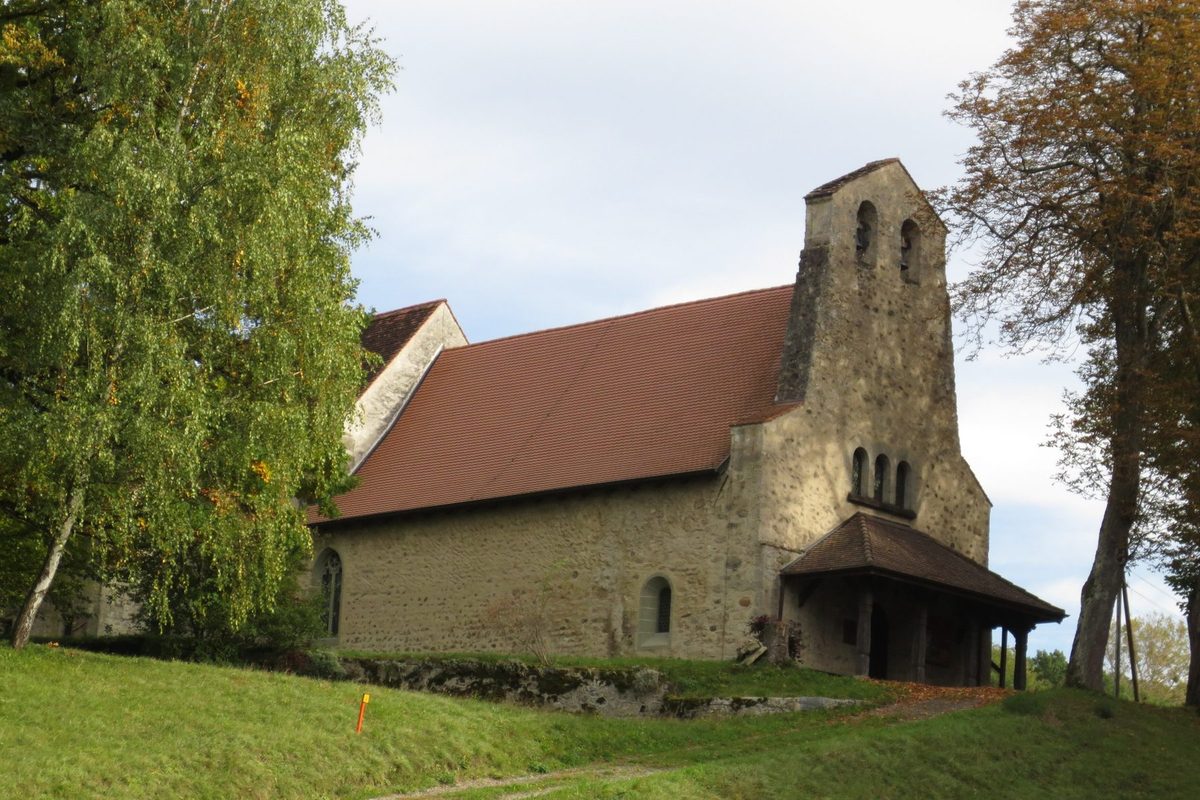
The church of Saint-Pierre. Parish church founded in 1050, with major repairs in the 16th and 19th centuries. It preserves stained-glass windows from 1491 and 1517. The church is a cultural property of regional importance (listed as « Eglise réformée Notre-Dame »).[1][5]
The old school. Built in 1840, or in 1838-1840 (the dates vary), it is reportedly the work of the architects Henri Perregaux and Achille de La Harpe. It has been closed since 1968.[1]
Remains in Curtilles
Burgundian cemetery. A cemetery from the Burgundian period lay at the foot of the castle, showing the occupation of the site in the Early Middle Ages.[1]
Ancient remains. A Bronze Age settlement, a milestone and a Roman villa are attested in the area.[1]
Protected heritage in Curtilles
Cultural property of national significance (A objects in the PCP inventory)[8]
- Château
Cultural property of regional significance (B objects)[8]
- Eglise réformée Notre-Dame
Traditions and festivals in Curtilles
The pilgrims' stamp. The church of Curtilles lies on the Way of St James. Pilgrims have their passage certified there with a stamp.[10]
Les Guenilles. The people of Curtilles go by the nickname "Guenilles" (rags).[10]
Sources
- Valérie Favez, « Curtilles », Dictionnaire historique de la Suisse (DHS), version du 17.08.2005
- Commune de Lucens, « Fusions de communes »
- Communes de Lucens et Curtilles, brochure explicative pour la votation du 18 mai 2025 sur la fusion
- Statistique Vaud, « Population résidante permanente au 31 décembre 2025 »
- Office fédéral de la protection de la population, Inventaire PBC, liste cantonale VD (état au 1.1.2026)
- Inventaire PBC, fiche n° 06045 « Château » (Curtilles), texte de la Société d'histoire de l'art en Suisse
- État de Vaud, communiqué du 12.07.2007, « Organisation des préfectures et adaptation au nouveau découpage territorial »
- Federal Office for Civil Protection (FOCP), Swiss Inventory of Cultural Property (PCP), list for the canton of Vaud (as of 1.1.2026)
- IPI, Swissreg, emblems database: coat of arms of Curtilles (no. 101507)
- Official Gazette of the Canton of Vaud (FAO), "Alphabet des communes vaudoises: Curtilles"
- Register of Swiss Surnames, 3rd edition (1989), search Commune "Curtilles", Canton VD
Published by Sébastien Jörg ·
Other villages near Curtilles
Missing information, or do you have a source? Suggest a correction or addition. Every submission is checked before it's published.
Suggest a change