Lovatens
In the 1970s this ridge village above the Broye lost its café, post office, school and two shops. In 2004 it had nine farms.
Entry based on 8 sources · Our method · Reusable text (CC BY-SA)
Origin of the name Lovatens
Lovatens appears around the year 1000, between 996 and 1017, as «Lovatingis». The name «Lovatens» still awaits an explanation.[1]
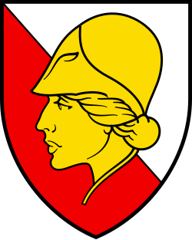
Coat of arms of Lovatens
Per bend argent and gules, a head of Minerva or overall. The shield is divided diagonally, from the top left corner to the bottom right, white above and red below. A yellow head of Minerva lies over both. Adopted in 1927, the arms allude to a stone found at the place called Au Marais, bearing a votive inscription that begins with the words "Deae Minervae". The colours recall that Lovatens was once part of the lands of the bishopric of Lausanne.[5][6]
Founding of Lovatens
When, why and by whom the village was founded is not known. Roman remains and early medieval burial grounds are recorded on its territory. At the beginning of the 11th century Lovatens belonged to the Abbey of Saint-Maurice. It later became part of Curtilles, which from the early Middle Ages belonged to the temporal domain of the Bishop of Lausanne. Set on a ridge on the right bank of the Broye, the village also includes the hamlets of Colans and Prassy.[1][2]
History of Lovatens
Roman period. Roman remains are recorded in the area.[1]
early Middle Ages. Burial grounds are recorded in the area.[1]
996-1017. First mention, in the form «Lovatingis».[1]
early 11th century. Lovatens is a possession of the Abbey of Saint-Maurice.[1][2]
Middle Ages. The village then becomes part of Curtilles, temporal domain of the Bishop of Lausanne. In religious matters it has always depended on Curtilles.[1][2]
1536-1798. Under Bernese rule, Lovatens is attached to the bailiwick of Moudon.[1]
1798. Lovatens belongs to the district of Moudon, until 2007.[1]
1840. Demolition of the old chapel.[1][2]
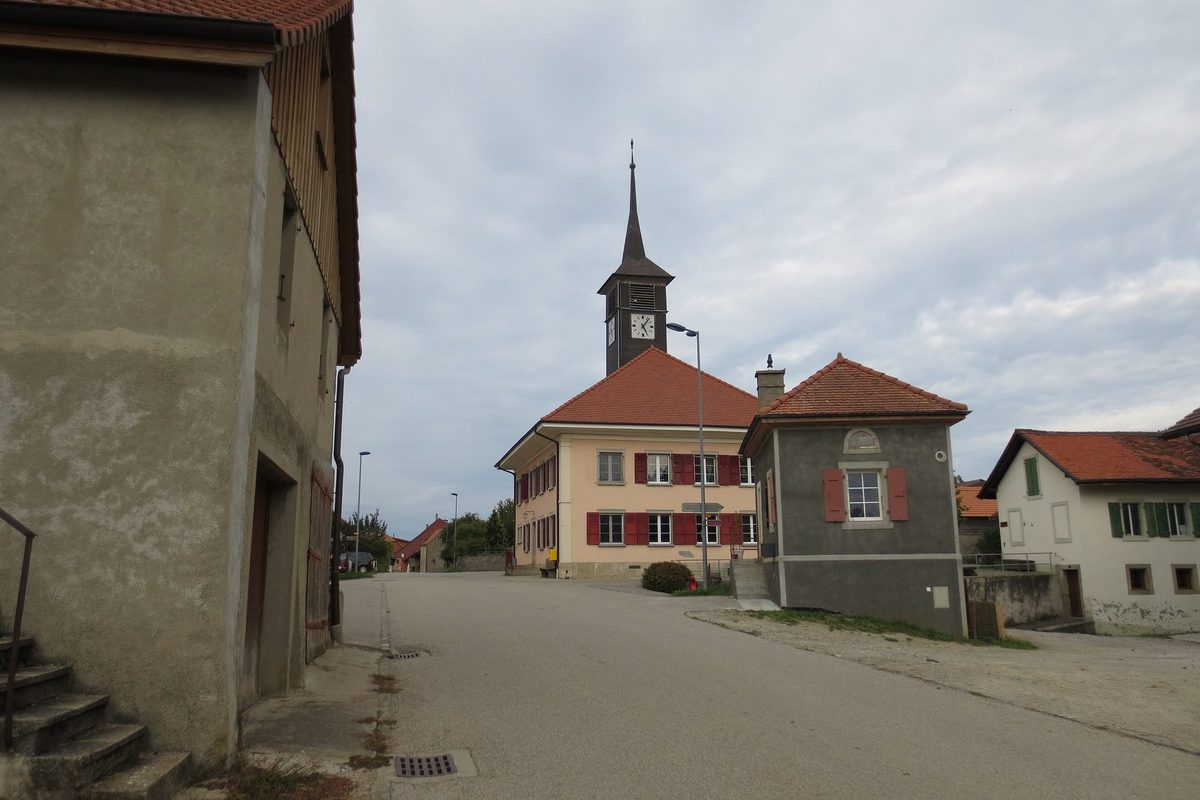
around 1844. Construction of the schoolhouse, with a small bell tower, on the site of the old chapel.[2]
1961. Construction of a new chapel at the north-eastern edge of the village.[1][2]
1970s. Slow decline of the village: closure of the café, the post office, the school and two grocery shops.[2]
1985. Land consolidation.[1]
2004. The village has nine farms.[1]
2008. Lovatens becomes part of the new district of Broye-Vully.[3]
Population of Lovatens
Sources and references: [1][2][4]
| 1798 | 195 |
| 1850 | 281 |
| 1900 | 256 |
| 1950 | 184 |
| 1980 | 103 |
| 2000 | 151 |
| 2025 | 152 |
Families of Lovatens
Citizen families before 1800. Eleven families, with no precise date, several of them under two spellings: Germond, Giroud, Giroux, Léchaire, Lécheyre, May, Ogay, Pichonnat, Pichonnaz, Poras and Poraz.[7]
In the 19th century. The Froebelius, registered in 1900.[7]
From 1901 to 1962. Five registrations: the Golaz in 1913, the Chenou, from France, in 1916, the Savoye, from Italy, in 1947, and the Röthlisberger, of Bowil BE, in 1957. The last registered, in 1959, are the Cuffia, from Italy.[7]
Notable people of Lovatens
Louis Germond (1796-1868). Born in Lovatens, this pastor was ordained in 1819 and served in Sainte-Croix, Yvonand and Echallens among other places. In 1845 he became pastor of the Free Church of Echallens. In 1842 he founded an institution of deaconesses, moved in 1852 from Echallens castle to Saint-Loup.[8]
Economy of Lovatens, past and present
The land and its trades. For a long time Lovatens's economy rested solely on farming and the trades that served it, such as blacksmith or saddler. In 1825, a house with cellars for making cheese was built south of the chapel. The cheese dairy belongs to the Société de laiterie de Lovatens. The orchards, smaller than in the 19th century, still surround the village.[2]
A village without shops. In 2011 the economy remains centred on farming but is diversifying: farm machinery repair, trade in generators and industrial engines, salaried jobs and artistic work. Since the closures of the 1970s, Lovatens has had no shops and relies on mutual help between residents.[2][6]
Historic sites in Lovatens
Chapel of 1961. Plain, functional chapel with a detached bell tower, built at the north-eastern edge of the village. The old chapel in the village centre had been demolished in 1840. Lovatens has always belonged to the parish of Curtilles.[1][2]
Former school. Schoolhouse with a small bell tower, built around 1844 on the site of the old chapel in the village centre. The school closed in the 1970s.[2]
The village. The street village of Lovatens is listed in the Federal Inventory of Swiss Heritage Sites of national importance (ISOS).[2]
Remains in Lovatens
Roman remains and burial grounds. Roman remains and early medieval burial grounds are recorded in the municipality. A Burgundian cemetery was discovered there in 1839.[1][2]
Traditions and festivals in Lovatens
Animation Lovatens. The Animation Lovatens group runs the village's community life: "Coup de Balai" clean-up days, "Terrasses de l'été" summer aperitifs, the national day, and Halloween and Christmas parties.[6]
Sources
- Dictionnaire historique de la Suisse, « Lovatens » (version allemande)
- Inventaire fédéral des sites construits d'importance nationale à protéger en Suisse (ISOS), fiche n° 4524 « Lovatens »
- État de Vaud, communiqué du 12.07.2007, « Les préfètes et les préfets sont attribués aux nouveaux districts »
- Statistique Vaud, « Population résidante permanente au 31 décembre 2025 »
- IPI, Swissreg, emblems database: coat of arms of Lovatens (no. 102021)
- Official Gazette of the Canton of Vaud (FAO), "Alphabet des communes vaudoises: Lovatens"
- Register of Swiss Surnames, 3rd edition (1989), search Commune "Lovatens", Canton VD
- Dictionnaire historique de la Suisse, « Germond, Louis », version du 14.11.2005
Published by Sébastien Jörg ·
Other villages near Lovatens
Missing information, or do you have a source? Suggest a correction or addition. Every submission is checked before it's published.
Suggest a change