Denezy
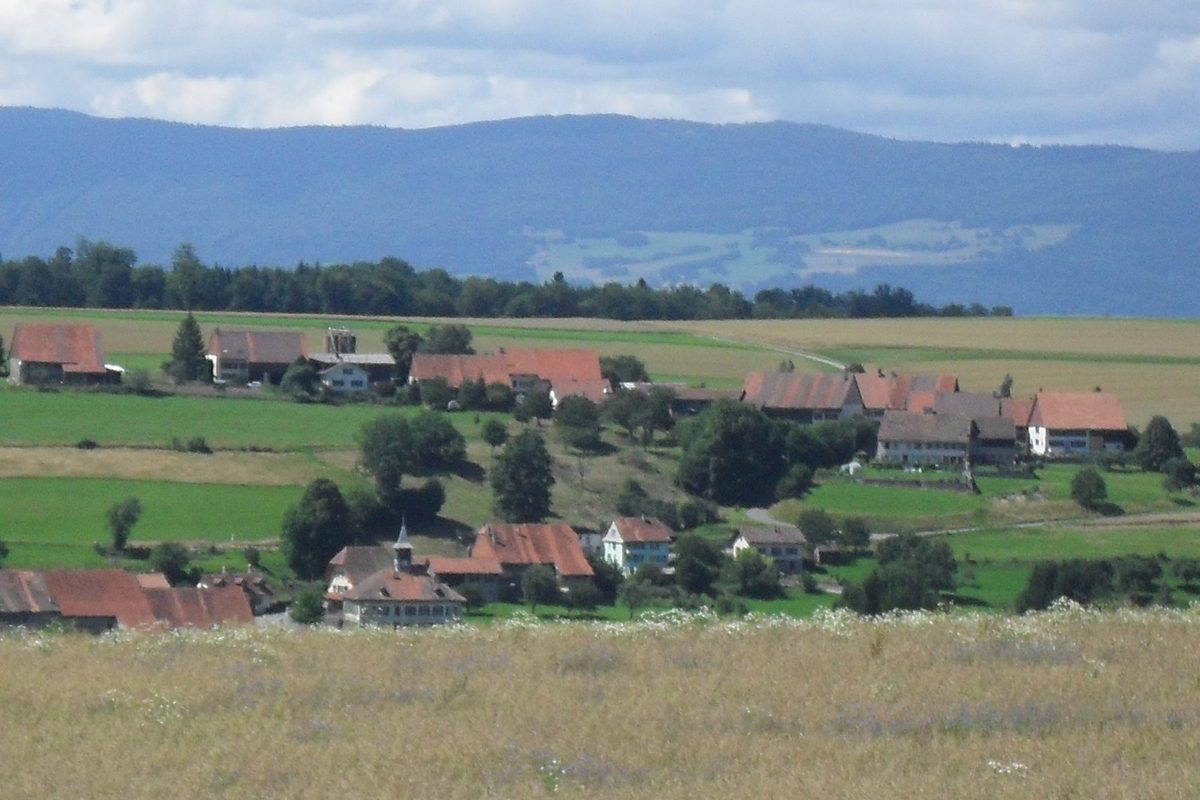
The village grew up around a chapel recorded as early as 929. Its lordship then stayed with the Cerjat family for nearly four centuries, from 1409 to 1798.
Entry based on 3 sources · Our method · Reusable text (CC BY-SA)
Origin of the name Denezy
The village appears in 929 in the Latinised form «villare Donaciaco», in connection with a chapel, then in 1142 as «Danisei». These forms recall place names of Gallo-Roman origin ending in «-acum», but the exact meaning of the name is not established.[1]
Founding of Denezy
Who founded Denezy is not known. The oldest traces of occupation are slab-lined graves of the early Middle Ages. Burgundian burials are also said to have been found in the Baumettaz forest. The village then grew up around a chapel mentioned from 929, which became the parish church before 1228.[1]
History of Denezy
Early Middle Ages. Oldest attested traces of occupation in the area: slab-lined graves.[1]
929. First written mention of the place, in the Latinised form «villare Donaciaco», in connection with a chapel.[1]
1142. The place is mentioned in the early form «Danisei».[1]
before 1228. The chapel of Denezy becomes the village's parish church.[1]
1316. The seigneury of Denezy is granted in fief by Count Louis of Savoy to Hugues Mallet.[1]
1409 to 1798. The seigneury of Denezy belongs to the de Cerjat family, originally from Moudon.[1]
14th century. Construction of a fortified house at the place called Creux du Château, of which only the foundations survive today.[1]
1536 to 1798. Under Bernese rule, Denezy forms a métralie whose court of justice sits in Moudon. The commune is run by the body of burghers and a governor.
1727. A mill and a sawmill are attested in the village.[1]
1798. The fall of the Ancien Régime ends the seigneurial possession of the de Cerjat family. Denezy becomes a Vaud municipality.[1]
1828. Founding of a village dairy society.[1]
1900. Construction of the village school building, which remains in operation for 114 years before its closure.[1][2]
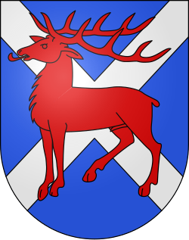
10 February 1925. Adoption of the present municipal coat of arms, reportedly azure, a saltire argent, a stag statant gules over all.
2012. The people of Denezy approve in a vote the merger project with Chanéaz, Chapelle-sur-Moudon, Correvon, Martherenges, Neyruz-sur-Moudon, Peyres-Possens, Saint-Cierges and Thierrens.[2]
1 January 2013. Denezy loses its status as an independent municipality and becomes one of the nine villages of the new municipality of Montanaire.[1][2]
Population of Denezy
Sources and references: [1][2]
| 1432 | 8 hearths (households) |
| 1850 | 253 |
| 1950 | 198 |
| 2000 | 122 |
| 2021 | 197 |
Families of Denezy
Citizen families before 1800. Chambaz, Chevalley, Crisinel, Deppierraz and Girard, without a precise date.[3]
In the 19th century. The Pochon family (from Chavannes-le-Chêne VD), without a precise date.[3]
From 1901 to 1962. Several families come from abroad: from Italy (Ansermin in 1920) and from France (Dunant in 1957). They are joined by the Nicolet family (1946) and the Loosli family (1955). The last family registered, in 1957, is the Dunant family.[3]
Economy of Denezy, past and present
Mill, sawmill and dairy. Farming remains the dominant activity. The mill and sawmill are attested since at least 1727, and in 1950 there was a Denezy agricultural mill society. The village dairy dates from 1828. Since 1930 a PostBus has linked the village to Moudon.[1]
What has gone, what remains. The mill, sawmill, wine press and threshing house have gone, as have the grocery and the cheesemaker. The dairy was sold. The shooting range has been restored. A small bakery opens on Saturday mornings, and two brewers make beer with hops grown in the village.[2]
Disasters and major events in Denezy
The parsonage fire of 1702. Fire destroyed the parsonage. The Cerjat family then made their country house available to the pastor, who lived there until 1958.[1]
Historic sites in Denezy
Creux du Château. Place where the foundations of a 14th-century fortified house survive, a reminder of the village's former seigneurial organisation.[1]
Site of the former chapel and parish church. Site of the chapel mentioned from 929, which became the parish church before 1228.[1]
Forest of the Baumettaz. Wooded area where Burgundian burials are said to have been uncovered.
Remains in Denezy
Ruins of the fortified house of Creux du Château. Remains of a fortified residence built in the 14th century, of which only the foundations survive, linked to the lordship of Denezy, held by Hugues Mallet from 1316 and then by the de Cerjat family from 1409 to 1798.[1]
Graves from the early Middle Ages. Slab-lined graves of the early Middle Ages. Other burials, described as Burgundian, are said to have been found in the Baumettaz forest.[1]
Traditions and festivals in Denezy
Lè Benozî. The Lè Benozî society organises the national day celebration and the Fête de l'Étang (pond festival). It also holds Friday drinks in the schoolyard.[2]
St Martin's meal and the Christmas workshop. The village gathers for a St Martin's meal and a ten-day Christmas workshop at the school. Residents open their gardens to visitors, with free entry and refreshments.[2]
Les Ludzons. The people of Denezy go by the nickname "ludzons".[2]
Sources
- Valérie Favez, « Denezy », Dictionnaire historique de la Suisse (DHS), version du 04.01.2017
- Commune de Montanaire, « Les 9 villages qui forment Montanaire »
- Register of Swiss Surnames, 3rd edition (1989), search Commune "Denezy", Canton VD
Published by Sébastien Jörg ·
Other villages near Denezy
Missing information, or do you have a source? Suggest a correction or addition. Every submission is checked before it's published.
Suggest a change