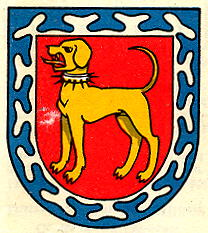
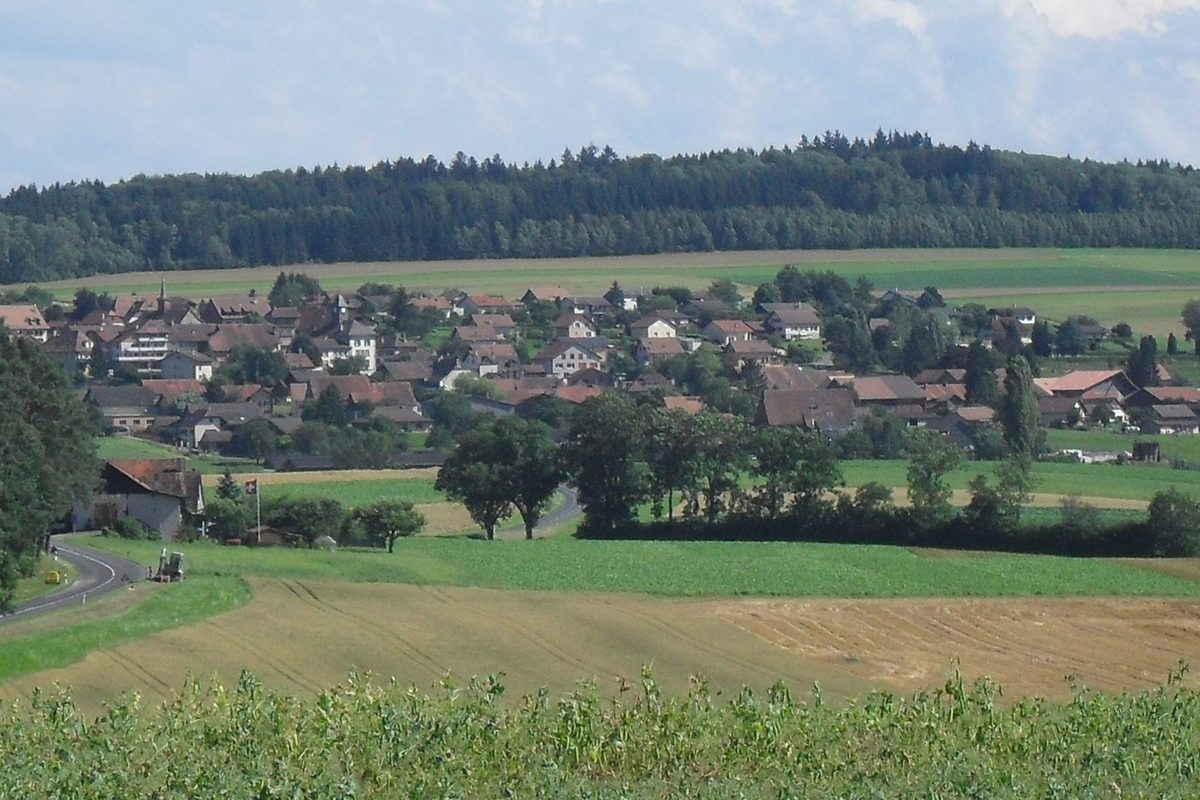
Thierrens
On 25 January 1798 local guards at Thierrens killed two French hussars. The incident served as a pretext for French troops to enter Switzerland three days later.
Entry based on 6 sources · Our method · Reusable text (CC BY-SA)
Origin of the name Thierrens
The name Thierrens first appears in 1004-1007 in the Latinized form « Teoderinco ». Its origin may be pre-Celtic or Burgundian. Each hypothesis comes with a proposed meaning, « Teoder's spring » or « among Theudar's people » (a personal name or deity, Theudarius), but neither is certain. The intermediate forms Tierens (1150), Tyerens and Thyerens (1154), Tierrens (1228) and Tierreins (1238) are not certain either.[1][2]
Founding of Thierrens
Who founded Thierrens is not known. Early medieval burials beneath the church of Saint-Martin and a necropolis at La Carrière show that the site has long been occupied. The village enters the records through its church: around 1150 the bishop of Lausanne ceded its patronage to the priory of Saint-Maire in Lausanne, which Pope Alexander III confirmed in 1177. Having passed by marriage from the lords of Belmont to the Gruyère family, Thierrens was ceded to the chapter of Lausanne in 1227. The tithe belonged in 1461 to the Duke of Savoy, who had bought it back from the bishop, and in 1546 passed from the counts of Gruyère to Bern. From the Bernese conquest of 1536 until 1798 the village belonged to the bailiwick of Moudon.[1]
History of Thierrens
Bronze Age. Human presence in the Bronze Age and a Roman road across the territory are mentioned, though this is not certain.
1004-1007. First written mention of the place, in the Latinized form « Teoderinco ».[1]
around 1150. The bishop of Lausanne transfers the patronage of the Saint-Martin church of Thierrens to the priory of Saint-Maire in Lausanne.[1]
1177. Pope Alexander III confirms this transfer of patronage.[1]
1227. Having passed by marriage from the lords of Belmont to the Gruyère family, the village is ceded to the chapter of Lausanne.[1]
1461. The tithe of Thierrens belongs to the Duke of Savoy, who had bought it back from the bishop of Lausanne. In 1546 it passes from the counts of Gruyère to Bern.[1]
1536. Bernese conquest of the Pays de Vaud: Thierrens is incorporated into the Bernese bailiwick of Moudon.[1]
16th century. The Saint-Martin church is rebuilt on the foundations of a 12th-century building. The present parsonage also dates from this period.[1][2]
18th century. Wolves are reportedly still present in the region.
25 January 1798. « Affaire de Thierrens »: local guards kill two French hussars accompanying an aide-de-camp of General Ménard. This incident serves as a pretext for the entry of French troops into Switzerland on 28 January 1798.[1][2]
1798-2006. Thierrens is part of the district of Moudon.[1]
1992. The municipality gains a primary and secondary school and emerges as a regional centre.[1]
2000. Two thirds of the working population work outside the municipality.[1]
2005. The primary sector still provides 30% of jobs.[1]
2008. With the new Vaud territorial division, effective on 1 January 2008, the district of Moudon disappears and Thierrens joins the district of Gros-de-Vaud.
2009. The temple and the parsonage of Thierrens are listed as cultural properties of regional importance in the cantonal list drawn up in 2009.[2][3]
1 January 2013. Thierrens merges with Chanéaz, Chapelle-sur-Moudon, Correvon, Denezy, Martherenges, Neyruz-sur-Moudon, Peyres-Possens and Saint-Cierges to form the new municipality of Montanaire, losing its status as an independent municipality but becoming its chief town and administrative seat.[1][2]
Population of Thierrens
Sources and references: [1][2]
| 1550 | 30 hearths (households) |
| 1764 | 300 |
| 1850 | 720 |
| 1900 | 607 |
| 1950 | 466 |
| 1970 | 375 |
| 2000 | 579 |
| 2017 | 818 (on 31 December, municipal figure) |
| 2021 | 888 (on 1 May, municipal figure) |
Families of Thierrens
Burgher families before 1800. Baudin, Berzin, Chevalley, Favre, Forestier, Genier, Meystre, Pahud and Piot, with no precise date.[6]
From 1901 to 1962. Fourteen entries. Six families came from Italy: Fantoli (1918, 1956 and 1958), Ranzoni (1937), Tesauri (1942), Dagostino and Gianina (1953), Rosa (1960). The Francey, from Poland, were registered in 1946 and the Peccoud, from France, in 1958. Others came from other cantons: the Mottier of Salvan VS and the Schertenleib of Vechigen BE in 1956, the Leoni of Medeglia TI in 1957, the Müller of Boltigen BE in 1958 and the Gosteli of Krauchthal BE in 1959. The Aubert closed the list in 1960, the same year as the Rosa.[6]
Economy of Thierrens, past and present
Shops and services. The cantonal structure plan recognises Thierrens as a local centre. The village has two restaurants, a medical centre with doctors, a dentist and a physiotherapist, three garages, a local shopping centre and several craftsmen.[2]
Historic sites in Thierrens
Saint-Martin Church. Dedicated to Saint Martin, the church was the centre of a parish in 1228. It was rebuilt in the 16th century on 12th-century foundations, and early medieval burials have been found beneath it. Its vault is said to bear a very old representation of Christ surrounded by the four symbolic living creatures, and a 14th-century stained-glass window of the Crucifixion is said to be preserved there. It is a cultural property of regional importance.[1][2][3]
Thierrens parsonage. Parsonage dating from the 16th century, listed together with the temple as a cultural heritage asset of regional importance in 2009.[2][3]
Administrative chief town of Montanaire. Since the 2013 merger, Thierrens has been the administrative seat of Montanaire. The village is recognised as a local centre in the cantonal master plan, with a primary school of over 200 pupils, a small shopping centre, restaurants and a medical centre.[2]
Historic road junction. The village lies at the crossroads of the roads from Moudon to Yverdon and from Échallens to Payerne.[1][2]
Remains in Thierrens
Early Middle Ages burials. Burials dating from the early Middle Ages were uncovered beneath the Saint-Martin church.[1][2]
La Carrière necropolis. A necropolis was discovered at the place called La Carrière, on the village's territory.[1]
Protected heritage in Thierrens
Cultural property of regional significance (B objects)[5]
- Cure
- Eglise réformée Saint-Martin
Traditions and festivals in Thierrens
The FC Thierrens revue. Every year, the Football Club Thierrens stages a revue. The village also has a youth society, a mixed choir and a badminton club.[2]
Sources
- Emmanuel Abetel, « Thierrens », Dictionnaire historique de la Suisse (DHS), version du 04.01.2017
- Commune de Montanaire, « Les 9 villages qui forment Montanaire »
- Office fédéral de la protection de la population, Inventaire PBC, liste du canton de Vaud (état au 1.1.2026)
- État de Vaud, communiqué du 12.07.2007, « Les préfètes et les préfets sont attribués aux nouveaux districts »
- Federal Office for Civil Protection (FOCP), Swiss Inventory of Cultural Property (PCP), list for the canton of Vaud (as of 1.1.2026)
- Register of Swiss Surnames, 3rd edition (1989), search Commune "Thierrens", Canton VD
Published by Sébastien Jörg ·
Other villages near Thierrens
Missing information, or do you have a source? Suggest a correction or addition. Every submission is checked before it's published.
Suggest a change