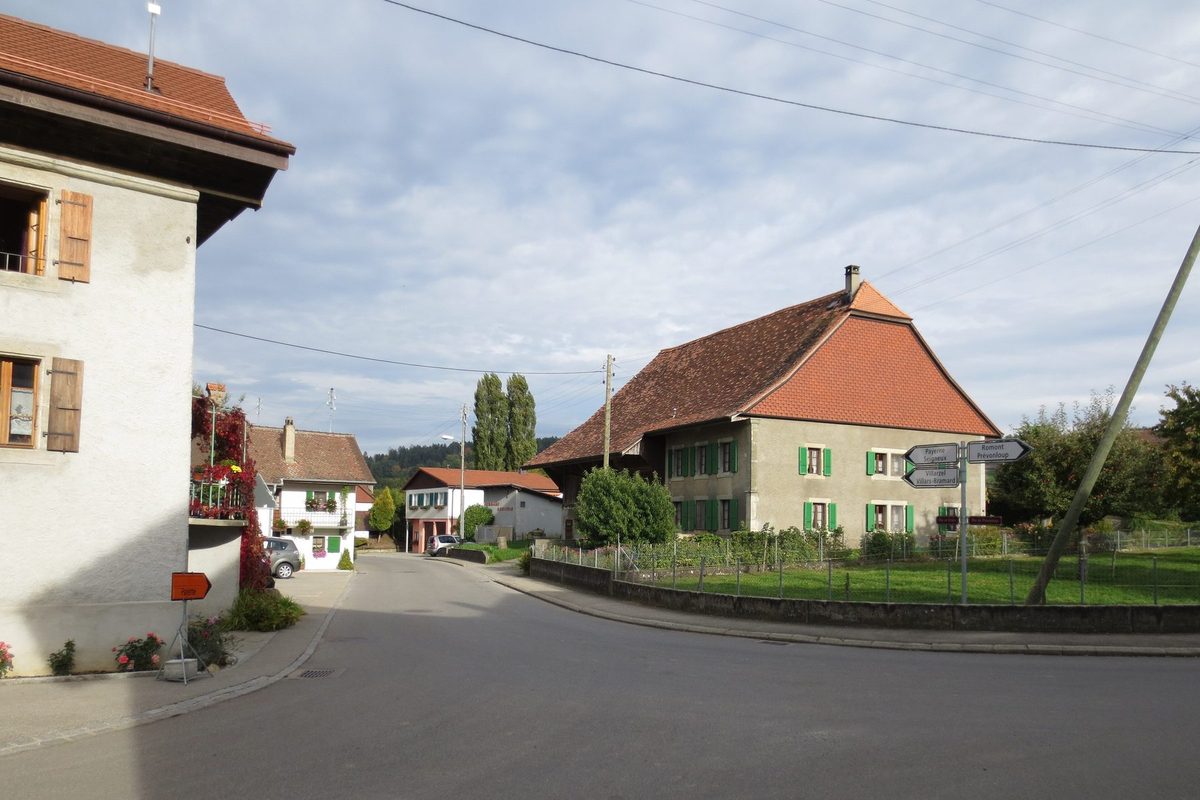
Dompierre
Beneath the church of 1839, walls uncovered in 1975 reveal a building even older than the 12th-century church of Notre-Dame.
Entry based on 6 sources · Our method · Reusable text (CC BY-SA)
Origin of the name Dompierre
The village is first recorded in 1228, as «Donperro». The name betrays an ancient origin, in the 6th-7th century.[1]
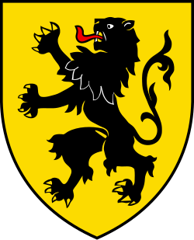
Coat of arms of Dompierre
Or, a lion sable langued gules. A black lion with a red tongue stands on a yellow field. It comes from the seal of a family of knights and squires of the village, used by Guillaume de Dompierre in 1350 and 1351. The municipality took up these arms in 1927.[4][5]
Founding of Dompierre
Dompierre has no known founder or founding act. Only the form of the name takes the place back to the 6th-7th century. In the Middle Ages a Dompierre family, most of its members knights, appears in documents from the 13th to the 15th century. The tithe of the place went to the chapter of Lausanne, which had received it from Bishop Marius and collected it until the 16th century.[1]
History of Dompierre
6th-7th century. Probable origin of the locality, judging by the form of its name.[1]
12th century. A church dedicated to Notre-Dame exists. Members of the Dompierre family, mostly knights, appear in documents from the 13th to the 15th century.[1]
1228. First mention, as «Donperro»; Dompierre is already a parish.[1]
until the 16th century. The chapter of Lausanne collects the tithe, which had been given to it by Bishop Marius.[1]
1536-1798. Under Bernese rule, Dompierre belongs to the bailiwick of Moudon and falls under the castellany court of Lucens. At the Reformation the medieval parsonage is sold.[1]
1752. Construction of a new parsonage.[1]
1798. Dompierre belongs to the district of Moudon, until 2007.[1]
1839. Construction of the present church on the site of the church of Notre-Dame.[1]
1889. The village youth founds a reading circle, Le Progrès.[1]
1975. Remains of walls found on the site of the church bear witness to a building older than the 12th-century church.[1]
2000. The municipality has remained agricultural, with a few craft businesses, but more than half of the working population works outside the municipality.[1]
2008. Dompierre becomes part of the new district of Broye-Vully.[2][3]
Population of Dompierre
Sources and references: [1][2]
| 1764 | 146 |
| 1798 | 175 |
| 1850 | 371 |
| 1900 | 339 |
| 1910 | 342 |
| 1950 | 278 |
| 1980 | 183 |
| 2000 | 246 |
| 2025 | 242 (municipality) |
Families of Dompierre
De Dompierre. The village was the cradle of a family of knights and squires found in documents from the 13th to the 15th century. In 1310 Pierre de Dompierre held the village tithe from the bishop.[5][1]
Citizen families before 1800. Badoux, Besson, Chatelanat, Corthésy, Gentil and Tenthorey, without a precise date.[6]
From 1901 to 1962. 10 registrations. Several families come from abroad: from Italy (Antonietti in 1923, Degaudenzi in 1925 and Pezzatti in 1950), from France (Auger in 1934) and from Germany (Hatzki in 1939). From Switzerland come the Schneider family from Aetigkofen SO (1956), the Berger family from Thielle-Wavre NE (1957) and the Hauser family from Worb BE (1958). They are joined by the Clément family (1954) and the Morier family (1956). The last family registered, in 1958, is the Hauser family.[6]
Economy of Dompierre, past and present
Fields and craftsmen. Dompierre still lives from farming and a few craft businesses. In 2000 more than half of the working population worked outside the municipality.[1]
Disasters and major events in Dompierre
The fires of 1625, 1804 and 1864. Three fires, in 1625, 1804 and 1864, destroyed many houses in the village.[5]
Historic sites in Dompierre
The church. Built in 1839 on the site of the 12th-century church of Notre-Dame. Remains of walls found in 1975 show an even older building.[1]
The parsonage. As the medieval parsonage had been sold at the Reformation, a new parsonage was built in 1752.[1]
The hamlet of Les Granges. Besides the village, the municipality includes the hamlet of Les Granges.[1]
Remains in Dompierre
Walls of an earlier building. During excavations in 1975, remains of walls were found on the site of the church. They show a building older than the 12th-century church of Notre-Dame.[1]
Traditions and festivals in Dompierre
The Orthodox monastery. The Monastery of the Most Holy and Divine Trinity was founded in 1995 by Archbishop Séraphim of Zurich. The FAO describes it as the only Orthodox monastery in the country.[5]
The 20 Cuits' vin cuit. Every year, on a weekend in October, the Amicale des 20 Cuits gathers to make vin cuit (boiled-down juice) in large cauldrons.[5]
The mixed choir. Founded in 1965, the Chœur mixte de Dompierre has about forty members and puts on a show every year. The La Potue brass band and the Dompierre and Prévonloup gymnastics society also enliven the village.[5]
Les Brises-Verres. The people of Dompierre go by the nickname "Brises-Verres" (glass-breakers). On 24 January, Vaud independence day, the village gathers for a papet vaudois.[5]
Sources
- Valérie Favez, « Dompierre (VD) », Dictionnaire historique de la Suisse (DHS), version du 14.04.2004
- Statistique Vaud, « Population résidante permanente au 31 décembre 2025 »
- État de Vaud, communiqué du 12.07.2007, « Organisation des préfectures et adaptation au nouveau découpage territorial »
- IPI, Swissreg, emblems database: coat of arms of Dompierre (no. 101986)
- Official Gazette of the Canton of Vaud (FAO), "Alphabet des communes vaudoises: Dompierre"
- Register of Swiss Surnames, 3rd edition (1989), search Commune "Dompierre", Canton VD
Published by Sébastien Jörg ·
Other villages near Dompierre
Missing information, or do you have a source? Suggest a correction or addition. Every submission is checked before it's published.
Suggest a change