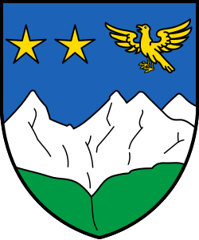
Evolène
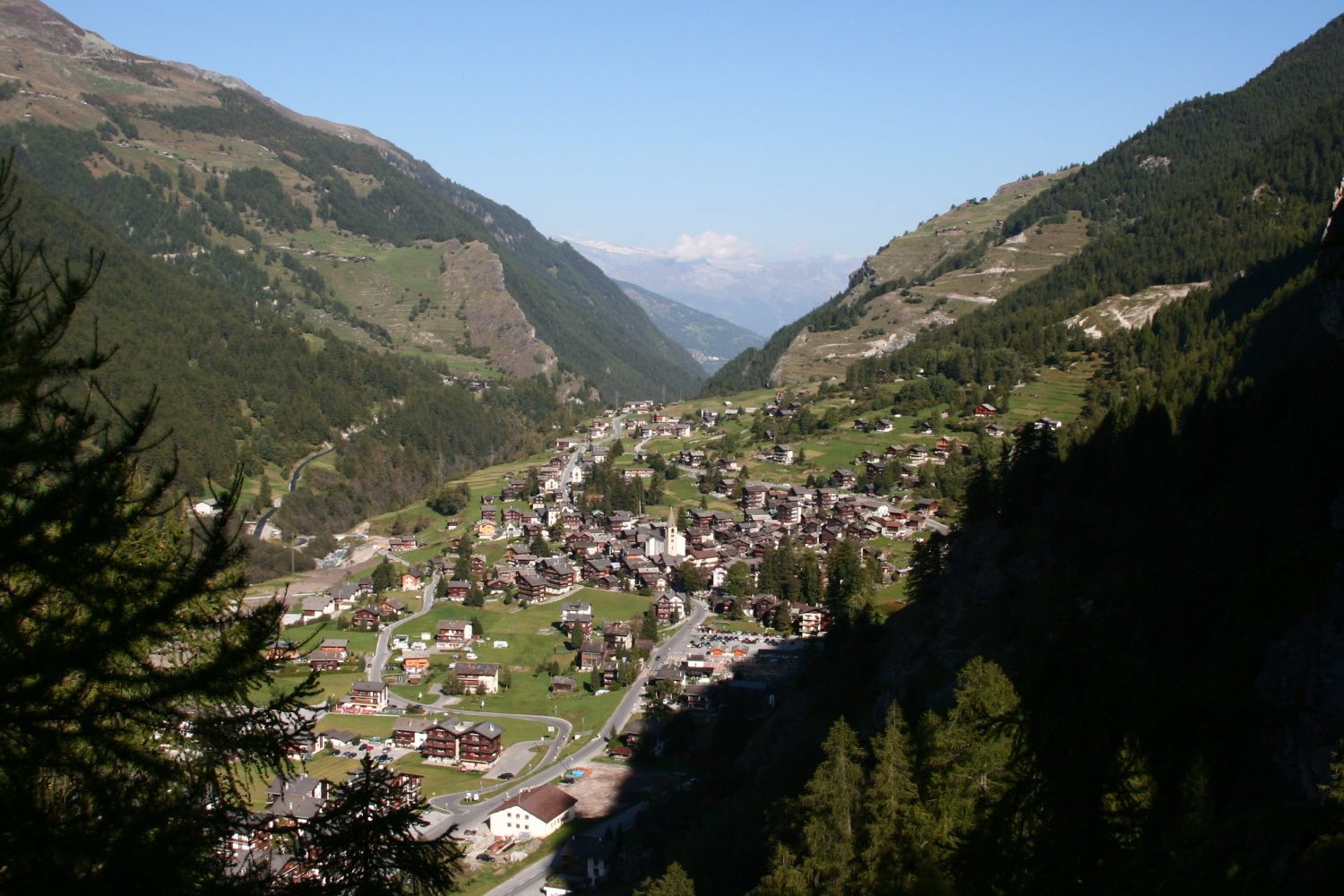
Origin of the name Evolène
The name appears in 1250 as « Ewelina », then in 1444 as « in loco de Evolena ». In patois it is « Oleïnna ». One explanation links it to the stream that rises in the village: Franco-Provençal ewe (from Latin aqua, « water ») followed by a feminine adjective lèïnna, perhaps derived from latinus and associated with lenis, « gentle, calm ». This explanation is not confirmed.[2]
Founding of Evolène
Nobody knows who founded Evolène. The upper Val d'Hérens, along the Borgne up to the Italian border, has been frequented since prehistory, as its rock engravings, cup-marked stones and rock shelters show. In the Middle Ages the valley formed the community of Hérens. It belonged to the lords of Bex, vassals of the House of Savoy, after which rights passed between the chapter of Sion, the mistralty of Ayent and the lords of Raron. In the 14th and 15th centuries many families from Zermatt settled here. From the 16th century the community bought back its feudal dues. Evolène only became a separate municipality when the municipality of Hérens was divided with Saint-Martin. It includes in particular Evolène, Villa, La Sage, La Forclaz, Les Haudères, Arolla and the Ferpècle valley.
History of Evolène
Prehistory. Rock engravings, cup-marked stones and rock shelters from the Neolithic, the Early Bronze Age and the La Tène period.
Middle Ages. The community of Hérens belongs to the lords of Bex, vassals of the House of Savoy. Rights then pass between the chapter of Sion, the mistralty of Ayent and the lords of Raron.
1250. Mentioned as « Ewelina ».[2]
14th-15th century. Substantial immigration of families from Zermatt.
1444. Mentioned as « in loco de Evolena ».
1445. 101 heads of household ask for a church to be built in Evolène at their own expense.
1448. Consecration of the chapel dedicated to Saint John and Saint Theodul.
1498. Two-thirds of the inhabitants are native German speakers.
1517. The Valais Diet decides to close the Col de Collon, the pass to the Aosta Valley with which Evolène has many ties.
around 1550. Bishop Jean Jordan recognises the customs of Evolène and Saint-Martin.
1722. Evolène, until then part of the parish of Saint-Martin, becomes a parish.
1840s. During the 1840s the community of Hérens has two councils, one conservative and the other liberal-radical.
1849. A chapel is built at La Sage.
1850. A canon of the Great St Bernard comes to serve Villa, La Forclaz and La Sage.
around 1860. Tourism begins with the opening of the Hôtel de la Dent Blanche.[2]
1881. The burgher property is divided between Evolène and Saint-Martin.
1882. Creation of the municipality of Evolène through the division of the municipality of Hérens.
1950. Evolène sells its water rights to the Grande Dixence company. Until then the economy relied mainly on mountain farming.
1999. On 21 February avalanches kill 12 people on the municipal territory.[5]
Population of Evolène
Sources and references: [6]
| 1850 | 1'040 |
| 1900 | 1'208 |
| 1910 | 1'300 |
| 1950 | 1'315 |
| 2000 | 1'522 |
| 2025 | 1'673 |
Historic sites in Evolène
Church and chapel of Evolène. In 1445, 101 heads of household ask for a church at their own expense. The chapel dedicated to Saint John and Saint Theodul is consecrated in 1448, and Evolène becomes a parish in 1722. The present parish church is under the patronage of Saint John the Baptist.[2][4]
La Sage, Villa and La Forclaz. Villages on a terrace on the right bank of the Borgne. A chapel is built at La Sage in 1849 and, from 1850, a canon of the Great St Bernard serves Villa, La Forclaz and La Sage.
Les Haudères. Village at the confluence of the streams coming down from Ferpècle and Arolla.[3]
Arolla and the Col de Collon. The Col de Collon links the upper Val d'Hérens with the Aosta Valley. In 1517 its closure, decided by the Valais Diet, provoked protests from the inhabitants, who offered to defend the pass themselves. Arolla, at about 2'000 m, is said to be the highest village of the municipality.
Lanna. The hamlet is said to be built in a ring around a meadow, with the chapel of Saint-Laurent at its centre.
Remains in Evolène
Rock engravings and rock shelters. The municipal territory preserves rock engravings and cup-marked stones, as well as rock shelters occupied in the Neolithic, the Early Bronze Age and the La Tène period.
Mines and quarries. The municipality worked lead and copper mines and soapstone quarries.
Sources
- Dictionnaire historique de la Suisse, « Evolène » (Bernard Monnet, version du 27.03.2006)
- Office fédéral de la culture, ISOS, « Evolène » (2e version, 11.1996), copie publiée par Val d'Hérens Tourisme
- Office fédéral de la culture, ISOS, « Les Haudères » (2e version, 05.1998), copie publiée par Val d'Hérens Tourisme
- Office fédéral de la protection de la population (PBC), « Révision Inventaire PBC 2021 : liste cantonale du canton du Valais » (état au 1.1.2026)
- Marc-André Miserez, « Loi de la montagne contre loi des hommes », swissinfo.ch, 2.3.2005
- Office fédéral de la statistique (OFS), STATPOP, chiffres provisoires au 31.12.2025, via citypopulation.de
- geo.admin.ch, recherche de lieux (coordonnées)
Localities of the municipality with a page
Other villages near Evolène
Missing information, or do you have a source? Suggest a correction or addition. Every submission is checked before it's published.
Suggest a change