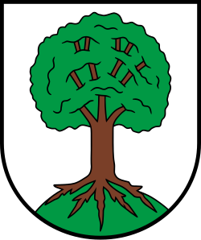
Fahy
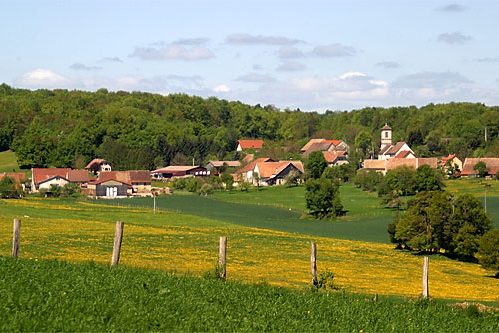
Origin of the name Fahy
The name appears as « Fahyl » in 1177 and « Fahyt » in 1438. It is said to come from the Latin « fagetum », a place planted with beech trees, meaning « the beech wood ».[1]
Founding of Fahy
The village appears in 1177, when a chapel there is listed among the possessions of the priory of Lanthenans in Franche-Comté. Located on the border, on the road to Montbéliard, it developed in several clusters of tall houses and long lived from farming, within the mairie of Bure and the Prince-Bishopric of Basel. It is not known who founded Fahy or when.[1]
History of Fahy
1177. First mention: a chapel of « Fahyl » is listed among the possessions of the priory of Lanthenans, in Franche-Comté.[1]
1438. The name is written « Fahyt ».[1]
1477. The prince-bishop of Basel leases out his rights over the village, almost entirely destroyed during the Burgundian Wars.[1]
Ancien Régime. Fahy belongs to the mairie of Bure, in the Prince-Bishopric of Basel, and to the parish of Grandfontaine.[1]
1787-1788. The church of Saint-Pierre is built to plans by the architect Pierre François Paris.[1]
1793. The village becomes French: department of Mont-Terrible, then Haut-Rhin.[1]
1802. Fahy, until then attached to Grandfontaine, becomes an independent parish.[1]
1815. Joined to the canton of Bern, until 1978.[1]
1836. Fahy becomes a mixed municipality.[1]
around 1950. The economy, until then essentially agricultural, sees modest industrialisation: Fahy becomes Switzerland's entry point for Peugeot cars, which receive their final equipment there.[1]
1979. Fahy becomes part of the new canton of Jura (district of Porrentruy).
Population of Fahy
Sources and references: [1]
| 1809 | 390 |
| 1850 | 549 |
| 1900 | 492 |
| 1950 | 524 |
| 2000 | 386 |
| 2010 | 354 |
| 2025 | 328 |
Historic sites in Fahy
Church of Saint-Pierre. Parish church built in 1787-1788 to plans by the architect Pierre François Paris. Fahy became an independent parish in 1802. Cultural property of regional significance (federal PCP inventory).[1][3]
Tall village houses. The village has several clusters of tall houses typical of the Ajoie. Two of them, the farmhouse and the dwelling house at Bout-Dessous (nos 18 and 19), are cultural property of national significance (federal PCP inventory).[1][3]
Sources
- Dictionnaire historique de la Suisse, « Fahy » (Dominique Prongué)
- Statistique Jura, tableau JU-T.01.01.03, population résidante permanente au 31 décembre 2025
- Office fédéral de la protection de la population (OFPP), Inventaire PBC, liste cantonale du canton du Jura (état au 1.1.2026)
- geo.admin.ch (swisstopo), recherche de lieux « Fahy »
Other villages near Fahy
Missing information, or do you have a source? Suggest a correction or addition. Every submission is checked before it's published.
Suggest a change